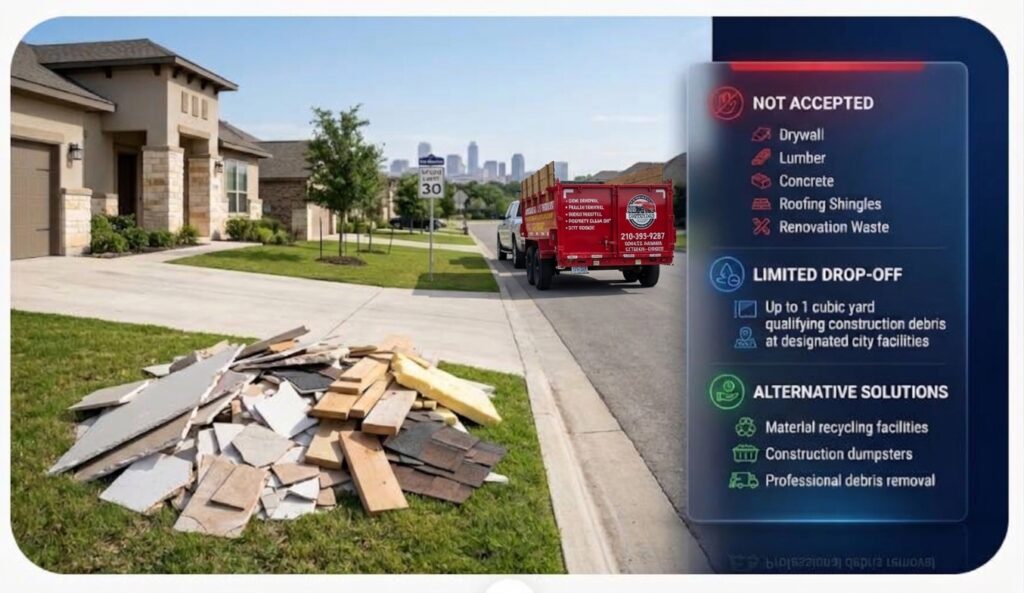
No. The City of San Antonio does not pick up construction debris at the curb, and that holds true for every residential collection program it runs. Not the garbage cart, not twice-a-year bulky item collection, not brush collection.
This catches a lot of homeowners off guard, usually after a bathroom demo or a fence replacement, when the pile is already stacked by the street, and the truck has come and gone without touching it. Worse, setting that pile out can cost you money rather than save it.
Here is what the city actually does with construction debris, the one narrow exception that lets you drop off a small load for free, and what your realistic options are once your load outgrows it.
Will San Antonio Pick Up Construction Debris at the Curb?
San Antonio’s Solid Waste Management Department handles household waste. Construction and demolition material is treated as a separate waste stream, and none of the three residential curbside programs are set up to take it.
Not With Regular Garbage Collection
The brown cart is for household trash. Drywall scrap, tile, lumber, shingles, concrete chunks, and old fixtures are not household trash, no matter how small the pieces are or how much room is left in the cart.
Crews are also working against a weight limit. A cart packed with wet drywall or tile weighs far more than the same cart full of kitchen garbage, and automated trucks are not built to lift it.
Not With Curbside Bulky Item Collection
Bulky item collection comes around twice a year and covers large household items: furniture, mattresses, appliances, water heaters, and similar goods that will not fit in a cart. It does not cover renovation debris.
This is the program most people assume will save them, because the pile is allowed to be large, up to eight cubic yards, placed within eight feet of the curb. The size allowance is real. The material allowance is not. A bulky pile with construction debris mixed into it is a pile the crew will not take.
Not With Brush Collection Either
Brush collection is also twice a year and is limited to tree limbs, trimmings, and yard material. The city is explicit that non-brush material does not belong in a brush pile.
That matters more than it sounds. Brush goes to a different processing stream than mixed waste. A few sheets of plywood or a stack of fence pickets tossed on top of your limbs can disqualify the whole pile.
What Happens If You Leave It Out Anyway
Nothing good, and it tends to get more expensive the longer the pile sits. The city’s curbside brush and bulky item rules state that an improperly set out pile can bring a fine of up to $2,000 per day, plus charges for collection and disposal.
| What You Set Out | What the City Does | What It Can Cost You |
| Construction debris in your trash cart | The cart is skipped, or the material is left behind after the rest is emptied | Repeated violations can bring code enforcement action |
| Construction debris in a bulky item pile | The pile is passed over and left in place | Improper set-out carries a fine of up to $2,000 per day, plus collection and disposal charges |
| Roofing material in any curbside pile | Not collected under any residential program | The same penalty structure applies |
| Construction debris mixed into brush | The brush pile is rejected along with everything in it | Up to $2,000 per day, and you have used up one of your two brush collections for nothing |
The last row is the one that stings. Brush and bulky collections come around roughly every six months. If yours is rejected over a few boards, you are waiting months for the next one with the pile still in your yard.
Why the Pile Just Sits There
Crews are not making a judgment call at the curb. Brush, bulky items, and construction debris go to different facilities with different permits and different acceptance rules, and the trucks are matched to the material. A grapple truck running a brush route cannot drop a load of drywall and shingles at a yard waste site.
So when a crew sees contaminated material, the only option is to leave the pile. Nobody knocks on the door to explain it. You find out when you look outside, and everything is still there.
The One Exception: Small Loads at a Drop-Off Center
The city will take a limited amount of construction material, but you have to bring it yourself. San Antonio runs four bulky waste collection centers on Bitters, Frio City, Culebra, and Rigsby, open Tuesday through Friday and Saturday mornings.
These are residential drop-offs. Material brought in by commercial waste haulers is not accepted, and there is no curbside version of this service.
The One Cubic Yard Limit
Construction material and lumber are capped at one cubic yard per trip. Bulky household items get four cubic yards, but construction debris is held to the smaller limit.
One cubic yard is less than most people picture. It is roughly a 3 ft x 3 ft x 3 ft cube, or about what fits in the bed of a half-ton pickup filled a little over knee-deep. A single interior door, a few sheets of drywall, and a stack of baseboard will get you close.
Loads also cannot sit higher than the fender wheel of your truck bed, and boards longer than 10 feet are turned away.
What You Need to Bring
Two things, and you will not get through the gate without both:
- A recent CPS Energy bill showing payment of the city’s environmental fee
- A photo ID matching that address
If you pay that fee, the drop-off is free. If you live outside the city limits or your trash service is handled by a private hauler, the centers are not available to you. Renters in that situation should check with the property owner about who holds the account.
Trailers are not accepted at these centers either, which rules out the most common way people try to move a bigger load.
What They Still Will Not Take
Even inside the one cubic yard limit, several materials are refused outright:
- Soil, rocks, and concrete
- Boards longer than 10 feet
- Bagged garbage and household trash
- Brush, leaves, and yard waste
- Unbagged insulation
- Hazardous material
Concrete and dirt are worth calling out, because they are the two things people most often assume a waste facility will handle. They are heavy, they are refused at the city centers, and they need a different destination entirely.
Roofing material does not appear on the accepted list. If shingles are the bulk of your load, call 311 before you load the truck rather than driving out there and finding out at the gate.
What to Do Instead, Based on Your Load
The right answer depends less on what the material is and more on how much of it you have, how heavy it is, and whether you have a way to move it.
| Your Situation | What Actually Works |
| Less than one cubic yard, no concrete or dirt | Haul it to a city bulky waste drop-off center, free with a CPS Energy bill and photo ID |
| Clean concrete, brick, dirt, or rock | A material yard or aggregate recycler, since city facilities refuse these outright |
| A remodel’s worth of mixed debris | A Type IV construction and demolition landfill, charged by weight, or a hauler who takes it there for you |
| Debris building up over several days | A roll-off dumpster parked on your driveway for the duration of the job |
| No truck, or more than you want to load | Full-service construction debris removal |
A few notes on the ones people ask about most.
Type IV landfills are the facilities permitted in Texas to accept construction and demolition debris specifically. They charge by weight, so a load of tile and plaster costs more to dispose of than the same volume of cabinetry. Call ahead about hours, accepted materials, and whether they take walk-up residential loads, since policies differ by site.
Dumpster rental makes sense when the work is spread over days or weeks, and you want somewhere to throw debris as you go. You are doing the loading, you need driveway or street space, and you are responsible for what goes in it. A dumpster filled with the wrong material can be refused or surcharged the same way a curbside pile is.
Full-service removal makes sense when the loading is the problem. Crews bring the labor and the truck, which matters when debris is coming out of a second-floor bathroom, down a tight hallway, or out of a backyard with no gate access. It is also the practical option for anyone who should not be lifting tile backer board or soaked carpet.
Neither is automatically cheaper. Pricing on any debris job comes down to volume, weight, how far the material has to be carried to the truck, whether stairs are involved, and where it legally has to be taken. A load of lightweight trim from a garage and a load of demolished shower tile from an upstairs bathroom are not the same job, even if the piles look similar.
Frequently Asked Questions
Can I break construction debris down small enough to fit in my trash cart?
No. The restriction is on the material, not the size of the pieces. Cut-up drywall is still drywall, and broken tile is still tile.
Size is not the only issue anyway. Construction material is dense. A cart loaded with tile or wet drywall can exceed what the automated arm on the truck is rated to lift, which is why a cart like that sometimes gets left at the curb with no explanation.
Will the city take construction debris during Free Landfill Day?
No. Free Landfill Day covers household bulky items such as furniture, appliances, mattresses, carpet, water heaters, and toilets. The unaccepted list specifically names construction materials, lumber, sheetrock, roofing materials, brick, and dirt.
It is a genuinely useful program for clearing out a garage. It is not a solution for renovation debris.
Does my contractor have to haul away their own debris?
That depends entirely on your contract. Many remodeling and roofing contracts include debris removal and disposal; plenty of smaller jobs and handyman agreements do not, and the material gets stacked in the driveway when the work is finished.
Settle it before work starts and get it in writing. If it is not in the scope, you own the problem, because code enforcement deals with the property owner rather than whoever generated the pile.
How long can construction debris legally sit in my yard?
There is no posted grace period. San Antonio code enforcement treats accumulated debris visible from the public right-of-way as a property maintenance issue, and a complaint from a neighbor is usually what starts the process.
If an officer verifies a violation, you typically get a notice with 10 days to correct it. After that, the case can move to a citation, and the city can have the property cleaned up and bill the owner for the work. Most people want the pile gone well before any of that, but it is worth knowing the clock exists.
Can I put a few boards out with my regular bulky pile?
It is not worth the risk. A bulky pile is supposed to contain bulky household items, and crews reject piles with the wrong material in them rather than sorting at the curb.
You are gambling an entire collection, one you only get twice a year, on a handful of boards. If the pile is rejected, everything you set out stays where it is until you deal with it yourself.
Get Construction Debris Hauled Away in San Antonio
If your load is bigger than one cubic yard, includes concrete or roofing, or simply needs to be gone before the next brush cycle, curbside is not going to solve it.
American Valor Waste & Disaster Services handles construction debris removal for homeowners, landlords, property managers, and contractors in San Antonio and surrounding communities,s including New Braunfels, Cibolo, Stone Oak, Alamo Heights, and Fair Oaks Ranch. Crews do the loading and take the material to a facility permitted to accept it.
Tell us what the job is: a single bathroom demo, a roof tear-off, a garage full of leftovers from a project that ended months ago. Request an estimate, and we will walk through what you have, what it will take to move it, and where it needs to go. You can also read more about the company before you call.
A note on safety: leave unlabeled containers, suspected asbestos material, and anything chemical where it is and mention it when you call. Those materials follow separate disposal rules, and they are not something to sort through on your own.