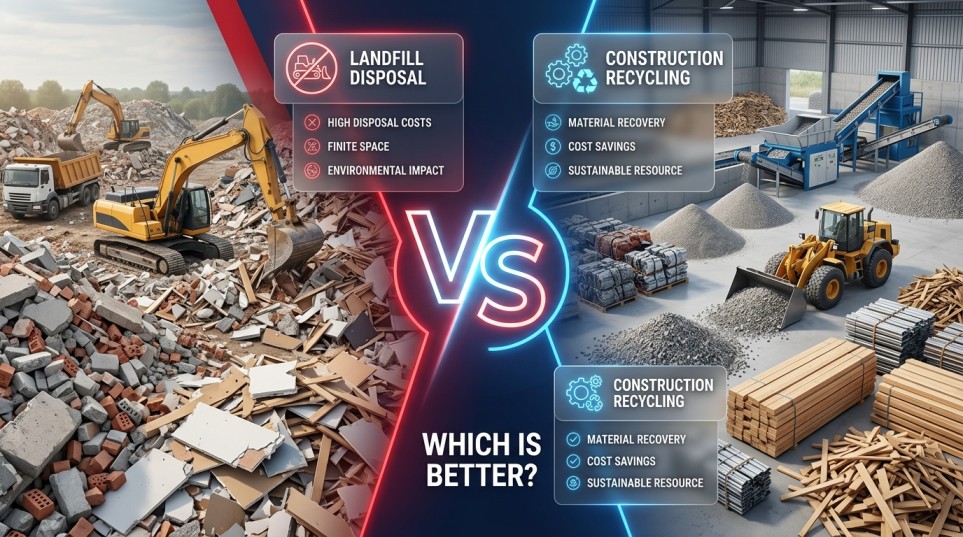
When a truck pulls away from your renovation or demolition site, the debris on it does not go to one place. Some of it may be crushed and sold as road base. Some may be sold as scrap. A good portion of it will most likely be buried. Which outcome your load gets depends on three things: what the material is, how clean it is, and whether a facility within hauling distance will take it.
The landfill disposal vs recycling question is not a choice you make once at the curb. It is decided by dozens of smaller decisions, most of them made before the first piece of debris goes into the truck. This guide explains where construction debris actually ends up in Texas, what can realistically be recovered from a job site, and what you can do as a property owner or contractor to change the outcome.
Key points
- Recycling is a material-by-material outcome, not a service you can buy for an entire load.
- Mixed debris is far harder to recycle than separated debris, and contamination can remove the option entirely.
- Texas permits more than one class of landfill, and clean construction debris does not go to the same place as household trash.
- The biggest influence you have on the outcome happens before pickup, not after.
- No hauler can promise a specific recycling percentage for your project without knowing the materials and the receiving facilities.
Landfill Disposal vs Recycling: What Happens to Construction Debris?
Construction and demolition debris from a San Antonio job site generally heads to one of a few destinations, and a single project can send material to several of them:
- A transfer station, where loads are consolidated before moving on to a final facility.
- A construction and demolition recycling or processing facility, where material is sorted, crushed, or ground for reuse.
- A construction and demolition landfill, for material that has no recovery route.
- A standard municipal solid waste landfill, for mixed loads that include household-type waste.
- A scrap metal yard, which pays for metal by type and weight.
- A salvage or reuse outlet, for fixtures and building components removed intact.
Where a given load lands is usually a practical decision rather than a philosophical one. Haulers weigh what the load contains, what each facility will accept, what each one charges, and how far away it is. A load of clean broken concrete has an obvious destination. A trailer holding drywall scrap, torn carpet, treated lumber, and a few bags of jobsite trash has far fewer options, and the cheapest of those is usually burial.
Why a C&D Landfill Is Not the Same as a Regular Landfill
People tend to picture one generic landfill taking everything. In practice, construction debris is treated as its own waste stream because it behaves differently from household garbage.
Household waste contains food, organics, and other material that rots. That decomposition produces leachate and landfill gas, which is why municipal landfills are built with extensive liner systems, leachate collection, gas controls, and long-term groundwater monitoring. Running that infrastructure costs money, and that cost shows up in the disposal rate.
Construction debris is mostly inert. Concrete, brick, dimensional lumber, and roofing do not decompose the way a bag of kitchen waste does. Landfills built specifically for this material are permitted under a different set of requirements, and the tipping fees are typically lower as a result.
That difference matters to you for one reason: a load only qualifies for the cheaper construction debris facility if it stays within what that facility is permitted to accept. Toss a few bags of lunch trash, a broken office chair, and some old paint cans onto a pile of clean lumber and the whole load can be reclassified. You lose the lower rate and the material loses any chance of being screened for recovery.
Type I and Type IV Landfills in Texas
Texas uses a naming system that is worth knowing if you are comparing disposal options or reading a hauler’s paperwork. The Texas Commission on Environmental Quality permits municipal solid waste landfills by type. Type I units accept the full range of municipal solid waste, while Type IV units are limited to brush, construction and demolition waste, and rubbish. A single permitted facility can operate both kinds of units on the same site.
The practical distinction is putrescible waste, meaning anything that rots. Type IV units are not permitted to take it. That is the line your load has to stay on the right side of.
Texas also permits arid exempt versions of both, designated Type IAE and Type IVAE, which are small facilities in dry regions that are exempt from liner and groundwater monitoring requirements. These are a rural West Texas arrangement and are not what a San Antonio remodel load is going to.
So when someone asks whether construction debris goes to “the landfill,” the honest answer is that it depends on which landfill, and that the answer is partly in your hands. Material that arrives clean and separated can go to a Type IV unit or, better, never reach a landfill at all. Material that arrives mixed goes to a Type I unit with everything else.
What Gets Recovered and What Gets Buried
Recycling rates get quoted as a single number for a whole project, which hides how uneven the reality is. Some materials have strong, established markets. Others are technically recyclable but have nowhere local to go. A few cannot be recycled at all.
| Material | What Happens to It | What It Becomes |
| Clean concrete, brick, and asphalt | Crushed and screened | Recycled aggregate for road base and fill |
| Scrap metal | Separated and sold by type | Feedstock for new steel, copper, and aluminum |
| Untreated lumber | Ground or chipped | Mulch, boiler fuel, or engineered wood products |
| Treated and painted wood | Landfilled | Cannot be recycled because of the chemical treatment |
| Drywall | Usually landfilled locally | Recyclable in theory, but few facilities accept it |
| Roofing shingles | Usually landfilled | Recyclable into asphalt paving where processors exist |
| Cabinets, doors, and fixtures | Resold if salvaged before demolition | Reuse, which recovers far more value than recycling |
| Mixed and contaminated debris | Landfilled whole | Contamination removes the recycling option entirely |
Read down that table and a pattern shows up. The materials with real recovery value are the heavy, uniform ones: concrete, metal, clean wood. They are also the ones easiest to keep separate on a job site, because they tend to come off the structure in distinct phases of the work.
Why Contamination Ends the Recycling Option
Contamination is the word facilities use for anything in a load that does not belong in that material stream. It is less dramatic than it sounds. A pile of clean concrete with rebar sticking out is normal and gets processed. That same pile with a few sheets of drywall, some plastic sheeting, and a bucket of joint compound mixed in is a different matter.
The problem is economics, not chemistry. A crusher producing recycled aggregate has to hit a spec. If the operator has to pay someone to pick foreign material out of incoming loads by hand, the material stops being worth processing. Facilities respond by rejecting contaminated loads at the scale house, charging a contamination surcharge, or simply downgrading the whole load to disposal.
This is why a load cannot be partly recycled once materials are mixed in the same pile. The unit of decision is the load, not the individual board. One trailer of mixed debris produces one disposal ticket.
Two additional points worth knowing. First, certain materials change the handling requirements for everything around them. Suspected asbestos-containing material, lead-painted components, and materials from a fire or water loss all have their own rules and should be identified by a qualified party before anything is loaded. Second, do not assume a container left open on a street-facing site stays clean overnight. Illegal dumping into an open roll-off is common enough that it routinely turns a clean load into a mixed one.
The Materials San Antonio Has No Local Recycling Route For
A material being recyclable in principle does not mean it is recyclable where you are. Recycling requires a processor within economical hauling distance that is actively accepting that material, and that list shifts as facilities open, close, and change what they take.
Drywall is the clearest example. Gypsum board can be processed back into new wallboard or used as a soil amendment, and facilities that do this exist in parts of the country. For most San Antonio projects, there is no practical local outlet, so drywall scrap is a disposal item. Asphalt shingles follow a similar pattern: they can be reprocessed into paving material where a processor exists, but availability is regional and inconsistent.
Treated and painted wood sits in a different category. It is not a question of local infrastructure. The preservatives in pressure-treated lumber and the coatings on painted trim make the material unsuitable for mulch, animal bedding, or fuel, so it is a disposal item regardless of location.
If you want to know what is actually accepted for your specific project this month, that is a question for your hauler or for the receiving facility directly. Anyone quoting you fixed recycling percentages before seeing the material is guessing.
Why Sorting Before Pickup Changes the Outcome
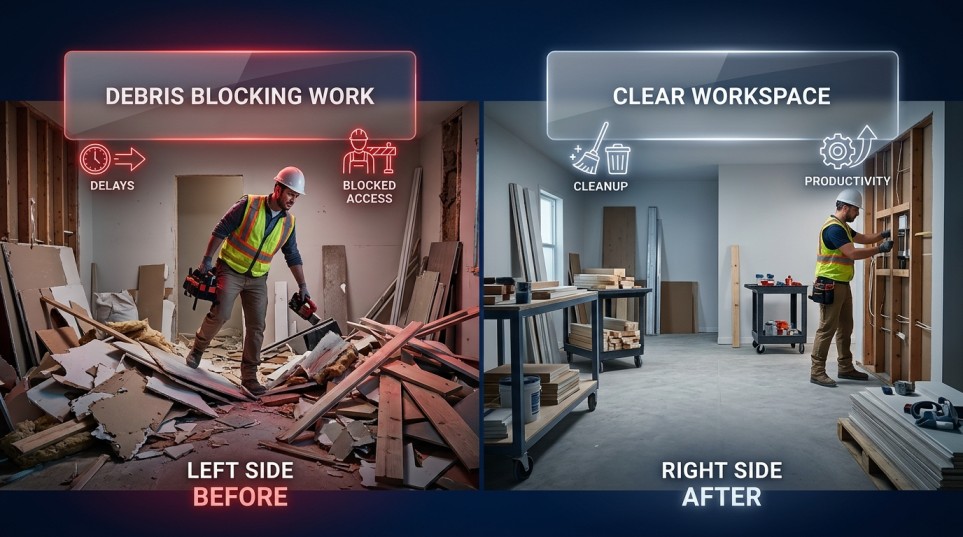
The single largest factor in whether your debris gets recovered is whether it was kept separate while the work was happening. Not after. During.
On most residential remodels, the materials come off the building in phases anyway. Demolition of finishes happens before framing changes. Roofing comes off in its own operation. Concrete work is its own stage. Keeping those streams apart is often a matter of staging them in different spots rather than doing additional labor, and it is far cheaper than paying someone to untangle them later.
For larger commercial projects, separation is usually planned into the schedule, with designated areas or separate containers for metal, clean wood, and concrete. For a single-family remodel, it can be as simple as a tarp for clean wood on one side of the driveway and a pile for metal on the other.
What this gets you, practically: metal that is worth something, concrete that qualifies for an aggregate processor instead of a landfill, and a smaller volume of genuinely mixed waste left over. It can also reduce your disposal cost, though whether it does depends on volumes, local tipping rates, and how much extra handling the separation requires.
What a Hauler Can and Cannot Separate After Loading
This is where expectations and reality often diverge, so it is worth being direct about it.
What a crew can realistically do on site: pull out obvious, high-value, easily handled items before they go into the truck. Appliances, HVAC units, copper pipe, steel framing, cast iron, and large clean concrete pieces can be set aside during loading. Intact cabinets, doors, and fixtures can be kept whole rather than broken up. A crew that is paying attention catches a lot at this stage.
What a crew cannot do: un-mix a load. Once debris is compacted into a truck or a roll-off, pulling a specific material back out means unloading everything onto a surface, sorting by hand, and reloading. Nobody is doing that on a job site, and no reasonable pricing model supports it.
There are mixed C&D processing facilities that run incoming loads across picking lines and magnets to pull out recoverable material. They are genuinely useful, and they do recover material from mixed loads, but their recovery rate on mixed debris is well below what source separation achieves, and whether one is available for your project depends on the facilities in range.
So the honest framing is this. Separation before loading is where the real gains are. Anything after that is damage control, and the results are more limited.
Deconstruction Instead of Demolition
For some project,s there is a step beyond sorting debris, which is not producing the debris in the first place.
Demolition removes building components quickly by breaking them. Deconstruction removes them carefully so they stay intact and usable. Cabinets come out as cabinets. Hardwood flooring comes up as flooring. Doors, trim, light fixtures, plumbing fixtures, and sometimes framing lumber come out whole.
Reuse sits above recycling in terms of what it recovers. A salvaged solid-wood door keeps its full value as a door. The same door ground into wood chips keeps almost none of it.
Deconstruction is not right for every job. It takes more time and more labor hours, so it makes the most sense when the building contains materials worth saving, when the schedule can absorb the additional time, and when there is a local outlet that will take the salvaged material. A 1950s house with solid wood cabinetry and hardwood floors is a good candidate. A water-damaged 1990s rental interior usually is not.
If you are considering it, the decision has to happen before demolition starts. Once walls have been opened with a sledgehammer, the salvage option is closed.
What to Ask Your Hauler
Most disposal conversations never happen. The customer asks what it costs, the hauler quotes a number, and the load leaves. If the destination of your material matters to you, for environmental reasons, for a green building certification, or because you want to understand what you are paying for, you have to ask.
Two questions tell you most of what you need to know, and the quality of the answers tells you the rest.
Where Does My Load Actually Go?
Ask which facilities the company uses for construction debris. A useful answer names specific places and explains how the choice is made.
A vague answer is not automatically a red flag, because the destination genuinely depends on what the load turns out to contain. But a company that handles construction debris removal regularly knows where the material goes. Someone who cannot describe the options at all probably has one default destination and uses it for everything.
Be appropriately skeptical of a flat recycling percentage offered before anyone has seen your project. A company can describe its process honestly. It cannot know your recovery rate until it knows what is in the pile and which facilities are accepting that material. Specific claims about diversion rates and disposal partnerships are worth asking for documentation on, especially if you need them for a certification submission.
What Gets Separated and What Does Not?
The second question is more concrete and harder to answer vaguely. Ask what the crew will pull out during loading, and what they need from you in order to do it.
A useful conversation covers:
- Which materials the crew will separate on site, and which they will not
- Whether staging material in separate piles before arrival changes the price or the outcome
- What the company will not accept at all, so there are no surprises on the day
- How materials requiring special handling are identified and dealt with
- Whether anything on your project is worth salvaging rather than hauling
That last point is worth raising early. If you are gutting a kitchen with cabinets in good condition, say so before demolition. Some usable items may be suitable for donation or resale depending on their condition and what local organizations are accepting, and that option disappears once the cabinets are broken up.
It is also worth confirming how the company handles materials it cannot take. Paints, solvents, fuels, pesticides, asbestos-containing materials, and similar items have separate disposal requirements that most junk removal services are not set up for. Identify them before the crew arrives rather than discovering them mid-load. Do not open unlabeled containers, move suspected asbestos material, or attempt to dispose of chemicals yourself. Set those items aside, describe them to the company, and let them tell you what route they need to take.
Frequently Asked Questions
Can a hauler guarantee my debris gets recycled?
No, and you should be cautious about anyone who does. Recycling depends on what the material is, how clean it is, which facilities are currently accepting it, and what condition the load is in when it arrives. A hauler controls how carefully a crew separates material and which facility they drive to. They do not control whether a processor accepts a given load that day or whether a market exists for a given material. What a company can reasonably tell you is how it handles material and where it takes it. A guaranteed outcome is a different claim, and it is not one anyone can back up.
Is recycled construction debris actually reused, or just stockpiled?
It depends heavily on the material. Metal and clean concrete have the strongest track record. Scrap metal is bought and sold on established commodity markets, so it moves because it has value. Crushed concrete has steady demand as road base and fill, and in a region with ongoing construction activity, it generally gets used.
Materials with thinner markets are where stockpiling concerns are more reasonable. If demand for a processed material drops, it can accumulate. This is a fair thing to ask a facility about directly, and the better processors will tell you who buys their output.
Does recycling construction debris cost less than landfilling it?
Sometimes, but not reliably, and it is the wrong question to lead with. Clean, separated material often costs less to dispose of than mixed debris, because facilities accepting a single clean material typically charge less than a landfill taking everything, and metal can generate a small return rather than a cost.
But the full comparison includes labor. Separating material takes time, space on the job site, and sometimes additional containers. On a small project, that labor can exceed the disposal savings. On a larger project with real volumes of concrete or metal, the math more often works in your favor.
The only way to know for your project is to price it with the specifics: what materials, what volume, what access, and what the current rates are at the facilities in range. Treat any estimate given before someone has assessed the project as a starting point rather than a final number.
What percentage of a typical remodel can actually be recycled?
Published numbers vary widely, which is itself a useful signal. Recovery rates depend on what the building is made of, how the work is sequenced, how carefully material is separated, and what facilities are available locally. A concrete-heavy demolition and an interior remodel of a drywall-and-carpet apartment produce completely different results.
Rather than anchoring to a percentage, it is more useful to know which materials on your specific project have a recovery route. If your job produces a lot of concrete, metal, and clean lumber, meaningful recovery is realistic. If it is mostly drywall, carpet, treated wood, and shingles, most of it is headed for disposal no matter how it is handled. Knowing which situation you are in beforehand is worth more than a number.
Work With a Crew That Sorts Before It Dumps
The landfill versus recycling question comes down to something less abstract than it first appears. Material that arrives at a facility clean and separated has options. Material that arrives mixed has one.
That means the decisions that matter happen on your property, during the work, before anything is loaded. Which materials get staged separately. Whether the cabinets come out whole or in pieces. Whether anyone identifies the items that need different handling before they end up in the middle of a pile.
If you are planning a renovation, a demolition, or a commercial build-out in Texas, it is worth having that conversation before the debris starts accumulating rather than after. Talk through what your project will actually produce, what can be separated without disrupting the schedule, and what the realistic disposal route looks like for each material.
Contact American Valor Waste & Disaster Services to discuss your project and what handling makes sense for the materials involved. You can also read more about our approach to construction debris removal, or learn about our team and the cleanup and hauling services we provide.