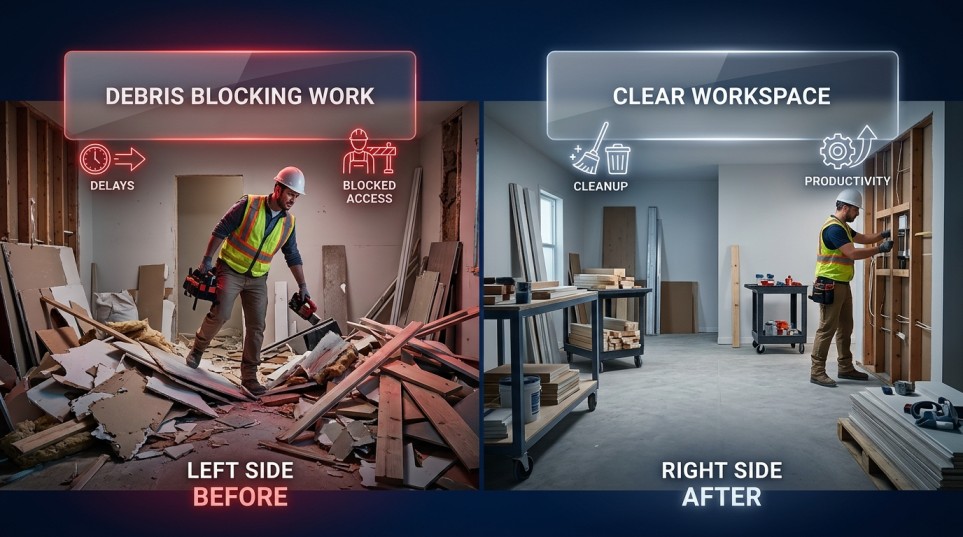

Construction debris is blocking the jobsite, and what looks like a routine housekeeping issue can quickly become a safety and scheduling problem. When debris obstructs a walkway, stairway, exit route, or access path needed by another trade, it creates hazards that OSHA addresses under its construction housekeeping requirements. Waiting until the end of a project phase to remove accumulated waste can put workers at risk and delay ongoing work.
Jobsite debris removal is a hauling service, not a cleaning service. A crew loads accumulated material, framing offcuts, drywall scrap, packaging, demolition rubble, and roofing tear-off from an active site and transports it to a facility that accepts commercial construction loads. What separates it from residential junk removal is sequencing. The work has to happen around active trades, site access rules, and a schedule that cannot pause while the site is cleared.
For most contractors and site supervisors, the real decision is not whether to clear the site. It is how to keep it clear: a one-time haul to reset a blocked site, recurring pickup on a set interval, or a container staged on site. The right answer depends on how much debris each phase produces, how much lay-down space you have, and how much control you need over when material leaves.
Key Takeaways
- OSHA 1926.25 requires debris to be kept cleared from work areas, passageways, and stairs during construction, not collected at the end of a phase.
- Clear blocked egress, stairs, and equipment routes first. Those carry the highest risk and draw the most attention during an inspection.
- San Antonio’s free residential disposal routes exclude contractor loads and commercial haulers, so jobsite debris needs a commercial disposal plan and its own budget line.
- Debris volume is not evenly spread across a project. Demolition and drywall phases produce far more than framing or punch list, so removal should be scheduled to the phase rather than the calendar.
- Pricing depends on volume, material type and weight, site access, and labor, which is why a site-specific estimate is more useful than a per-load number.
What OSHA Actually Requires for Jobsite Debris
Most of the debris rules that apply to an active construction site sit in two short standards: 1926.25, which covers housekeeping, and 1926.252, which covers how waste material is disposed of and moved between levels. Neither one is long, and neither one gives you a grace period.
| Standard | What It Requires | What Gets Cited |
| 1926.25(a) | Form and scrap lumber with protruding nails, and all other debris, kept cleared from work areas, passageways, and stairs | Debris and scrap left in walkways and on stairs while work continues around it |
| 1926.25(b) | Combustible scrap and debris removed at regular intervals during construction, with safe means provided for removal | Waste allowed to accumulate between phases |
| 1926.25(c) | Containers provided for the collection and separation of waste and trash, with covers on containers used for oily, flammable, or hazardous waste | Missing containers, or uncovered containers holding oily rags and flammable waste |
| 1926.252(a) | An enclosed chute whenever material is dropped more than 20 feet to a point outside the exterior walls | Debris thrown from upper floors without a chute |
| 1926.252(b) | Barricades at least 42 inches high, set back at least 6 feet from the projected edge of the opening, when debris is dropped through floor openings without a chute | Unprotected drop zones below active debris handling |
| 1926.252(c) | Scrap lumber, waste material, and rubbish removed from the immediate work area as the work progresses | Cleanup deferred to the end of a phase |
Housekeeping citations are common in construction, and they rarely arrive alone. An inspector who finds blocked stairs is already looking at egress, fall protection around floor openings, and whether combustible scrap is sitting next to hot work.
Why “Kept Cleared” Means Continuously, Not at the End
Read the verbs in the standards: kept cleared, at regular intervals, as the work progresses. None of them describe a single cleanup event. They describe a condition the site is supposed to stay in while people are working in it.
That distinction matters because compliance is judged at the moment someone looks. A site that gets swept every Friday afternoon can still be cited on Wednesday morning, when the week’s drywall scrap is stacked across the only route to the stairwell. “We have a crew coming Friday” is a schedule, not a defense.
It also matters because debris does not accumulate evenly. A single day of tear-out or a drywall delivery with heavy packaging can take a site from acceptable to blocked faster than a weekly cleanup cycle can respond. The practical standard is that clearing has to keep pace with the trades generating the material.
The Hazards Behind the Standard
The rules exist because the injuries are predictable and repetitive:
- Punctures. Protruding nails in form and scrap lumber are specifically named in the standard because stepping on a board is one of the most common ways a worker gets hurt during cleanup.
- Slips and trips. Offcuts, banding, bucket lids, and sheet scrap turn a level floor into uneven footing, often while someone is carrying material with both hands.
- Blocked egress. A passage that is merely inconvenient during normal work becomes dangerous during a fire, a medical event, or an evacuation, when people move fast and may not be able to see the floor.
- Fire load. Combustible scrap is the reason 1926.25(b) exists. Wood, cardboard, and packaging piled near hot work, temporary heat, or electrical panels turn ordinary waste into fuel.
- Falling material. The chute and barricade requirements in 1926.252 address what happens when debris is moved vertically. Material dropped without a chute or an enclosed drop zone puts anyone below in the path of it.
- Concealed hazards. Debris hides what is underneath it: floor openings, extension cords, rebar dowels, and unsecured plate. Crews step onto a pile assuming it is sitting on a solid floor.
When debris has reached the point where it is blocking the work, treat the cleanup itself as a task with its own hazards. Loose piles shift, material is heavier than it looks, and unknown containers left by another trade should not be opened or moved by someone who does not know what is in them.
Construction Debris Is Blocking the Jobsite: How to Clear It Safely
When a site is already past the point of a quick sweep, the instinct is to start at the biggest pile. That is usually the wrong order. Clearing a blocked site works better as a triage, where the question is not what looks worst but what has to be passable before anyone can safely work another shift.
Identifying Blocked Egress and Equipment Routes First
Walk the site and mark what is obstructed, in this order:
- Exits, stairs, and the routes to them. These come first regardless of how much debris is involved. Partial blockage counts; a stair landing with material stacked on one side forces single-file movement during an evacuation.
- Access to emergency and life-safety equipment. Fire extinguishers, first aid, eyewash, electrical panels, and shutoffs need a clear approach at all times, not just when someone remembers to move the pile.
- Equipment and vertical transport routes. Hoist landings, elevator lobbies, lift paths, and forklift lanes. A blocked lift route pushes crews into carrying material by hand, which creates a second set of problems.
- Delivery and lay-down access. If the next trade’s material cannot reach the floor it belongs on, the schedule stops whether or not the work area itself is clear.
- Active work areas and the paths between them.
Photograph conditions before you start. It documents the state of the site, it gives you something concrete to send a hauler when you request an estimate, and it tells you later which trade’s phase is generating more debris than planned.
What Has to Move Before Work Can Resume
Not everything in a pile is debris, and treating it all the same slows the cleanup down. Before a crew arrives, sort the site into four categories:
- Debris that goes. Scrap lumber, drywall offcuts, packaging and banding, broken units, demolition material, and general jobsite waste.
- Material that still has a use. Unopened stock, reusable form lumber, bracing, and partial bundles belong in a lay-down area, not in the haul. Mark or move it so it does not get loaded by mistake.
- Designated salvage. Fixtures, metals, or architectural material the owner intends to keep or sell. If this is not clearly separated and labeled, it will end up in the truck.
- Material that needs separate handling. Suspected asbestos-containing material, lead paint debris, solvents, fuels, adhesives, batteries, and unlabeled or unknown containers left behind by another trade. These are not general construction debris, and they are not something to sort through on the spot. Leave them in place, keep crews away from them, and handle them through the right channel before the debris haul happens.
A pile that has been sorted loads faster, costs less in labor, and avoids the situation where a single prohibited item holds up an entire load at the disposal facility.
Getting Heavy and Awkward Debris Out of Tight Sites
The difference between an easy haul and a hard one is rarely the volume. It is the distance between the debris and the truck, and what sits in between.
Things that change the work substantially:
- Carry distance and stairs. Material that has to come down two flights by hand takes several times longer than the same volume staged at a loading door.
- Vertical transport. Whether a hoist or elevator is available, whether it can be used for debris, and whether it needs protection before it is.
- Street frontage and staging. Narrow lots, shared alleys, active parking areas, and limited curb space all affect where a truck can sit and how far the crew has to walk.
- Occupied or partially occupied buildings. Tenant corridors, business hours, noise limits, and protected finishes change both the route and the timing.
- Site restrictions. Gate hours, badging, escort requirements, and any limits the general contractor or property owner places on when debris can be moved.
Material type matters as much as quantity. Concrete, tile, mortar, cast iron, and roofing tear-off reach weight limits long before they fill a truck, while framing scrap and packaging fill space without adding much weight. Long or rigid materials, conduit, pipe, trusses, countertop, and glazing may need to be cut down or handled as oversize. This is why capacity is not a single number: what fits depends on the density and shape of what you are getting rid of, not just the size of the truck.
It is worth saying plainly that debris removal is not demolition. A hauler clears and transports material that is already loose. Taking down structure, cutting out fixed assemblies, or removing regulated materials are separate scopes handled by the appropriate trades.
Why Contractors Cannot Use the City’s Free Disposal Routes
There is a persistent assumption on small commercial jobs that debris can go out the same way household junk does, a few trips to a city drop-off center in somebody’s truck. In San Antonio, that route is closed to contractors, and finding out at the gate costs a half day.
Commercial Loads Are Excluded From Residential Facilities
The city’s free disposal network is funded by the solid waste environmental fee residential customers pay through their CPS Energy bill, and access is restricted accordingly.
- Bulky Waste Collection Centers. Use requires a recent CPS Energy bill showing the environmental fee along with a matching photo ID. Materials from commercial waste haulers are not accepted, commercial trailers are turned away, and even residential loads are capped at roughly four cubic yards of bulky items and one cubic yard of construction material per trip. One cubic yard is a few wheelbarrows of drywall scrap, not a jobsite’s worth.
- Brush recycling centers. The Bitters Brush Recycling Center moved to residential customers only in May 2023 and no longer takes brush from commercial accounts, including landscaping companies, arborists, and firms clearing land for development.
- Free Landfill Days. These quarterly events are for residential customers. Contractor, commercial, and industrial waste is excluded, as is hazardous waste.
Commercial routes do exist. Private landfills, transfer stations, and facilities such as the Nelson Road brush recycling operation accept commercial loads at commercial rates, and clean single-material loads sometimes have better options than mixed debris. The point is that these are paid, account-based disposal channels with their own rules, hours, and material restrictions, not the free residential system.
It is also worth noting that a logo on the door is often enough to get a vehicle turned around at a residential facility, and loads taken to city disposal and processing sites have to be covered. Sending a crew member on a dump run in a company truck is not the workaround it looks like.
What This Means for Your Disposal Budget
Once residential disposal is off the table, debris removal becomes a real line item rather than an afterthought absorbed by whoever has a truck. It helps to budget it the way you budget any other subcontracted scope.
What drives the cost:
- Volume and weight. Facilities that accept commercial construction loads generally charge by weight or by load, so dense material like concrete, tile, and roofing tear-off costs differently than an equivalent space filled with framing scrap and packaging.
- Material mix. Separated loads of a single material are sometimes handled differently than mixed debris. Whether separation is worth the on-site effort depends on the project and what is actually available locally.
- Labor and access. Carry distance, stairs, hoist availability, and how much sorting the crew has to do on arrival all affect the time a removal takes.
- Number of trips and scheduling. Several small pickups across a long project is a different cost structure than one large haul, and neither is automatically cheaper. It depends on how fast your site fills up and what blocking the site costs you.
The self-haul comparison is usually the one people get wrong. A crew member making dump runs is being paid a trade wage to drive, the truck is off the job while they do it, and the loads still have to go to a facility that accepts commercial material and charges for it. That can still be the right call on a small job with light debris and a flexible schedule. On an active commercial site, the hours lost are often the larger number.
Because every site differs in volume, material, and access, treat any figure you find online as a starting point rather than a quote, and ask for an estimate based on your actual conditions. You can request an estimate with photos and a description of the site and get a far more useful number than a generic per-load price.
Building Debris Removal Into the Schedule
Sites get blocked because debris removal is treated as a reaction instead of a scheduled activity. Every phase of a project produces a predictable kind of waste in a predictable quantity, which means removal can be planned the same way deliveries and inspections are.
| Project Phase | Debris Generated | When to Schedule Removal |
| Demolition and tear-out | The highest volume of the entire project, often mixed and heavy | Before demo finishes rather than after, so the next trade is not waiting on a clear floor |
| Framing and rough-in | Steady offcuts, banding, and packaging | Recurring pickup at set intervals |
| Drywall and finish | High volume, light, fills containers faster than crews expect | Right before finish trades arrive |
| Roofing | Concentrated and heavy, generated in a single compressed window | Arranged around the tear-off itself, since the load lands all at once |
| Punch list and turnover | Low volume, high visibility | A final clear before the walkthrough |
The table is a planning tool, not a formula. A gut renovation and a tenant finish-out on the same square footage produce very different volumes, and a project with no on-site storage fills up faster than one with a yard.
Coordinating Pickups With Trade Handoffs
The most useful place to put a pickup is at a handoff, because that is when the floor needs to be clear and when the responsibility for what is on it is about to change hands.
A few practices that make this work:
- Tie removal to the schedule, not to the calendar. “After demo, before framing” survives a schedule shift. “Every other Tuesday” does not.
- Give the hauler the lookahead. If your three-week lookahead shows tear-out finishing on the 14th, a removal partner can plan around it instead of being called the morning of.
- Confirm the window, not just the day. On an active site, when a truck can be at the dock matters as much as which day, especially where a crane, a concrete pour, or a delivery owns the access point.
- Clear before inspections and owner walks. Blocked routes and overflowing containers shape the impression an inspector or owner forms before anyone discusses the work itself.
- Build in a contingency pickup. Most projects hit at least one week where demolition finds more than expected. Knowing who to call before that week arrives is the difference between a day lost and an afternoon.
One-Time Haul, Recurring Pickup, or On-Site Container
These three approaches solve different problems, and plenty of projects use more than one across their lifecycle.
| Approach | Fits Best When | What It Requires From You |
| One-time haul | The site is already blocked, a phase just ended, or debris volume is unpredictable | Material staged and sorted enough to load efficiently |
| Recurring pickup | Debris accumulates steadily, and you want it gone on a set rhythm | A consistent staging point and a schedule the crews actually use |
| On-site container | Volume is high and continuous, and you want control over when material leaves | Space for the container, permitted placement, and management so it is not overfilled or filled by others |
The tradeoffs are real in both directions. A container gives crews somewhere to put debris at the moment they generate it, which is what clean-as-you-go depends on, but it occupies space, needs a legal placement, and becomes a liability once it is overfull or once the public starts using it. Scheduled pickups keep the site free of equipment and shift the loading labor off your crews, but they depend on the staging discipline between visits. A one-time haul resets a site quickly and does not commit you to anything, which is why it is the right call for a blocked site even when the long-term answer is something else.
Most multi-phase jobs end up with a combination: a reset haul to clear what has accumulated, a recurring schedule through the heavy phases, and a final clear before turnover. Our construction debris removal service page covers how this is set up for active sites.
Keeping the Site Clear After the First Cleanup
A cleared site stays cleared for about as long as the system behind it holds. If debris has nowhere obvious to go, crews will put it where they are standing, and the site is blocked again within a week.
Designated Debris Zones and Container Placement
Give every work area a debris point that is closer and easier than the floor. A zone that requires a detour will be ignored.
When choosing locations:
- Put zones on routes crews already walk, near the exit from each work area rather than tucked out of the way.
- Keep them out of egress paths, stairwells, and the approach to panels, extinguishers, and shutoffs.
- Keep combustible scrap away from hot work, temporary heat, and electrical equipment.
- Use separate containers where separation is worth doing on your project, such as clean wood, metal, and general debris. Keep covers on containers holding oily rags or flammable waste, which 1926.25(c) requires.
- Move the zones as the work moves. A debris point that made sense during demo is in the wrong place once finishes start.
For containers outside, confirm placement before delivery: fire lanes, hydrants, accessible routes, and sight lines at drives have to stay clear; placement in the public right-of-way may require permission, and finished paving usually needs protection under the container. An unsecured container on an open site will also collect material from people who have nothing to do with your project.
Daily Clean-As-You-Go Procedures
The standards expect debris to be removed as work progresses, and the practical version of that is a short, repeated routine rather than a weekly event.
- Build cleanup into the end of each shift and treat it as part of the task, not as overtime.
- Remove or bend over protruding nails before scrap lumber is stacked or moved.
- Keep a wheeled bin or cart on each floor, so material has somewhere to go the moment it is generated.
- Break down cardboard and packaging immediately. Intact boxes take up several times the space.
- Clear cut stations after each use. Offcuts migrate from where they were made.
- Follow your written exposure control plan for concrete, masonry, and drywall dust. Cleanup methods for silica-generating work are regulated, and dry sweeping is not always an acceptable option.
Assigning Responsibility Between Trades
Most debris disputes are a scope problem, not an attitude problem. If the subcontract does not say who moves what, the answer defaults to whoever is most annoyed by it.
Put it in writing before the trade mobilizes:
- Each trade removes its own debris to the designated zone before the end of each shift.
- The general contractor handles hauling, disposal, and container management unless the subcontract says otherwise.
- Define what happens when a trade leaves material behind, including how cleanup labor is backcharged.
- Name one person per shift who walks the site and confirms the zones are being used.
Keep in mind that on a multi-employer site, responsibility for site conditions is not fully transferable. A general contractor with authority over the site can be held accountable for hazardous conditions it had the ability to correct, even when another employer created them. Your safety lead or counsel is the right person to confirm how that applies to your contracts.
Scheduling Pickups Before Containers Overflow
An overflowing container is worse than no container. Material gets stacked beside it, the pile spreads into the route next to it, and an overfilled container cannot be covered or transported safely, which means it does not leave on the day you expected.
Set a trigger rather than waiting for it to be full. When a container reaches roughly three-quarters, or the first time someone sets material next to it instead of in it, that is the call. Give one person responsibility for making it, make sure they know the lead time required for a pickup, and note which phases fill fastest so the next project schedules them differently.
Frequently Asked Questions
Can you haul debris from an active jobsite without disrupting work?
Removal on an active site is normal work, and it is planned around the trades rather than through them. That usually means an agreed arrival window, a staging point, and truck position that keeps access open, and loading in the sequence that frees the most important routes first. The area being loaded will be occupied while the crew works in it, so the realistic goal is contained, predictable disruption rather than none at all.
Do you offer recurring pickup for multi-phase projects?
Recurring pickup is a common arrangement for projects that generate debris steadily, and the schedule is usually built around your phases rather than a fixed calendar. Because lookaheads shift, it helps to agree up front on how much notice is needed to move, add, or skip a visit. Discuss the project duration and phase plan when you request an estimate so the schedule reflects where the volume actually falls.
Who is responsible for debris left behind by a subcontractor?
Contractually, that depends on what the subcontract says, which is why spelling out daily cleanup obligations and backcharges before a trade mobilizes is worth the effort. From a safety standpoint, a general contractor with authority over the site can be held responsible for hazardous conditions it had the ability to correct, regardless of who created them. From a hauling standpoint, the material gets removed either way; the question of who pays for it is settled in your contracts, not at the truck.
Can you work around our site access and delivery schedule?
Yes, provided the constraints are known in advance. Gate hours, badging or escort requirements, shared access points, crane picks, concrete pours, and tenant business hours all affect when a truck can be on site and where it can sit. Share those details when you schedule rather than on the morning of, since most access conflicts are solvable with notice and expensive without it.
What do you need from us before arriving at a jobsite?
A short list makes the visit go quickly:
A site contact with a phone number who will be there during the window.
Access details: gate codes, badging, escort requirements, and where the truck can park and stage.
A clear separation between debris, material that stays, and anything designated as salvage.
Confirmation that no hazardous or regulated material is mixed into the piles.
Any site-specific PPE or orientation requirements for the crew.
An idea of volume and material types, with photos if you have them.
Do you provide documentation of where debris was disposed?
Disposal facilities issue receipts or weight tickets for commercial loads, and that paperwork can generally be passed along. If you need documentation for an owner, a green building program, or your own project records, say so when you book rather than after the haul, since what can be provided depends on the facility and the material. Ask specifically what format you need, and it can be confirmed before the work is scheduled.
Keep Your San Antonio Jobsite Clear and Compliant
A blocked site costs you twice: once in the hazard and citation exposure it creates, and again in the hours trades spend working around material that should have left days ago. Clearing it is the short task. Keeping it clear is a scheduling decision, and it is easier to make once before the heavy phases than repeatedly in the middle of them.
American Valor Waste & Disaster Services handles construction debris removal for active jobsites in San Antonio, whether you need a one-time haul to reset a site that has gotten away from you or a recurring schedule through demolition, drywall, and turnover. You can read more about the company and how it works or browse the full range of junk removal and hauling services.
When you are ready, get in touch for an estimate. Bring the details that make a quote useful: project type and phase, approximate volume, the materials involved, access and staging conditions, and the window you need the site cleared by. The more specific the picture, the more accurate the number, and the less likely the schedule is to be the thing that slips.