Most families don’t start researching hoarding cleanouts casually. Usually something has happened: a parent fell, a landlord sent a notice, a code officer left a card on the door, or you finally saw the inside of a house you hadn’t been allowed into for years. Now you’re trying to figure out what a cleanout actually involves, whether it’s safe to handle yourselves, what it might cost, and how to do it without destroying your relationship with the person who lives there.
This Hoarding Cleanouts Guide explains how professional hoarding cleanouts work in practical terms, what the health and safety risks really are, who has authority to arrange one, and what to ask before hiring anyone. It’s written from the perspective of crews who do this work, and it’s meant to help you make a decision, not to sell you on a single option.
One note before we start: this is general information, not medical, legal, or insurance advice. Cognitive changes, guardianship questions, and lease disputes all need a qualified professional who can look at your specific situation.
What families most need to know:
- Hoarding cleanouts are sorting projects first and hauling projects second. The volume of material is rarely the hardest part; the decisions are.
- The threshold for professional help is safety, not appearance: biohazards, pests, mold, blocked exits, structural concerns, or volume beyond a couple of truckloads.
- Cost and timeline are project-specific. Any firm price given without a walkthrough should make you cautious.
- Consent matters legally and practically. Surprise cleanouts tend to produce re-accumulation, mistrust, and sometimes legal exposure.
- The cleanout is one phase. Repairs, treatment, and a maintenance plan determine whether the results hold.
What a Hoarding Cleanouts Guide Should Help You Understand
A hoarding cleanout is a planned, consent-based process for clearing a home where belongings, trash, or biohazards have built up to the point of blocking daily use or creating safety risks. It combines sorting decisions with heavy removal, disposal, and cleaning, and it usually involves the resident, their family, and a trained crew.
Who needs one varies more than people expect. It may be an adult child helping an aging parent stay safely in the home, a landlord facing a unit that can’t be turned over, a property manager with a code deadline, an executor handling an estate, or a homeowner who has decided on their own that things went too far. What affects the decision most is the condition of the property, who has legal authority to act, how involved the resident can be, and how much of the work your family is physically and emotionally able to take on.
Hoarding vs. Clutter: What Families Should Understand First
Clutter is a backlog. A garage fills up, a spare room becomes storage, a busy season gets away from someone. Clutter responds to a weekend and a dumpster, and it usually stays fixed afterward.
Hoarding is different in a specific way: discarding causes real distress. Hoarding disorder has been recognized as a distinct mental health condition since the DSM-5 was published in 2013, and it’s characterized by persistent difficulty parting with possessions, distress at the thought of discarding them, and accumulation that makes living space unusable for its intended purpose. That’s why a cleared house can refill within months if nothing else changes.
It also isn’t laziness or a character flaw, and it isn’t always hoarding disorder. Heavy accumulation can follow grief, a serious illness, a disability that limits mobility, financial insecurity, a caregiving collapse, or cognitive decline in an older adult. Some homes have severe sanitation problems without any hoarding pattern at all.
This distinction matters because it changes the plan. A clutter problem needs labor and a truck. A hoarding situation needs labor, a truck, a decision process the resident can tolerate, and usually some form of ongoing support afterward.
How a Hoarding Cleanout Differs From Cleaning or Junk Removal
Standard junk removal assumes the decisions are already made. You point at the pile in the garage, the crew loads it, and it’s gone. Cleaning services assume surfaces can be reached.
A hoarding cleanout can’t assume either. The crew is working through material that hasn’t been sorted, in a house where the true volume isn’t visible until they’re a few feet in. The practical differences:
- Decisions happen during the work, not before it, and the pace is set by whoever is making them.
- The volume estimate is provisional. Piles compress, and floors, closets, and back rooms hide more than a walkthrough reveals.
- Hidden conditions are normal: water damage under stacked paper, pest activity, sharps, unknown chemical containers, unstable stacks.
- Sorting is protective, not just logistical. Cash, deeds, jewelry, medications, photographs, and titles turn up in ordinary-looking boxes and bags.
- Personal protective equipment and containment may be required, which changes who can be in the house while work happens.
- Removal is often staged across multiple loads or multiple days, with disposal routed differently depending on the material.
- Cleaning, odor treatment, and repairs are frequently separate scopes that can only be estimated once the contents are out.
Why Hoarding Cleanouts Need a Compassionate Approach
There’s a practical reason crews who do this work regularly insist on a respectful, resident-involved approach, and it isn’t sentiment. Cleanouts done to someone rather than with them tend to fail. Clinicians and organizing professionals who specialize in hoarding consistently report the same pattern: forced clearing produces acute distress, a collapse of trust, and rapid re-accumulation, and it often ends any willingness to accept help in the future.
A compassionate approach looks concrete on the ground. Crew members use neutral language instead of words like junk or filth. Nothing leaves without the agreed decision-maker’s approval. Photographs, if taken at all, are used for scope documentation and not shared. Work is scheduled to draw as little attention as possible. The resident gets breaks, a quiet place to sit, and the ability to stop the work.
None of that means being vague about safety. The goal is to be honest about hazards while still treating the person as the owner of their own belongings.
How Do You Know When a Home Needs a Hoarding Cleanout?
The threshold isn’t how the house looks. It’s whether the home still functions and whether anyone in it is at risk. A tidy-looking house with a blocked back exit and a space heater against stacked newspaper is more dangerous than a messy one with clear paths and working smoke alarms.
The Five Levels of Hoarding, Explained Simply
Cleanup and organizing professionals commonly describe hoarding conditions on a five-level scale. The best-known version is the Clutter–Hoarding Scale developed by the Institute for Challenging Disorganization, used to communicate conditions between families, crews, social workers, and code officials. In plain language:
Level I: Cluttered but functional. All doors and windows work, stairways are usable, sanitation is normal, pets are cared for. Clutter is noticeable, but the home does what a home does. Often manageable by family, sometimes with a hauling crew for volume.
Level II: Starting to break down. One exit or one room is hard to use, there are light odors, some pet waste or overflowing litter, minor mold in wet areas, appliances or HVAC not maintained, some clutter visible outside.
Level III: Rooms lost. Visible clutter outdoors, narrow pathways through rooms, one or more rooms no longer usable for their purpose, strong odors, animal waste in living areas, heavy dust, evidence of pests, possible light structural damage.
Level IV: Contamination and damage. Structural damage, non-functioning plumbing or standing sewage, significant rodent or insect infestation, mold beyond spot cleaning, human or animal waste, hazardous chemicals stored improperly, unsanitary food conditions. This level generally requires PPE and containment.
Level V: Not habitable. Utilities disconnected or unsafe, extensive waste accumulation, serious structural or sanitation failure. These projects usually involve coordination with health authorities, code enforcement, social services, and licensed repair trades.
Two cautions. The scale describes property conditions, not a person, and it isn’t a diagnosis. And two homes rated at the same level can require very different work, because volume, access, and biohazard presence vary independently of level. Assessors use the level as shorthand and then price and plan from what they actually see.
Signs Clutter Has Become a Safety Concern
Look for function, not aesthetics. Any of these deserves attention:
- Exits, hallways, or stairways narrowed to a single winding path, or a door that can no longer open fully
- The bed, sofa, stove, sink, shower, or toilet can’t be used or can’t be reached
- Extension cords or power strips running under piles, space heaters near combustibles, overloaded outlets
- Piles above waist height, leaning stacks, or material stored on stairs
- Smoke alarms removed, disconnected, or covered
- Water stains, soft or sloping floors, sagging ceilings, or a musty smell that doesn’t clear
- Rodent droppings, roaches, flies, fleas, or bite marks on packaging
- Food stored past use with no clear separation from waste
- Medications, mail, bills, or identification routinely lost
- The resident has fallen, or navigates the house by holding onto piles
- Home health aides, family, or repair techs have refused or stopped entering
- Utilities shut off, or a bathroom no longer in service
- Stored fuel, propane, paint, solvents, or pesticides in living areas
When a Cleanout Cannot Safely Wait
Some situations shift from “we should plan something” to “we need a path cleared this week”:
- Only one usable exit, especially with active ignition sources in the house
- Sewage backup, standing water, or no working toilet
- Rodent or roach infestation in contact with food and sleeping areas
- A medically fragile resident: oxygen in use around clutter, a recent fall, or a hospital discharge that depends on a safe home environment
- Structural signs like sagging floors or ceilings under stored weight
- A code compliance deadline, court order, or Adult Protective Services involvement
- Children or dependent adults living in the conditions
In urgent cases, the sequence usually changes. Rather than starting a full-house cleanout, crews stabilize first: clear the exits and primary paths, restore a usable bathroom and kitchen area, remove the immediate hazards, then plan the rest. If there is immediate danger to someone, that’s a call to 911 or the fire department, not a scheduling question. For a vulnerable adult in Texas, Adult Protective Services can be reached through the Texas Department of Family and Protective Services abuse hotline at 1-800-252-5400.
What Health and Safety Risks Does Hoarding Create?
Fire Hazards and Blocked Exits
Hoarding conditions create a fire problem in three ways at once. There’s more fuel in the building, the ignition sources are often in contact with it, and the ways out are compromised.
Paper, textiles, plastics, and stored furniture burn fast and hot. Space heaters get pushed against stacks. Outlets get overloaded, and cords get run under piles where damage goes unnoticed. Candles and smoking materials add ignition points. Meanwhile, exits and windows are blocked, so escape time drops at exactly the moment it matters, and firefighters entering the building face restricted movement, unstable piles, and no visibility of the floor. Disabled smoke alarms remove the early warning that would have offset some of this.
If you do nothing else before a cleanout, keeping one exit genuinely clear and getting working smoke alarms in place are the two highest-value actions. Don’t attempt to repair or reroute damaged wiring yourself; that’s an electrician’s job.
Trip, Fall, and Structural Hazards
Narrow paths through stacked material are uneven, shift underfoot, and hide what’s below them: broken glass, nails, needles, pet waste, standing water, missing floorboards. Falls in these homes are common and are especially serious for older residents.
Stored weight is its own issue. Books, paper, canned goods, and water-saturated material are heavy, and floors, shelving, and attic joists have limits. Sagging floors, doors that no longer close square, and cracked walls are reasons to stop and get a professional look before adding people and lifting activity to the space.
Crews manage this by clearing and lighting a working path before moving volume, working in pairs on awkward loads, and staging material out rather than carrying it through blind corners. Climbing on piles, pulling items out of a leaning stack, or moving heavy furniture alone is how people get hurt. Don’t do it to save a few hours.
Mold, Dust, and Indoor Air Quality
Long-term accumulation traps moisture and hides leaks. Paper and textiles hold water, air can’t move, and a slow plumbing leak or roof drip can go undetected for years behind stored material. HVAC systems in these homes are frequently unserviced and filthy. The result is dust loaded with mold spores, dander, insect debris, and rodent droppings, all of which go airborne the moment someone starts moving boxes.
Two practical points for Texas families:
- The EPA’s general guidance for building mold is that areas larger than roughly 10 square feet usually call for professional remediation rather than a do-it-yourself cleanup.
- Texas regulates mold work. Under the Texas Mold Assessment and Remediation Rules administered by the Texas Department of Licensing and Regulation, mold remediation projects affecting 25 contiguous square feet or more generally require licensed assessment and remediation. Removing contaminated contents is not the same activity as licensed mold remediation, so ask any company exactly which of those two things they are licensed and scoped to do.
If you need to enter a dusty or contaminated space at all, an N95 or better respirator, gloves, eye protection, and closed shoes are the minimum. Don’t dry sweep, and don’t put a box fan in the window and start moving material, which mostly distributes contamination through the rest of the house.
Pests, Animal Waste, and Biohazards
Pests follow food, water, and shelter, and hoarded homes supply all three. Rodents, cockroaches, fleas, and bed bugs are the usual findings. Dried rodent droppings and urine can carry pathogens, and disturbing them puts particles into the air, which is why sweeping and shaking out material is the wrong first move.
Animal-related situations need their own planning. Urine saturation produces ammonia levels that can make a room genuinely unsafe to occupy, and contamination frequently reaches carpet pad, subfloor, and baseboards, meaning the fix is removal rather than cleaning. When animals are still in the home, the cleanout has to be coordinated with animal care: veterinary attention, temporary housing, and in some cases local animal services.
Other biohazard findings that change the scope: human waste, used needles, expired or unsecured medications, spoiled food in volume, and decomposition. Several of these can’t legally go into ordinary household trash and must be handled as regulated or special waste with documented disposal.
Pest treatment is a sequencing question, and it’s easy to get wrong. Removing infested material can spread an infestation through the house and into vehicles, and bed bugs in particular travel with belongings. That’s a conversation with a licensed structural pest control operator, licensed in Texas through the Texas Department of Agriculture, ideally before the load-out rather than after.
Why Crews Use PPE and Containment
When families see coveralls and respirators, they sometimes read it as theater or as judgment. It’s neither. PPE is matched to what’s actually in the house: respirators for airborne dust, spores, and ammonia, coveralls and gloves for waste and sharps contact, eye protection for overhead work, and boots for uneven contaminated flooring. Where conditions warrant it, crews add containment: sheeting to isolate work areas, air scrubbers, dedicated waste containers, taped-off routes, and a decontamination point at the exit so contamination doesn’t migrate.
What this means for you is worth clarifying up front. If a house needs containment, it usually isn’t a place for children, older adults, anyone with asthma or a compromised immune system, or anyone without PPE to be standing around. Ask directly: is it safe for the resident and family to be onsite, and if not, where should we be while you work?
How Does a Professional Hoarding Cleanout Work?
Processes vary between companies, and the scope for any given property is confirmed after an assessment. The shape below is what a well-run hoarding cleanout generally follows, and it gives you a checklist for evaluating anyone’s proposal.
Step 1: Private Property Assessment
An assessment is a walkthrough with a purpose. The assessor is measuring the project, not touring the house: volume room by room, clutter level, access constraints (stairs, elevators, doorway widths, distance from the truck, driveway and parking, rural distance to a disposal facility), utility status, water damage, pest evidence, biohazard presence, unknown chemical containers, floor loading concerns, pets, and any known valuables or documents to watch for. They should also check the practical logistics: where a truck or roll-off can sit, whether street placement needs a permit, and whether an HOA or apartment complex restricts hours or access.
Ideally, the resident knows about the visit and is present for it. If photographs are taken for scoping, ask how they’re stored, who sees them, and whether they’re deleted afterward.
Step 2: A Written Cleanout Plan and Scope of Work
Most mid-cleanout disputes trace back to something that was discussed but never written down. Ask for a written scope that names:
- The rooms in scope, and the order they’ll be worked
- What’s included: labor, hauling, disposal fees, cleaning, PPE, containment
- What’s excluded, and who is expected to provide it: mold remediation, pest treatment, repairs, hazardous waste disposal, animal care
- The designated decision-maker and backup, and who the crew asks when there’s a question
- The sorting rules, including any pre-authorized categories that can be discarded without item-by-item review
- Crew size, work hours, and the number of days or phases anticipated
- How change orders are triggered, priced, and approved
- How disposal is handled, and whether you’ll receive disposal documentation
- Payment terms, and who signs off at completion
Step 3: Room-by-Room Sorting- Keep, Donate, Recycle, Discard
Work happens in zones, not all at once. A four-category system with physical staging areas keeps material moving: keep, donate, recycle, discard. Most crews add a fifth bin for undecided items, which functions as a pressure valve. It lets the resident defer a hard decision without stopping the day, and it prevents the argument that ends cooperation.
A few things that make sorting go better in practice: start in a lower-emotion area to build trust and momentum before touching bedrooms or memorabilia; time-box decisions rather than debating value; once an item is decided, don’t reopen it; and keep the decision authority in one place, because three family members giving different instructions will stall a crew.
On donation and recycling, be realistic. Some usable items may be suitable for donation depending on condition and local acceptance policies, and some materials can be recycled depending on type and available local facilities. Neither is a guaranteed outcome for a given item, and no honest company will tell you otherwise before seeing what’s there.
Step 4: Protecting Valuables, Documents, and Sentimental Items
Cleanouts turn up cash in books, jewelry in kitchen drawers, savings bonds in grocery bags, deeds and titles in paper stacks, prescription medications, firearms, and irreplaceable photographs. This is one of the strongest arguments against a rushed cleanout.
Good practice looks like this: the family provides a specific list of items to watch for before work starts; found items go into a secured container rather than a pile; finds are verified by two people and handed to the designated family member at the end of each work session; paper isn’t discarded in bulk until someone has reviewed or scanned it; and medications and firearms are handled by the family or the appropriate authorities rather than by the crew.
The honest limitation: in a full-house cleanout with thousands of items, no company can guarantee that every valuable is found. Careful item-by-item sorting reduces that risk substantially and also costs more time and money. That tradeoff should be a decision you make deliberately, not a surprise.
Step 5: Safe Removal and Disposal
Load-out is the visible part of the job. Crews clear and protect a route, pad door frames and floors where needed, break down large furniture where necessary, and move material in a controlled sequence rather than a scramble. Heavy items, awkward stairs, and long carries are planned, not improvised.
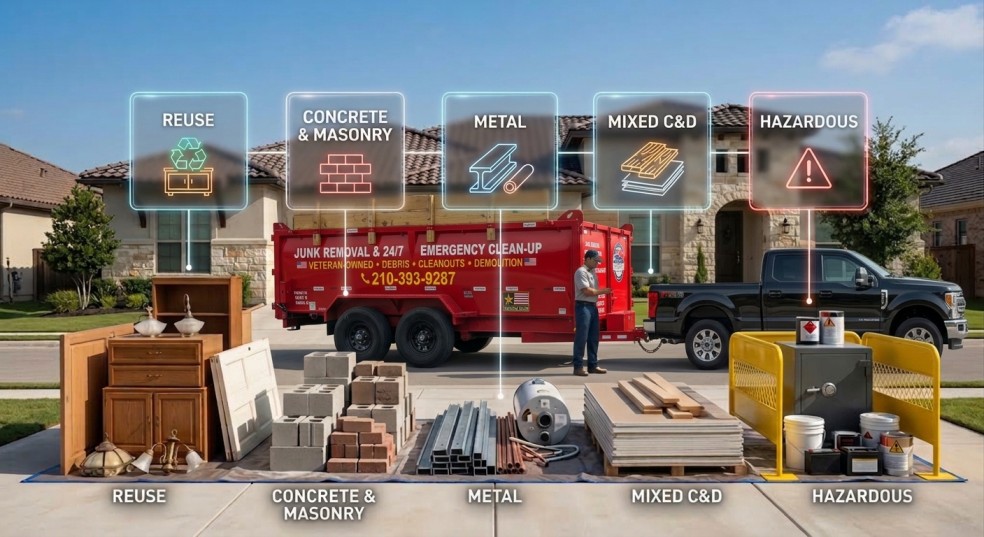
Where material goes depends on what it is:
- General household waste goes to a permitted municipal solid waste facility, which has its own acceptance rules and fees, often based on weight
- Scrap metal, cardboard, and electronics may be recyclable depending on material condition and the facilities available in the area.
- Appliances containing refrigerant require refrigerant recovery before disposal.
- Mattresses, tires, and e-waste are frequently handled under separate acceptance rules and fees.
- Paint, solvents, fuels, pesticides, and pool chemicals belong in a household hazardous waste program, not household trash, and program availability varies by city and county.
- Sharps, medical waste, and other biohazards require regulated handling and documented disposal.l
- Suspected asbestos-containing materials in older homes require licensed abatement under the Texas asbestos rules administered by state health authorities. Junk removal is not abatement, and disturbing these materials is exactly the wrong move.
Ask for disposal receipts. It’s your protection, since illegal dumping is a criminal offense in Texas and the trail can lead back to the property owner.
Step 6: Deep Cleaning, Sanitizing, Odor and Mold Treatment
Once contents are out, the actual condition of the house is finally visible. Typical work at this stage includes HEPA vacuuming, wiping and sanitizing hard surfaces, and removing contaminated porous materials such as carpet, pad, saturated flooring, and in some cases lower drywall. HVAC systems and ducts often need attention because they’ve been circulating the same dust for years.
Odor is a source problem. Removing and replacing contaminated material is what resolves it; fragrances and fogging without source removal buy a few days. Be skeptical of anyone who promises to eliminate deep odor without addressing what’s producing it, and be aware that mold work at any real scale is licensed work in Texas.
Cleaning is a separate scope from removal at many companies. Confirm in writing which you’re buying.
Step 7: Final Walkthrough and Safety Check
The last hour of the job matters more than most families expect. A proper walkthrough confirms that exits and paths are clear and usable, smoke alarms are present and working, the kitchen and bathroom function, appliances and utilities are accessible and either operational or flagged for repair, no sharps or hazards were missed, and all found valuables and documents have been handed over. You should get a punch list of anything outstanding and referrals for the repair trades the property now needs.
This is also the right moment for a short, unsentimental conversation about next week: who’s checking in, what the maintenance routine is, and what happens with the items that went into the undecided bin.
If you’re weighing options for a property in Texas, the practical next step is a private assessment so the scope, phases, and cost drivers are based on what’s actually in the house. You can contact American Valor Waste & Disaster Services to discuss the situation and arrange a walkthrough.
Who Can Arrange a Hoarding Cleanout for a Loved One?
Authority is the question that stops more cleanouts than cost does. Reputable companies ask about it early, because clearing a home without the right consent creates real legal exposure for everyone involved. What follows is general information; a Texas attorney should answer questions about your specific circumstances.
When the Resident Agrees to the Cleanout
If a competent adult owns or rents the home, it’s their decision. That holds even when a family member is paying for the work. The resident can set the rules, define what’s off limits, decide what leaves, and stop the job.
In practice, the resident should be a named party in the scope of work rather than a bystander to it. Have them sign or verbally agree in front of witnesses to the specific rules: which rooms are in scope, which categories can be discarded without individual review, and who the crew asks when something is unclear. Ten minutes of that conversation prevents the mid-afternoon standoff where a crew is standing in the driveway while the family argues.
Power of Attorney, Guardianship, and Estate Situations
Several kinds of authority can apply, and they aren’t interchangeable:
- Durable power of attorney. Scope depends entirely on what the document says. Some grant broad property authority; some don’t cover disposing of personal property. Read it, and note that a medical power of attorney generally doesn’t govern property at all.
- Guardianship. Court-ordered through the Texas probate courts, with defined powers over the person, the estate, or both. This is a formal process, not a family agreement.
- After a death. An executor or administrator acts under authority granted by the court, typically documented by letters testamentary or letters of administration. Before that authority exists, clearing an estate can create disputes with other heirs, and property may need to be inventoried first.
Two cautions. Acting without authority, even with good intentions, can result in claims over discarded property. And if siblings or heirs disagree, settle that before scheduling a crew, because a cleanout is the worst possible place to have the argument.
When a Landlord, Code Enforcement, or APS Is Involved
Landlords and property managers. A hoarded unit usually raises lease violations, habitability issues, and sometimes damage claims. Texas landlord-tenant law sets out procedures for notices, eviction, and handling a tenant’s property, and you can’t safely assume that belongings left behind may be removed immediately. Get legal guidance on the sequence before the truck shows up, particularly for occupied units.
Code enforcement. Texas cities have authority under state law to address substandard structures and nuisance conditions, but the specific ordinances, notice periods, and reinspection processes vary by municipality. If there’s an open case, ask the code officer exactly what conditions must be corrected and by when, then build the scope around that. Documentation and photographs of progress are useful.
Adult Protective Services. APS, part of the Texas Department of Family and Protective Services, investigates reports involving adults 65 and older and adults with disabilities, including self-neglect situations where hoarding conditions are a factor. APS may help coordinate services, but it doesn’t perform cleanouts itself. The Texas abuse hotline is 1-800-252-5400. Some Texas communities also have hoarding task forces that bring together fire, code, health, and social services; the local health department or 2-1-1 can tell you whether one exists in your area.
Why Forced or Surprise Cleanouts Usually Backfire
The scenario comes up often: a parent is in the hospital for a week, the family sees an opening, and they clear the house before the parent gets home. It rarely ends the way families hope.
What tends to follow is acute distress on return, a permanent loss of trust in the family members involved, re-accumulation that can be faster and more defensive than before, refusal to allow anyone into the home again, and sometimes legal claims over items that were discarded. The house gets cleared once, and the underlying situation gets harder to help.
The alternative isn’t inaction. It’s narrowing the goal: clear the exits, restore a working bathroom and kitchen, remove the immediate fire and fall hazards, and leave the harder categories for a later phase with the resident participating. Where a genuine emergency or a legal order forces immediate action, the same principle still applies as far as it can. Give notice, involve the resident in whatever decisions are possible, keep a photographic record of what was removed, and hold anything ambiguous rather than discarding it.
How Can Families Prepare Before the Cleanout?
How to Start the Conversation
Choose a calm, private moment away from the worst of the clutter, with one or two people rather than a delegation. Lead with something the resident cares about: staying in their home, not falling, having grandchildren visit, keeping their pets, avoiding a code case.
Language matters more than families expect. Words like hoarder, junk, trash, and filthy tend to end the conversation. Ask permission before touching anything, offer choices instead of announcements, and expect this to take several conversations rather than one.
A few openings that tend to work better than an intervention:
- “I’m worried about how you’d get out if there were a fire. Can we work on the back door together?”
- “The city sent a letter. I’d like to help you deal with it before it gets worse. Can we look at it together?”
- “You decide what stays. I’d just like the bathroom usable again.”
Agree on Safety Goals, Not Perfection
Vague goals produce fear, because “clean out the house” sounds like “take everything.” Specific goals are easier to agree to and easier to measure. Write down a short list, for example:
- Front and back exits fully clear and openable
- A clear path roughly a yard wide through main hallways and to the bathroom
- Working stove, sink, toilet, shower, and a sleeping surface
- No stored material within a safe distance of heaters, furnaces, or water heaters
- Working smoke alarms on every level
- Floor visible in the bedroom
Post the list somewhere visible on the workday. It gives everyone, including the crew, a shared definition of success that doesn’t depend on how the house looks in a photograph.
Decide Who Makes Final Decisions About Belongings
Name one decision-maker, usually the resident, plus one backup for when they need a break. Decide in advance how stalemates get resolved and who the crew asks when a question comes up.
Also decide in advance which categories don’t need item-by-item review. With the resident’s agreement, obvious waste like spoiled food, soiled paper, broken glass, and empty packaging can go straight out. Pre-authorizing those categories is the single biggest thing families can do to keep a cleanout moving without anyone feeling overruled.
When to Involve a Mental Health Professional
Hoarding disorder is treatable, and cognitive behavioral therapy adapted specifically for hoarding has the strongest research support. Professional organizers with hoarding training can help build the sorting and decision skills that keep a cleared house clear.
Signs that professional support should be part of the plan rather than an afterthought:
- A previous cleanout that reversed within a year
- Severe distress, panic, or anger at the idea of discarding anything
- Co-occurring depression, OCD, anxiety, grief, or trauma
- Noticeable memory or judgment changes in an older adult, which need a medical evaluation rather than an organizing solution
- Any hint of self-harm risk, which is a reason to call 988 rather than schedule a crew
Where Texas families commonly start: a primary care referral, the local mental health authority through Texas Health and Human Services, the International OCD Foundation’s hoarding resources, the Institute for Challenging Disorganization’s directory of trained professionals, or an Area Agency on Aging for older adults. Availability differs a lot between metro areas and rural counties.
How Should You Support a Loved One During the Cleanout?
Use Respectful, Neutral Language
The crew’s language and the family’s language both set the tone for the day. Practical substitutions:
- “Keep or let go?” instead of “You don’t need that.”
- “Donate” and “recycle” instead of “throw out.”
- “This room is finished” instead of “Look how much we got rid of.”
Avoid arguing about what an item is worth, reciting how much money was spent, or narrating the volume as it leaves. Keep the audience small, and keep the cleanout off social media. Nothing gets shared, including with well-meaning relatives who aren’t part of the plan.
Never Discard Items Without Permission
One unauthorized discard can end cooperation for the entire project, and it’s the most common way a cleanout goes sideways. Protections worth putting in place:
- The undecided bin, used freely and without commentary
- A hold period before a load leaves the property, so anything questioned can be pulled back out
- Bulk paper reviewed or scanned before it goes
- Pre-authorized waste categories agreed in advance, so the crew isn’t forced to interrupt for every empty box
If something was removed by mistake, say so immediately. Discovering it later does far more damage than admitting it in the moment.
Allow Time for Difficult Decisions
Decision fatigue is the real constraint on these projects. Plan work in blocks of roughly an hour to ninety minutes with genuine breaks, and make sure there’s water, food, shade, and a quiet place to sit away from the noise. Texas heat is a factor for much of the year; crews often start early for that reason, and the same logic applies to an older resident who shouldn’t be standing in a hot garage for six hours.
Set a realistic daily target and stop while things are still going reasonably well. Ending on a good note makes the next session possible. Don’t stack other stressful events, medical appointments, or family visits onto a cleanout day.
Know When to Step Back and Let the Crew Work
There are two different jobs happening. One is deciding, which needs the resident and the family. The other is load-out, which is loud, dusty, heavy, and hazardous. Once the decisions in a zone are made, standing in the work path slows the crew and increases the chance someone gets hurt.
Give yourself a useful job away from the action: staging donations, handling paperwork and finds, sitting with your loved one, or minding pets. Step out entirely from any area under containment, any biohazard zone, and stairways during load-out. If you’re unsure, ask the crew lead where you should be.
Should Your Family Handle a Hoarding Cleanout Yourselves?
When a DIY Cleanout May Be Reasonable
A family cleanout can be a reasonable choice when most of these are true:
- Conditions are around Level I or II: no biohazards, no significant pest infestation, no mold beyond a small patch, working plumbing
- The structure is sound, and floors are stable
- The resident is engaged and making decisions
- The volume is realistically a truckload or two, not a house full
- Family members are physically able to lift, carry, and work in heat
- You have a plan for disposal, including facility hours, acceptance rules, and fees
- There’s no external deadline forcing the pace
You’ll need more than motivation: a roll-off or truck access, PPE, bins and boxes, enough people, and time to go slowly enough that the resident stays involved.
There’s also a middle option families often overlook. The family handles sorting and decisions over several weekends, and a company handles the heavy removal, disposal routing, and the materials that need special handling. That split keeps the emotional work inside the family while the liability and logistics sit with people equipped for them.
Risks of Handling Mold, Waste, Pests, and Biohazards
The reasons families get hurt or make things worse:
- Exposure. Dust masks aren’t respirators, and a respirator without proper fit and use isn’t much better. Mold spores, rodent droppings, ammonia, and chemical residues are the routine findings.
- Spreading contamination. Moving infested or contaminated material through the house, into your car, and into your own home is common. Bed bugs in particular travel with belongings.
- Injuries. Hidden sharps, collapsing stacks, heavy appliances, awkward stairs, and heat exhaustion. No workers’ compensation covers a family member who gets hurt in the driveway.
- Disposal mistakes. Chemicals, paint, fuels, refrigerant-containing appliances, and medical waste have specific requirements, and improper dumping carries penalties in Texas.
- Older buildings. Disturbing suspected asbestos-containing materials during a cleanout turns a hauling job into a regulated abatement problem.
- Family dynamics. Without a neutral third party, the day frequently becomes a decades-old argument with boxes in it.
Do not open unknown containers, mix chemicals, remove hazardous waste yourselves, or enter areas with visible structural damage.
When Professional Cleanup Is the Safer Choice
Professional help is the safer call when any of these are present:
- Level III conditions or worse
- Human or animal waste, needles, or decomposition
- Active rodent or roach infestation, or bed bugs
- Mold beyond a small surface patch, or any suspected mold behind materials
- Non-functioning plumbing, sewage backup, or standing water
- Structural concerns: sagging floors, damaged ceilings, heavy stored weight
- Code deadlines, court orders, insurance claims, or APS involvement
- A medically fragile resident, or family members who can’t safely do heavy work
- Volume beyond what your family can realistically finish before the resident’s tolerance runs out
If that describes your situation, the hoarder cleanout services page outlines how American Valor Waste & Disaster Services approaches these projects in Texas, and what an assessment covers.
How Much Does a Hoarding Cleanout Cost in Texas?
Hoarding cleanout pricing is project-specific, and it’s determined after a walkthrough. That answer is less satisfying than a number, but it’s the honest one: two 1,500-square-foot houses at the same clutter level can differ several times over in price depending on volume, weight, access, biohazard presence, and how much item-by-item sorting the family wants.
Be cautious with any firm quote given sight unseen, and treat online ranges as background reading rather than a budget. What you can do is understand the cost drivers well enough to compare estimates intelligently and to know which choices you actually control.
What Drives Hoarding Cleanup Pricing
- Volume of material. Usually the largest single factor, measured in truckloads or roll-off containers rather than square footage.
- Weight. Disposal facilities frequently charge by weight, and paper, books, canned goods, and water-saturated material are heavy.
- Square footage and rooms in scope. Whether the garage, attic, shed, and yard are included changes the project substantially.
- Clutter level. Level IV and V conditions bring PPE, containment, and slower work.
- Access. Stairs, upper floors, elevator restrictions, long carries from the door to the truck, tight driveways, street parking limits, and distance to the nearest permitted disposal facility.
- Biohazard presence. Animal or human waste, sharps, and spoiled organics require different handling, protection, and disposal routing.
- Pest treatment and mold remediation. Typically separate licensed scopes, sequenced around the cleanout.
- Cleaning and sanitizing scope. Removal only, versus removal plus deep cleaning, odor treatment, and removal of contaminated flooring.
- Sorting intensity. This is the highest cost most families don’t see coming. Careful item-by-item review with the resident present takes several times longer than bulk removal. It’s often the right choice, and it should be a deliberate one.
- Pace set by the resident. A cleanout that runs at the speed of someone’s decisions costs more in crew hours than one that doesn’t, and that’s a legitimate trade for a better outcome.
- Crew size and number of days, including any phased schedule.
- Special items. Pianos, safes, appliances containing refrigerant, tires, electronics, mattresses, paint and chemicals, and anything requiring a licensed trade.
- Site logistics. Permits for street placement of a container, HOA restrictions, apartment loading rules, and after-hours or weekend work.
What a Professional Estimate Should Include
Use this as a comparison checklist. A good estimate is specific about all of it:
- Rooms and areas in scope, with the order of work
- The pricing unit: volume, weight, hourly, or day rate, and exactly what’s counted
- Whether disposal fees are included or passed through, and how they’re documented
- Whether cleaning, sanitizing, and odor treatment are included
- PPE and containment, where required
- Explicit exclusions and who handles them
- Crew size and estimated days or phases
- What triggers a change order, how it’s priced, and who approves it
- Proof of general liability insurance, sent directly by the insurer
- Payment terms, deposit, and cancellation or reschedule policy
- Confirmation that a walkthrough was performed
Compare estimates on scope rather than on the total. The lowest number often excludes disposal fees, cleaning, or the biohazard handling the property actually needs, and the highest isn’t automatically the most thorough.
Does Homeowners Insurance Cover Hoarding Cleanup?
Generally, no. Standard homeowners policies are designed for sudden, accidental damage from covered perils, and clearing accumulated belongings is usually treated as maintenance or housekeeping rather than a covered loss.
Where coverage can become relevant is when a covered event caused damage inside the home: a burst pipe, a fire, or storm damage. In those cases, cleanup and restoration related to that loss may fall within the claim, and documentation matters. Photograph conditions, keep receipts, and involve the adjuster before work begins where the policy requires it. Some policies cover structural damage but limit contents removal, and hoarding conditions can create separate coverage problems, including nonrenewal or added exclusions after an inspection.
Read the policy and ask the carrier directly before assuming either way. No cleanup company can promise how a claim will be decided. Medicare and Medicaid don’t pay for cleanouts. Occasionally an Area Agency on Aging, a county program, or a local nonprofit offers limited assistance, but availability varies widely by area and is worth asking 2-1-1 about rather than counting on it.
How Long Does a Hoarding Cleanout Take?
The range runs from a single day for a light-volume project to several weeks for a heavily loaded home with biohazard conditions and repairs. Nobody can give you an honest duration without a walkthrough, and a guaranteed completion date offered before one should raise questions.
What Determines the Timeline
Most of the cost drivers are also timeline drivers, plus a few specific to scheduling:
- How quickly decisions get made, which is usually the real governor on the whole project
- Crew size and how many crews the scope justifies
- Round-trip distance to the disposal facility, facility hours, and weight limits per load
- Whether water and power work, which affects cleaning
- Weather. Texas heat limits safe working hours in summer, and crews often start early for that reason; storms and rain affect load-out and container placement.
- Pest treatment and mold remediation sequencing, which can require waiting periods
- Access restrictions: HOA hours, elevator reservations, gated properties, narrow rural access
- Whether repairs are in scope, which can only be estimated once the contents are out
As a general shape rather than a promise: single-family projects tend to run in days rather than hours, and heavy-volume or biohazard homes commonly span multiple days or several phases.
When a Cleanout Is Better Done in Phases
Phasing means splitting the work into planned stages rather than one continuous push. A common structure:
- Safety phase. Clear exits and main paths, restore a usable bathroom and kitchen area, remove fire and fall hazards, address the most acute biohazards.
- Volume phase. Room-by-room clearing and sorting, in the agreed order.
- Finish phase. Deep cleaning, odor treatment, repairs, and setting up a maintenance routine.
Phasing tends to fit best when the resident is making the decisions, the budget is limited, the resident is medically fragile or has to keep living in the home during the work, or a code case allows staged reinspections. The tradeoffs are real: more mobilizations, a longer total calendar, and some risk of re-accumulation between phases. If you go this route, get the phases in writing with target dates and a defined scope for each, the same way you would a single-visit project.
Why Rushing Can Undo the Work
Speed has a cost that shows up later. Rushed cleanouts miss valuables and legal documents, miss hazards that need attention, produce disposal mistakes, cause injuries, and leave the resident feeling steamrolled, which is the single best predictor of a house filling back up. Families who force the pace often find that the person will never allow help again.
Real deadlines exist. Court dates, closings, hospital discharges, and inspection dates aren’t negotiable. The way to handle them is to narrow the scope, not to discard without consent. Hit the safety and code requirements first, get the specific items in front of the deadline resolved, and schedule the rest.
How Do You Choose a Hoarding Cleanout Company in Texas?
Licensing, Insurance, and Biohazard Certification
Verify documents rather than accepting verbal claims. Ask for:
- General liability insurance, with a certificate sent directly by the insurance agency rather than a PDF forwarded by the company.
- Workers’ compensation status. Texas does not require most private employers to carry workers’ compensation, so ask specifically whether crews are covered and what happens if someone is injured at your property.
- Mold licensing, if any mold remediation is in scope. Texas licenses mold assessment and remediation through the Texas Department of Licensing and Regulation, and projects at or above 25 contiguous square feet generally fall under those rules.
- Asbestos licensing, if suspected asbestos-containing material is present. This is regulated separately, and general junk removal doesn’t cover it.
- Structural pest control licensing, through the Texas Department of Agriculture, if treatment is part of the scope rather than a referral.
- Biohazard handling and disposal. Ask how regulated waste is contained, transported, and disposed of, and whether you’ll get documentation. Ask what training crews have; bloodborne pathogens training under the federal OSHA standard is the common baseline, and it’s a training credential rather than a state license.
If a company is subcontracting any of the licensed work, ask who the subcontractor is and get their credentials too.
Questions to Ask Before You Hire
- Do you perform an in-person assessment before quoting?
- What’s included in the price, and what’s excluded?
- Are disposal fees included or billed separately, and will I receive disposal receipts?
- How do you price: volume, weight, hourly, or by the day?
- What happens if the volume turns out to be greater than estimated?
- Who supervises the crew onsite, and how many people will be here?
- How do you handle found cash, jewelry, documents, medications, and firearms?
- Will you work at the resident’s pace, and how do you handle it when they want to stop?
- What’s your policy on discarding anything the resident hasn’t approved?
- Do you provide cleaning and sanitizing, or removal only?
- Who handles mold, pests, and repairs, and are they licensed?
- What are your vehicles marked with, and where will they park?
- Do you photograph the property, and how are those images stored and used?
- Are your employees background checked, and do you use subcontractors or day labor?
- Can you provide proof of insurance and references for comparable work?
Discretion, Confidentiality, and Judgment-Free Service
Privacy is one of the most common reasons families delay calling anyone. Ask directly how a company handles it: vehicle markings and placement, crew conduct rules, whether work can be scheduled to minimize visibility, who they will and won’t speak to about the project, whether they’ll sign a nondisclosure agreement, and their policy on photographs and social media.
Be aware of the limits too, so you’re not surprised. A roll-off container in the driveway is visible. Street placement permits can be public records. Code enforcement cases, HOA proceedings, and APS involvement create documentation outside anyone’s control. What a company can control is that no one on the crew comments, posts, or shares, and that the resident is treated the same way they’d want their own parent treated.
Texas Waste Disposal and Local Code Requirements
A few things specific to disposing of a hoarded home’s contents in Texas:
- Municipal solid waste facilities are permitted and overseen by the Texas Commission on Environmental Quality. Individual facilities set their own acceptance rules and fee structures, often weight-based, and some materials are handled as special waste requiring prior approval.
- Household hazardous waste, including paint, solvents, fuels, pesticides, and pool chemicals, goes to city or county collection programs or events. Availability varies significantly between metro areas and rural counties.
- Placing a roll-off container on a public street often requires a permit, and the rules differ by municipality. HOAs may restrict container placement and duration.
- Illegal dumping is a criminal offense under Texas law, and responsibility can extend to the property owner. That’s the practical reason to insist on documented disposal from whoever hauls your material.
What Happens After the Cleanout?
Repairs and Restoration of Damaged Areas
Clearing a house reveals what the contents were hiding. Common findings include water damage and stained subfloor, damaged or contaminated flooring, damaged drywall, non-functioning plumbing fixtures, unsafe or improvised wiring, pest damage to insulation and structure, an unserviceable HVAC system, and missing or disabled smoke alarms.
Because none of this is fully visible during the assessment, repairs are usually a separate scope priced after removal. Plumbing, electrical, and HVAC work in Texas is performed by licensed trades, and mold remediation at scale falls under the state’s licensing rules. If the property is a rental or is being prepared for sale, prioritize habitability and code items first, then cosmetics.
Preventing Relapse and Maintaining a Safe Home
Re-accumulation is common, and treating it as a moral failure guarantees the next conversation will be worse. Plan for it instead:
- Set a maintenance routine that’s small and frequent rather than large and occasional: ten minutes a day beats a monthly overhaul.
- Control the inflow. Mail, deliveries, purchases, and free items are where accumulation restarts. A simple rule like one-in-one-out helps, as does opening mail the day it arrives.
- Keep the safety list from earlier and check it monthly: exits clear, paths clear, smoke alarms working, nothing stored near heat sources.
- Schedule regular, low-pressure family contact rather than surprise inspections.
- Consider a recurring small haul or donation pickup so decisions don’t pile up for another decade.
- Continue treatment or organizing support if it’s part of the plan. Clearing the house doesn’t treat the underlying condition.
- Be careful with storage units. They can be a useful short-term staging tool, but they often become a way to defer decisions indefinitely at ongoing cost.
Set the first check-in date before the crew leaves, while everyone is still cooperating.
Ongoing Support Resources for Texas Families
Availability differs by county and city, so verify locally, but these are the usual starting points:
- 2-1-1 Texas for referrals to local services, including Area Agencies on Aging
- Local mental health authorities through Texas Health and Human Services, for assessment and treatment referrals
- Adult Protective Services through the Texas Department of Family and Protective Services, at 1-800-252-5400, for concerns about an older adult or an adult with disabilities
- 988 Suicide and Crisis Lifeline for mental health crises
- International OCD Foundation for hoarding-specific treatment information and provider directories
- Institute for Challenging Disorganization for organizers trained in working with hoarding conditions
- Your local fire department, many of which offer home safety checks and smoke alarm installation
- City code compliance, if there’s an open case, to confirm exactly what’s required
- Family support groups, which exist in some Texas communities through health departments and nonprofits
Frequently Asked Questions
Will the crew judge us?
A crew that does this work regularly has seen the range of what accumulation looks like, and the professional standard is neutral language, no commentary, and no reaction. If anyone on a crew makes your family member feel humiliated, that’s a reason to stop the work and call the company owner. Ask about conduct expectations before you hire.
Can we keep it private from neighbors?
Largely, though not completely. Scheduling, vehicle placement, container choice, and how the crew moves material all affect visibility, and those are worth discussing up front. What can’t be hidden is a container in the driveway or a code case that’s already in public records. Ask what the company will do to keep the project low-profile and whether they’ll sign a confidentiality agreement.
What if my parent refuses?
Then a full cleanout usually shouldn’t proceed, both for legal reasons and because forced cleanouts tend to fail. What often works better is negotiating a much smaller goal: one exit, the bathroom, the path to the bed. Involving a clinician or a trained organizer helps, and if there’s genuine danger to a vulnerable adult, APS can assess the situation. If the resident’s decision-making capacity is in question, that’s a medical evaluation and a legal conversation, not a cleaning decision.
Do we have to be there?
Someone with decision authority should be reachable, and for occupied homes the resident’s involvement is usually what makes the day work. That said, you don’t need to stand in the work zone, and in homes requiring containment you shouldn’t. A reasonable arrangement is for the decision-maker to be onsite in a comfortable spot away from the dust, available for questions.
What happens to donated items?
Usable items may be suitable for donation depending on their condition and the acceptance policies of local organizations. Charities routinely decline upholstered furniture, mattresses, damaged goods, and anything with odor or pest exposure, and acceptance varies by location and season. Ask how a company handles donation attempts and what happens to items an organization turns down. No one can promise a specific donation outcome for a specific item.
Will you find our important documents and valuables?
Careful sorting finds a great deal, and giving the crew a specific list of what to watch for before work starts makes a real difference. But in a home with thousands of items, no company can guarantee that everything is recovered. If documents and valuables are a priority, say so early, because it changes the sorting method, the timeline, and the cost.
Talk Through Your Situation
If you’re deciding between a family cleanout and professional help, the useful next step is a private assessment of the property so the scope, phasing, and cost drivers reflect what’s actually there rather than a guess. American Valor Waste & Disaster Services works with Texas families, landlords, property managers, and estate representatives on these projects; you can review how the company approaches this work or see the details of its hoarding cleanout service.
When you’re ready, get in touch to discuss the property and arrange a walkthrough. Bring your questions about consent, phasing, and privacy to that conversation; those are the ones worth resolving before any work is scheduled.