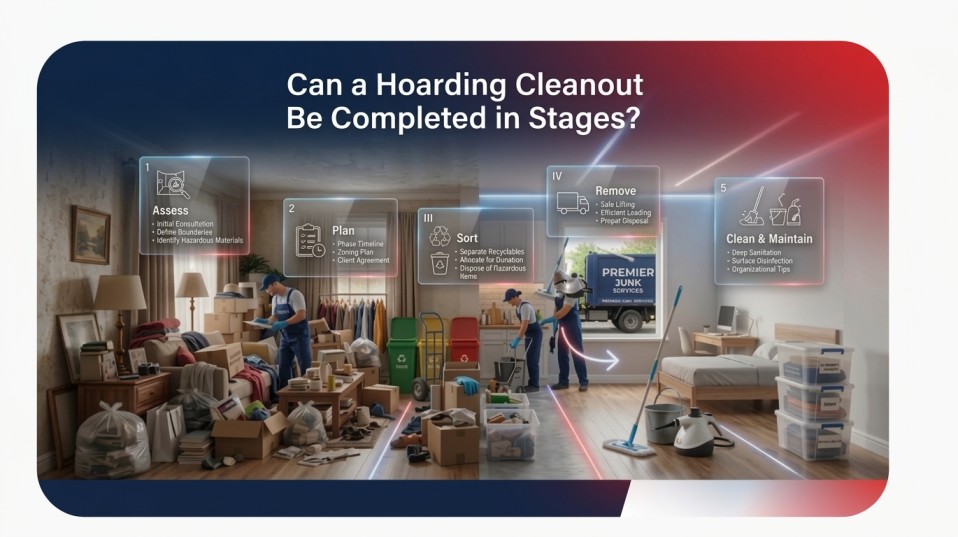
Yes. A hoarding cleanout in stages is normal, and most projects are handled that way rather than as one large haul-out. Phasing lets a crew clear safety hazards first, gives the resident time to make sorting decisions, and spreads labor and disposal across visits. Whether staging fits your property depends on hazards, occupancy, and deadlines.
What matters most when deciding:
- Safety-critical work (exits, walkways, fire and biohazard risks) should be handled in the first phase, not saved for later.
- Occupied homes usually benefit from staging; vacant properties with a fixed deadline often do not.
- Staging can raise the total cost slightly because each visit carries its own labor and travel, while making each payment smaller.
- The gap between visits is where progress is most often lost, so each phase should end with a scheduled next visit.
Why a Staged Cleanout Often Works Better Than a Single Haul-Out
Hoarding cleanup is not a volume problem alone. It is a decision problem layered on top of a volume problem, and decisions take time.
In a standard junk removal job, the customer has already decided what leaves. In a hoarded home, most items have not been reviewed in years. When a resident or family member is reviewing belongings item by item, the pace is set by how quickly those calls can be made, not by how fast a crew can load a truck. Sorting fatigue is real. After a few hours, most people start making decisions they regret or stop making decisions at all. A shorter session with a clear finish line usually produces more removed material over the full project than one exhausting marathon.
Staging also solves practical access problems. Crews often cannot reach interior rooms until perimeter paths are cleared. Narrow walkways, blocked stairs, and stacked doorways mean the first phase is partly about creating room to work. Disposal has its own constraints as well: transfer stations and landfills keep set hours, loads have weight limits, and materials that need separate handling have to be identified before they go on a truck.
Finally, phasing gives the household a chance to see what a cleared room looks like before committing to the whole property. For many residents, that first cleared room is what makes the rest of the project possible.
When a Room-by-Room Approach Makes the Most Sense
Room-by-room hoarding cleanup tends to be the better fit when:
- The home is occupied, and the resident needs a functioning kitchen, bathroom, and bedroom throughout the project.
- The resident is participating in sorting decisions rather than delegating them.
- Volume is high relative to access, such as a two-story home with one narrow stairway or a property with limited truck parking.
- Several people need to be involved adult children, a spouse, a case worker, or a property manager and their schedules do not line up on a single day.
- Documents, medications, or items with possible sentimental or financial value are expected in the piles and need careful review. Nobody can promise what will turn up, but rushing guarantees things get missed.
- Pest treatment or odor work has to happen between phases, which requires waiting periods that cannot be compressed.
When a Single-Visit Cleanout Is the Better Choice
A full cleanout in one mobilization is often the stronger option when:
- The property is vacant, and no one needs to live in it during the work.
- A hard deadline is in place: an eviction date, a code enforcement compliance window, a closing date, or a probate timeline.
- Sorting decisions are already made, or an executor or authorized family member has full authority to clear the contents.
- Conditions are severe enough that partial work leaves real risk behind, such as sewage contamination, heavy animal waste, or an active infestation. Clearing half a contaminated home can leave the remaining hazard in place for weeks.
- Re-cluttering between visits is a known pattern for that household, based on prior attempts.
A walkthrough is what settles this. Two homes with identical square footage and similar pile heights can call for opposite approaches once occupancy, deadlines, and contamination are factored in.
What Are the Stages of a Hoarding Cleanout?
These stages describe the sequence of work, not necessarily separate appointments. A single-visit cleanout still moves through the same order, only compressed. In a staged project, each visit typically covers stages two through four for a defined zone, with cleaning and inspection near the end of the project.
Stage 1: Assess the Property and Identify Hazards
The project starts with a walkthrough rather than a truck. An assessment normally covers:
- Pile height and depth, floor visibility, and how much of each room is reachable
- Condition of exits, stairs, windows, and hallways
- Utility status: working water, power, gas, heating, and cooling
- Signs of pests, mold growth, water damage, animal or human waste, and sharps
- Structural concerns such as sagging floors, weight-loaded upper levels, or blocked electrical panels and water heaters
- Unknown containers, chemicals, fuels, and anything that may need separate handling
- Access and logistics: driveway width, parking, distance from the door to the truck, and whether stairs or elevators are involved
- Whether other trades will be needed, such as pest control, plumbing, or mold remediation
This is also when the phase plan is drafted: which zones come first, roughly how many visits are realistic, and what each visit is meant to accomplish. Scope varies by provider, so confirm which of these items a company handles directly and which they coordinate or refer out.
Stage 2: Clear Emergency Exits and Immediate Safety Hazards
The first physical work is not the most cluttered room. It is the path in and out.
Crews normally start by opening front and rear doors, clearing hallways and stairways to a usable width, freeing at least one window per sleeping area, and creating clearance around the electrical panel, water heater, furnace, and any space heaters. Spoiled food and obvious biohazard material are typically pulled in this phase as well, since they attract pests and worsen quickly. The full priority order is covered in the next section.
The goal of this stage is simple: the home should be safer at the end of the first visit than it was at the start, even if it does not look dramatically different yet.
Stage 3: Sort Belongings: Keep, Donate, Recycle, Discard
Sorting works best with defined stations and a defined decision-maker. Before work starts, everyone should know who has authority to say an item leaves the resident, an executor, a property owner, or a family member acting with the resident’s agreement.
A workable setup uses four destinations plus one buffer:
- Keep moved to a cleared zone, not back into the working area
- Donate set aside for evaluation. Some usable items may be suitable for donation depending on condition and local acceptance policies, and organizations often decline upholstered furniture, mattresses, and anything with odor or staining.
- Recycle metal, cardboard, and some electronics may be recyclable depending on material type and what local facilities accept
- Discard bagged or loaded for removal.
- Undecided: a limited number of boxes for items the resident cannot rule on yet, with a date set to revisit them
Personal documents, identification, medications, keys, cash, jewelry, and photographs surface often during hoarding cleanouts. These should be collected and returned to the resident or the responsible family member rather than sorted alongside general contents.
Stage 4: Remove Trash and Unwanted Items
Once decisions are made, removal is straightforward labor: bagging loose debris, breaking down what needs breaking down, carrying items out, and loading for transport.
A few realities shape this stage. Weight and volume are different limits, and dense material such as books, tile, soaked textiles, or water-damaged furniture reaches a weight limit long before the truck looks full. Large furniture and appliances may need disassembly, and stairs, narrow doorways, and long carries add labor time. Restricted materials chemicals, fuels, paint, pesticides, propane, and similar items are typically set aside for handling that matches company policy and applicable regulations rather than loaded with general waste.
Multiple loads are common on a single visit. Waste should leave with the crew at the end of each phase rather than sitting in bags on the property between visits.
Stage 5: Deep Clean, Sanitize, and Deodorize
Cleaning happens after contents are out, because surfaces cannot be reached until then. Depending on conditions, this can include hard-surface cleaning, floor treatment, cabinet and appliance interiors, disinfection of affected areas, odor source removal, and attention to vents and filters where dust and odor have collected.
Deeper conditions call for specialized work. Sewage contamination, heavy animal waste, mold growth, and similar situations fall under remediation rather than cleaning, and they follow different procedures and protective requirements. Confirm what level of cleaning and sanitizing a provider performs, since this varies widely across companies.
Stage 6: Final Inspection and Repair of Remaining Damage
The last stage is a walkthrough of what the clutter was hiding. Common findings include damaged flooring and subfloor, drywall damage, slow plumbing leaks, pest damage, damaged or unsafe wiring, and non-functioning fixtures.
Repairs are usually handled by licensed trades and quoted separately from cleanup. Documentation matters here too. Landlords, executors, insurers, and code enforcement officers often want before-and-after photos and a written summary of what was removed and cleaned, so it is worth asking upfront whether a provider supplies that.
What Should Be Removed First From a Hoarding Home?
Priority is set by risk, not by which room bothers people most. The order below is the one most professional crews follow.
Blocked Walkways, Doorways, and Emergency Exits
Anything obstructing movement through the home comes out first. That means front and back doors, interior hallways, stairways, and the route from each sleeping area to an exit. Windows that serve as secondary escape routes count as exits. Blocked exits are the single condition most likely to turn a house fire or medical emergency into a fatal one, and they also prevent emergency responders from reaching a resident.
Fire, Trip, and Structural Hazards
Next comes anything that raises the chance of a fire or a fall, or that puts load where load does not belong:
- Combustible material stacked near stoves, water heaters, furnaces, space heaters, dryers, or light fixtures
- Blocked electrical panels, covered outlets, daisy-chained extension cords, and cords running under piles
- Piles above chest height, unstable stacks, and anything leaning against a door or stairway
- Heavy accumulation on upper floors, in attics, or on stair landings
- Loose material on stair treads and in the path between rooms
- Blocked or buried smoke alarms and vents
Food Waste, Biohazards, and Pest-Attracting Materials
Organic and contaminated material is time-sensitive and gets worse on its own. This category includes spoiled food and food packaging, standing water, soiled bedding and clothing, animal waste and urine-saturated flooring, and human waste where plumbing has failed.
This is where do-it-yourself work should stop. Do not open unknown containers, handle sharps or needles, disturb suspected mold, or enter areas with strong chemical or sewage odors. These conditions require protective equipment, specific procedures, and disposal handling that meets applicable rules. If any of this is present, the appropriate step is to have it assessed rather than moved.
How Do You Plan a Hoarding Cleanout in Stages?
Planning is what separates a staged cleanout from a series of stalled attempts.
Choose Which Zones to Address First
After safety work, most plans move through zones in roughly this order:
- Exit routes and hallways already covered in the first phase
- Bathroom a working, cleanable bathroom changes daily conditions immediately
- Kitchen: food safety, pest control, and a usable space for meals
- Primary sleeping area a clear bed, a clear path, and a clear window
- Main living area: the space that makes the home feel usable again
- Storage zones: spare rooms, closets, garage, attic, shed, and any vehicles
Sentimental-heavy zones are usually placed later, once the resident has practice making decisions on lower-stakes items.
Set a Realistic Goal for Each Visit
Each phase should have a written outcome, not an effort target. “Clear the kitchen floor, counters, and table, and empty the refrigerator” is a goal. “Get as much done as we can” is not, and it tends to end with an exhausted household and a half-finished room.
When setting goals, account for sorting speed rather than loading speed. If a resident is reviewing every item, a single room can take a full session. If the resident has delegated decisions, the same room may take an hour.
Decide Who Is Involved: Resident, Family, and Mental Health Support
Clarify three things before the first visit: who owns or controls the property, who has authority to approve items for removal, and who will be present during each phase.
Hoarding disorder is a recognized mental health condition, and cleanup that ignores that tends not to hold. Many households do better when a therapist, counselor, social worker, case manager, or professional organizer with hoarding experience is part of the plan. Hoarding disorder support and resources can also help residents and families find appropriate guidance and treatment options. Where an older or vulnerable adult is living in unsafe conditions, local adult protective services and municipal code offices are sometimes already involved, and coordinating with them is generally easier than working around them.
One principle applies throughout: forced discarding damages trust and often triggers rapid re-accumulation. A crew’s job is to execute decisions, not to overrule the person living there.
Leave the Home at a Safe Stopping Point Between Phases
Every phase should end in a defined safe state:
- Exits, walkways, and stairs remain clear
- The bathroom is usable, and the kitchen or a safe food-prep area is available
- No bagged waste, sorted piles, or removal-bound items are left in the home
- No exposed hazards are left uncovered: no loose sharps, no open containers, no disturbed contaminated material
- The next visit is on the calendar before the crew leaves
That last point does more work than it looks like it does.
Can Someone Keep Living in the Home During a Staged Cleanout?
Often yes, and for many households that is the reason staging is chosen. But occupancy depends on conditions, not preference.
When the Home Can Safely Remain Occupied
Staying in place is usually workable when the home has functioning water and a usable bathroom, working power and adequate heating or cooling, a safe way to store and prepare food, clear exit routes, no sewage or heavy animal waste contamination, no active infestation requiring treatment, and no structural concerns.
When Temporary Relocation Is Safer
Relocation, even for a few days, is the safer call when the property has sewage backup or failed plumbing, heavy animal or human waste, significant mold growth, no working utilities, an infestation requiring chemical treatment with re-entry restrictions, strong chemical odors or unidentified spills, or floor and stair damage. It is also worth considering when a resident has a respiratory or immune condition that makes dust and contaminant exposure during the work a genuine concern.
This is a decision to make with the household and, where health is a factor, with a medical provider rather than a cleanup crew alone.
Maintaining a Safe Living Zone Between Phases
If the resident stays, establish one fully cleared zone early and protect it. A workable safe zone includes a clear bed and floor, a clear path to the bathroom and to an exit, working lighting, and a defined place for medications, documents, phone, charger, and keys.
The rule for the safe zone is that nothing comes back into it. It functions as both a practical base and visible proof that a cleared room can stay cleared.
What Are the Risks of Splitting a Hoarding Cleanout Into Stages?
Staging is usually the right approach, but it carries specific downsides worth planning around.
Re-Cluttering and Backsliding Between Visits
This is the main risk. Long gaps between phases give accumulation time to resume, and cleared rooms can partly refill before the next visit. It can also work in reverse: items already sorted for removal get retrieved from the pile and moved back into the home. Both patterns are common, and neither means the project has failed, but each one adds visits and cost.
Longer Overall Timeline and Cumulative Cost
Every visit carries its own setup: crew mobilization, travel, protective equipment, re-orientation to where work stopped, and a separate disposal run. A project split across six visits absorbs that overhead six times. The work also stretches over weeks or months instead of days, which matters when a sale, a lease turnover, or a family member’s availability is on the line.
When a Deadline Rules Out Staging (Eviction, Code Enforcement, Property Sale)
Some situations do not leave room for phases. Eviction dates, code enforcement compliance windows, closing dates, probate deadlines, and insurance requirements are set by other parties. If a fixed date is within a few weeks and the volume is high, a concentrated cleanout with a larger crew is usually the realistic path, even if a staged approach would have been gentler. Bring any known deadline to the initial walkthrough, since it changes the plan more than almost any other factor.
How to Prevent Regression Between Phases
Practical measures that hold up in real projects:
- Schedule the next visit before the crew leaves the property
- Keep intervals short; closer together sustains momentum better than monthly visits
- Remove all waste at the end of every phase so nothing can be reclaimed
- Apply a one-in, one-out rule to cleared rooms
- Pause incoming volume where possible: mail, deliveries, and free-item pickups
- Photograph each cleared room at the end of a phase and compare at the start of the next
- Keep mental health or organizing support involved through the gaps, not only on work days
- Give the resident a defined role in each phase so the project stays theirs
How Long Does a Staged Hoarding Cleanout Take?
There is no standard duration, and any company quoting a timeline without seeing the property is guessing. What follows is planning guidance, not a schedule.
How Hoarding Level and Clutter Volume Affect the Timeline
Cleanup professionals commonly describe severity on a five-level scale, from light clutter with clear exits up to conditions involving structural damage, waste accumulation, and non-functioning utilities. Severity affects pace more than volume does. Lighter conditions are largely a removal job. At the upper levels, the crew is working in protective equipment, moving more slowly, handling contaminated material separately, and coordinating other trades, so the same square footage can take several times longer.
Volume matters in a specific way too: what fills a room is less important than how much of it needs individual review.
How Home Size Changes the Number of Phases
More rooms means more phases, but the count depends on which spaces are in scope. A small apartment may need two or three visits. A three-bedroom house with a full garage, a floored attic, a shed, and a stored vehicle can involve considerably more, because each of those is effectively its own zone with its own access constraints.
How Biohazards, Pests, and Structural Damage Add Time
These conditions add time in ways that cannot be compressed by adding crew:
- Pest treatments have application and re-entry waiting periods, and sequencing matters; sometimes treatment comes first, sometimes removal does
- Contaminated material requires separate handling and disposal routing
- Protective equipment slows work and requires breaks
- Mold and sewage conditions may require remediation before general removal continues
- Structural concerns can restrict where crews are allowed to work until assessed
Typical Phase Length and Visit Frequency
Most crews plan phases in half-day or full-day blocks. Sorting-heavy visits often run shorter, because decision fatigue sets in well before the crew runs out of energy. Removal-heavy visits, where decisions are already made, run longer and clear more.
Weekly or twice-weekly visits generally maintain the best momentum. Longer gaps raise the chance of backsliding. A realistic schedule comes out of the walkthrough, and it should be revisited after the first phase, since the first visit reveals how fast sorting actually goes for that household.
How Much Does a Staged Hoarding Cleanout Cost in Texas?
Hoarding cleanup is priced per project, not from a rate card. Pricing structures vary between providers, so ask how an estimate is built before comparing numbers.
What Drives Hoarding Cleanup Pricing
The factors that move a hoarding cleanout cost in Texas up or down:
- Volume and weight of material removed, and how many loads that requires
- Hoarding severity level, which drives labor hours, protective equipment, and procedures
- Home size and number of zones, including garages, attics, outbuildings, and vehicles
- Labor hours and crew size, including time spent supporting sorting decisions
- Access — stairs, narrow doorways, long carries, parking distance, elevator use
- Biohazard or contamination conditions requiring specialized handling
- Disposal requirements, including facility fees, weight-based charges, and materials that must be routed separately
- Specialty needs such as pest control, odor treatment, or remediation
- Travel distance to the property and to appropriate disposal facilities
Any figure given before a walkthrough is a range, not a quote. Written estimates after an on-site assessment are what you can plan against.
Does Staging Cost More or Less Overall?
Total project cost for a staged cleanout is often somewhat higher than the same work done in one mobilization, because setup, travel, and disposal runs repeat with each visit. The per-visit cost is lower, which is a different thing from the total being lower.
What is worth clarifying with any provider:
- Is the estimate for the full project or per phase?
- Is each phase a fixed price or an estimate that adjusts with actual volume?
- How is a change in scope handled when a phase reveals more material than expected?
- Are disposal fees included or billed separately?
- Are there charges for scheduling changes between phases?
How Phasing Can Help Spread the Budget
Phasing turns one large expense into a series of smaller ones, which is often the deciding factor for households paying out of pocket. It also lets you buy the most important work first. If the budget is limited, the first phase should cover exits, walkways, and biohazard removal, since that is where the safety return is highest.
Phasing can also align with funding that arrives on its own schedule, an estate settlement, an insurance determination, a landlord’s approved budget, or family contributions. If timing is a constraint, say so during the walkthrough so the phase plan can be built around it rather than adjusted mid-project.
Do You Need a Professional for a Staged Cleanout?
Not every cluttered home requires a professional crew. But hoarding conditions and general clutter are different problems, and the gap matters for safety.
Why Hoarding Cleanup Isn’t the Same as Junk Removal
Standard junk removal handles identified items that a customer has already decided to part with: a couch, an old refrigerator, garage overflow, renovation debris. The scope is known before the truck arrives.
Hoarding cleanup differs in ways that change how the work is done:
- Contents are largely unreviewed, so sorting is part of the job
- Conditions are unknown until material is moved, including pests, waste, water damage, and structural issues
- Protective equipment and contamination procedures are often required
- The resident’s participation and consent shape the pace and the outcome
- Documents, medications, and valuables are frequently mixed into general clutter
- Disposal is more complex, with more material needing separate routing
- Discretion and respect for the household are part of the service, not an add-on
If you are weighing options, look at hoarding cleanout services specifically rather than assuming a general hauling quote covers the same scope.
When DIY Staging Becomes Unsafe
Family-led staging can work for lighter conditions with a clear floor, working utilities, and no contamination. Stop and bring in professionals when any of these are present:
- Piles above chest height, or floors not visible across most of a room
- Animal or human waste, urine-saturated flooring, or sewage backup
- Active pest infestation, including rodents, roaches, or bed bugs
- Suspected mold growth or strong musty odor
- Sharps, needles, or broken glass mixed into piles
- Unlabeled chemicals, fuels, propane tanks, or leaking containers
- Blocked exits or unsafe stairs
- Heavy appliances or furniture that cannot be moved safely by the people present
- Any structural concern, including soft or sagging floors
Injuries during self-directed hoarding cleanup are common and mostly preventable. Falls, cuts, back injuries, and respiratory irritation account for most of them.
How Professional Crews Work Discreetly Across Multiple Visits
Privacy is a legitimate concern, and it is reasonable to ask how a company handles it. Useful questions: how vehicles are parked and how visible the work is from the street, how loading is timed and staged, whether the same crew returns for each phase, how photographs and project records are stored and shared, and who a crew is permitted to speak with about the project.
Continuity is worth asking about specifically. A crew that already knows the property, the plan, and the household’s preferences works faster and asks fewer repeat questions than a new team each visit.
Texas Hoarding Cleanout Requirements
Texas Waste Disposal and Contaminated Material Rules
Municipal solid waste handling in Texas is regulated at the state level by the Texas Commission on Environmental Quality, while individual landfills, transfer stations, and recycling facilities set their own acceptance policies. That combination is why disposal answers vary from one part of the state to another.
Categories that commonly require handling separate from regular waste include household hazardous materials such as paints, solvents, pesticides, and fuels; appliances containing refrigerants, which are subject to federal recovery requirements; electronics; scrap tires; medical waste and sharps; and any material suspected to contain asbestos, which has its own notification and handling rules. Contaminated material from a hoarded property may also need routing that differs from general household waste.
Because requirements differ by city, county, and receiving facility, confirm disposal handling with your provider before work begins rather than after a load is on the truck. Do not transport unknown chemicals or suspected hazardous material yourself.
Choosing a Licensed and Insured Texas Provider
Questions worth asking any Texas hoarding cleanup company:
- Insurance. Ask for current proof of general liability coverage. Ask about workers’ compensation as well, since Texas does not require most private employers to carry it meaning coverage varies between companies.
- Scope in writing. A written scope for each phase, with what is included and what is billed separately.
- Biohazard capability. Whether contamination and biohazard conditions are handled in-house or referred out, and what procedures are followed.
- Disposal handling. Where material goes, how restricted items are managed, and whether disposal documentation is provided.
- Hoarding-specific experience. Whether crews have worked occupied hoarding projects with resident participation, which is different from vacant cleanouts.
- References and reviews for hoarding work specifically rather than general hauling.
You can read more about American Valor Waste & Disaster Services before an initial conversation, and it is fair to ask any provider these questions directly.
FAQ
Can I stop halfway through a hoarding cleanout?
Yes, as long as the home is left in a safe state clear exits and walkways, a usable bathroom, working utilities, and no waste or exposed hazards left behind. The practical risk is not stopping; it is stopping without a scheduled return date. Confirm with your provider how a pause affects the estimate and whether pricing changes if the gap runs long.
How many visits does a hoarding cleanout usually take?
It depends on severity, home size, how much material needs individual review, and whether contamination is involved. A small apartment may take two or three visits, while a full house with a garage, attic, and outbuildings can take considerably more. A walkthrough is what produces a realistic phase count.
Will the crew force me to throw things away?
No. Removal decisions belong to the resident or the authorized decision-maker. A professional crew’s role is to carry out those decisions safely, flag genuine safety hazards, and handle removal and disposal. Safety-critical items such as blocked exits and spoiled food do need to be addressed, but that is a conversation, not a demand.
Can we work around a resident who is still living in the home?
Usually, yes, provided the home has working utilities, a usable bathroom, safe food storage, clear exits, and no contamination or infestation requiring treatment. The standard approach is to establish one fully cleared safe zone early and protect it through every phase.
Does homeowners insurance cover hoarding cleanup?
Coverage is limited and policy-specific. Gradual accumulation is generally not a covered loss, though related sudden damage a burst pipe or sewage backup, for example may be treated differently depending on the policy. Check with your insurer or agent before assuming cleanup costs are covered, and ask any provider what documentation they supply for a claim.
Planning Your Own Staged Cleanout
A hoarding cleanout in stages is a normal, workable approach, and for occupied homes it is usually the better one. The parts that decide whether it succeeds are set early: hazards handled in the first phase, a defined goal for each visit, a protected safe zone, and the next appointment on the calendar before the crew leaves.
The one thing that cannot be planned remotely is scope. Severity, contamination, access, and deadlines change the phase plan more than square footage does, and all four need an on-site look.
To talk through your property and whether a staged or single-visit approach fits your situation, get in touch with the team to arrange a walkthrough and a written estimate. You can also learn more about the company’s cleanup and property services before reaching out.