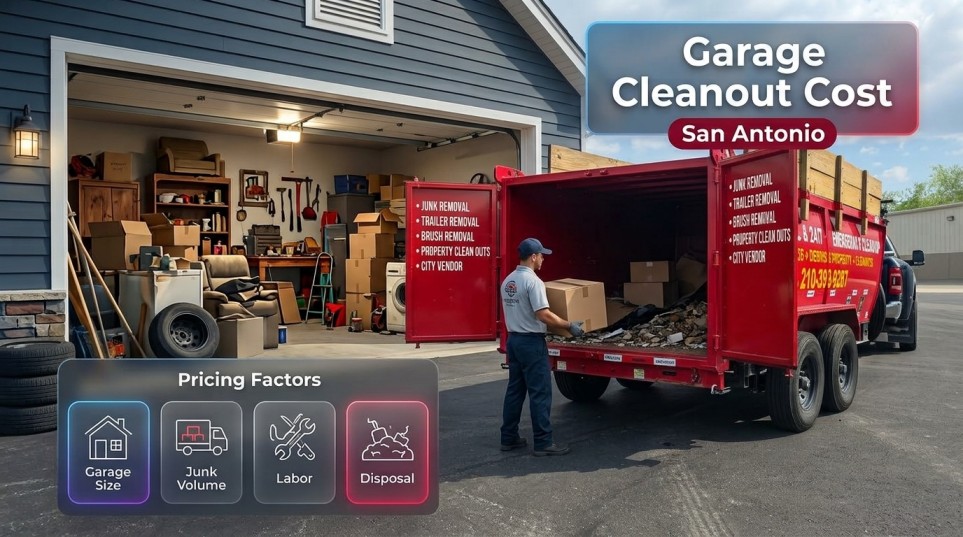
Most garage cleanout cost in San Antonio run between $150 and $900. A quick pickup of a few large items usually lands near the bottom of that range. A two-car garage packed wall to wall usually lands at the top, and sometimes above it if the load needs more than one trip.
The reason the range is that wide is simple. Garage cleanout pricing is based on how much truck space your junk takes up, not on how long the crew is there. Two garages that look equally full can price differently depending on what is inside them, how it is stacked, and how far the crew has to carry it.
This guide walks through what a garage cleanout actually costs here, what pushes the price up, what a junk removal crew is not allowed to haul, and how to get an accurate number before anyone starts loading. If you already know what you need and just want a price, you can go straight to our garage cleanout service page.
What a Garage Cleanout Cost in San Antonio
Key Takeaways
- Typical range: $150 to $900 for most residential garages, depending on volume.
- Pricing is set by truck space used, not by the hour.
- Construction debris is priced by weight, not volume, so it is quoted separately.
- The numbers below are planning ranges. Your final price is confirmed on site before loading starts.
Here is what garage cleanouts generally cost in the San Antonio area, sorted by how much of the garage you are clearing.
| Garage Situation | Typical Range | What That Usually Means |
|---|---|---|
| Partial cleanout, one corner or a few large items | $150 to $300 | A quarter truck or less, often done in under an hour |
| One-car garage, moderately cluttered | $300 to $500 | Roughly a half truckload, walkable floor space remaining |
| Two-car garage, moderately cluttered | $450 to $700 | Half to three-quarter truck, most of the floor still visible |
| Two-car garage, packed wall to wall | $600 to $900 | A full truckload, and sometimes more than one trip |
| Garage plus an attached shed or workshop | $700 to $1,200 | Multiple loads, often with tools and heavy equipment |
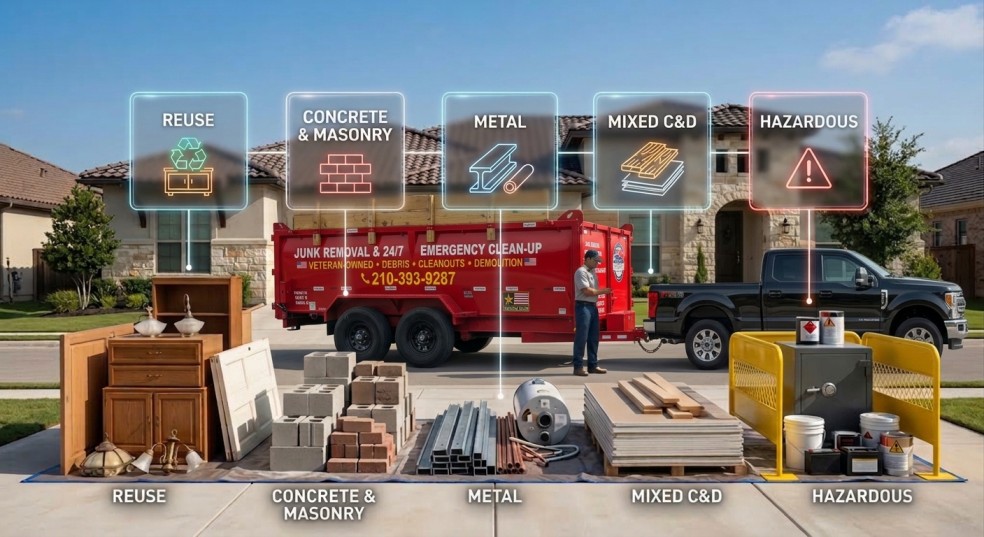
| Garage with construction debris or cabinetry | Priced separately by weight | Drywall, lumber, and concrete are charged differently than household junk |
Treat those as planning numbers rather than a quote. We confirm the real price on site, after we see the load and before we pick anything up. Nobody should be guessing at the end of the job, and you should never get a surprise number after the truck is full.
Why Garage Cleanouts Are Priced by Truck Space, Not by the Hour
Volume pricing protects you. Your price is tied to the fraction of the truck your items fill: a quarter, a half, three quarters, or the whole bed. Once that is agreed, the price does not move because the crew hit a jammed garage door or a long carry from the back of the driveway.
Hourly pricing does the opposite. It quietly charges you for a difficult garage, a hot afternoon, or a slow day. It also gives you no way to compare quotes, because nobody can tell you in advance how many hours a garage will take.
There is one real exception, and it is worth knowing about. Heavy debris is priced by weight instead of volume. Concrete, brick, dirt, roof shingles, and tile can max out a truck’s legal weight limit while barely filling a corner of it, and disposal facilities charge by the ton for that material. So a small pile of concrete can cost more than a large pile of empty boxes.
What a Partial Cleanout Costs Versus Clearing Everything
A partial cleanout is the cheapest option, but only if you actually keep it partial. Clearing one corner, hauling off an old fridge and a broken treadmill, or pulling out the pile of boxes along one wall usually falls in the $150 to $300 band. That is a quarter truck or less.
Clearing everything down to bare walls is priced on the full volume, so it lands in the $450 to $900 range for most one- and two-car garages. The trade is convenience. One appointment, one price, and a garage you can park in that evening.
The option that surprises people is the middle one, where you want to keep some things and clear the rest. That is completely doable, and we handle it constantly. But two half cleanouts almost always cost more than one full cleanout, because every visit carries its own minimum charge and its own trip to the disposal site. If you think you will need us back in a month, it is usually cheaper to decide now and do it once.
What Is Actually in Your Garage Changes the Price
Key Takeaways
- Volume sets the base price. Weight and handling difficulty adjust it.
- Heavy, dense items cost more than their size suggests because disposal is charged by the ton.
- Empty boxes and plastic bins are cheap to move but eat truck space fast.
- Tires and construction debris are quoted as separate line items.
Two garages can look identical from the driveway and price several hundred dollars apart. What separates them is the contents. Here is how the main categories affect a garage junk removal quote.
Heavy Items That Take Up Little Space but Add Real Weight
Dense items cost more per cubic foot than almost anything else in a garage. A gun safe, a cast iron tub, a stack of floor tile, a pallet of leftover pavers, a tool chest full of hand tools, or twenty bags of hardened concrete mix will barely fill a corner of the truck. They will still push the load toward its legal weight limit, and the transfer station charges by the ton at the other end.
Home gym equipment is the classic garage version of this. Treadmills, weight benches, and racks of iron plates are heavy, awkward, and often need two or three people to move safely. Please do not try to drag these out to the driveway yourself. Tell us they are in there when you request the quote so we can send the right number of people and the right equipment.
Bulky Items That Fill the Truck Fast
Bulk is what usually decides your bracket. The items that eat truck space fastest in a garage are old sofas and mattresses being stored out there, patio furniture, kids’ play sets and plastic slides, kayaks and canoes, particle board shelving units, exercise bikes, and lawn equipment.
Here is the one most people miss. Empty cardboard boxes and plastic storage bins are almost weightless, but they take up enormous volume. A wall of flattened boxes is fine. A wall of assembled boxes can move you from a half truck to a three-quarter truck by itself. If you have the time, break the cardboard down and put it in your curbside recycling cart. It is one of the easiest ways to lower your bill.
Tires, and Why They Are Charged Separately
Scrap tires are regulated separately in Texas, so they carry their own disposal fee. Landfills will not take them mixed in with household junk, and licensed tire disposal sites charge per tire. That fee gets passed through as a line item rather than folded into your volume price.
A few things affect that number. Passenger tires cost less to dispose of than truck tires. Tires still mounted on rims sometimes cost more, because the rim has to be separated before recycling. Tractor, trailer, and equipment tires are a different category again, and not every disposal site accepts them. If you have a stack of old tires in the corner, count them and tell us the count and the type when you call. It takes ten seconds, and it makes your quote accurate.
Cabinets, Lumber, and Remodel Leftovers
Remodel leftovers are construction debris, and construction debris is priced by weight. That includes drywall scrap, cut lumber, old kitchen cabinets stacked in the garage after a renovation, countertop pieces, tile, grout bags, and broken concrete. Disposal facilities weigh and charge that material differently than household junk, so we quote it as its own scope instead of guessing at a volume price.
One important distinction. Junk removal is hauling, not demolition. If your cabinets are stacked on the garage floor, that is a standard haul away. If they are still bolted to the wall, still plumbed, or still wired, that is removal work and a different conversation. The same goes for built-in shelving anchored into studs. Mention it when you book so we plan the job correctly instead of discovering it on arrival.
Loose lumber deserves one safety note. Old boards from a deck or a framing job usually still have nails in them. Leave that pile where it is and let the crew handle it with gloves and proper footwear.
What a Junk Removal Crew Cannot Legally Take From Your Garage
Key Takeaways
- Hazardous household waste cannot go on a junk removal truck. That is regulation, not company preference.
- San Antonio residents can drop most of it free at the Environmental Recycling Center on Culebra Road.
- You need a recent CPS Energy bill and a photo ID, and the site is for households only.
- Electronics have no weight or quantity limit at that facility.
- Pulling these items out before your appointment keeps your cleanout on schedule.
Every junk removal company in Texas is limited on hazardous materials, and it has nothing to do with willingness. Fuels, chemicals, and pressurized containers are regulated waste. They cannot be transported by a standard hauler, and the transfer stations that receive our loads will reject them. Garages are where most households store exactly this kind of thing, so it comes up on almost every garage cleanout we do.
Here is what has to stay off the truck, why, and where it goes instead.
| Item | Why It Cannot Go on the Truck | Where It Goes Instead |
|---|---|---|
| Oil-based paint, stains, and solvents | Classified as household hazardous waste | Environmental Recycling Center, 7030 Culebra Road, free with a CPS Energy bill and photo ID |
| Latex paint | Not hazardous, but it cannot be hauled wet | Dry it out with hardener or kitty litter, then it goes in your regular trash |
| Motor oil, antifreeze, and brake fluid | Automotive fluids contaminate landfills | Environmental Recycling Center, or many auto parts stores take used oil |
| Car and marine batteries | Corrosive and contain lead | Environmental Recycling Center, or the retailer where you buy the replacement |
| Propane tanks and camping canisters | Pressurized and a fire risk in a compactor | Exchange programs, or the Environmental Recycling Center |
| Pesticides, herbicides, and pool chemicals | Regulated hazardous materials | Environmental Recycling Center or a monthly drop-off event |
| Gasoline and old fuel cans | Flammable and cannot be transported by a hauler | Environmental Recycling Center only |
| Electronics and old TVs | Contain heavy metals and require e-waste processing | Environmental Recycling Center, with no quantity or weight limit |
| Ammunition and fireworks | Explosive hazard | Contact the San Antonio Police Department for disposal guidance |
If you find a container you cannot identify, do not open it and do not pour anything from one container into another. Set it aside where nobody will knock it over and ask the city’s household hazardous waste line what to do with it. If a container is leaking, bulging, or badly corroded, leave it alone entirely and call 311 for guidance.
How the Free Environmental Recycling Center Works
San Antonio runs a permanent household hazardous waste drop-off at 7030 Culebra Road, and for qualifying residents it is free. It is open Tuesday through Friday from 8:00 a.m. to 5:00 p.m., and Saturday from 8:00 a.m. to noon. It is closed Sunday and Monday, which catches a lot of weekend declutterers by surprise.
There are two requirements. First, the program is for residents who live inside the San Antonio city limits and pay the environmental fee on their CPS Energy bill. Second, you have to bring a recent copy of that CPS bill along with a photo ID as proof of residency. Without both, they will turn you away at the gate.
A few other details worth knowing. The facility is for households only, so businesses, churches, and schools cannot use it for their waste. Electronics are accepted with no weight or quantity limit, which makes it the easiest answer for the stack of old monitors and tube TVs that lives in most garages. And if you live outside the city limits, in places like New Braunfels, Cibolo, or Fair Oaks Ranch, check your own city or county program before you load up the car, because access rules are not the same everywhere in Bexar County and the surrounding area.
Hours and accepted-item lists do change, so it is worth a quick look at the city’s solid waste page before you drive out there with a trunk full of paint cans.
Monthly and Quarterly Drop-Off Events
If Culebra Road is inconvenient, the city also runs household hazardous waste collection events closer to home. These are typically held on the first Saturday of the month, with locations rotating around the city. During the spring and early summer months, the schedule often expands to the first Friday and Saturday. The city also holds larger mobile collection events on a quarterly basis.
The requirements are the same as the permanent site: proof of residency through a recent CPS Energy bill and a photo ID. Because the location changes month to month, confirm where the current event is being held before you go. Checking takes a minute and saves a wasted trip across town.
Sort These Out Before Your Cleanout Appointment
The single best thing you can do before a garage cleanout is pull the chemicals out of the pile. Not because the crew minds working around them, but because it keeps the job moving and prevents a situation where half the corner has to be left in place.
- Walk the garage once with a flashlight and check the back of every shelf. Aerosols, old fuel cans, and pool chemicals hide well.
- Group the containers into a sturdy box or plastic bin, keeping them upright and separated so nothing tips or mixes.
- Move that box out of the removal area and set it somewhere obvious, like the corner of the driveway or the back of your vehicle.
- If you are unsure whether something counts as hazardous, set it aside anyway and ask us when we arrive. We would rather answer the question than load something we should not.
- Plan one trip to the Culebra Road center or a monthly event, ideally before the cleanout so the garage is clear when we get there.
How Long a Garage Cleanout Takes
Key Takeaways
- Partial cleanouts often take under an hour. Most full garages run two to four hours.
- Access is the biggest time factor, more than the size of the pile.
- A garage plus a shed or workshop can take most of a working day.
- If a second trip is needed, we tell you before we make it, not after.
Most garage cleanouts are finished the same day. A partial job, meaning one corner or a handful of large items, is often done in under an hour. A moderately cluttered one-car garage usually takes one to two hours. A two-car garage packed to the walls typically runs two to four hours. A garage plus an attached shed or workshop can take most of a working day.
Those are realistic estimates from doing this work, not promises. Timing depends on the specific property, the crew’s schedule that day, and what we find once the door goes up.
What Determines the Time on Site
Carry distance matters more than most people expect. A garage with a short, clear driveway loads dramatically faster than one behind a narrow gate, up a slope, or down a long alley. Every extra step gets repeated a few hundred times over the course of a load.
- Access and parking. Where the truck can legally sit, and how far it is from the garage door.
- Stacking height. Items stacked to the ceiling need to come down carefully, especially loose boxes and stored furniture.
- Sorting decisions. If keep-versus-go is decided during loading, the crew stops constantly. That is the largest avoidable delay.
- Heavy or awkward pieces. Safes, gym equipment, and large appliances need a slower, safer approach.
- Weather. San Antonio summer heat genuinely slows heavy lifting, and safe crews take water breaks. Morning appointments help in July and August.
- Disassembly. Shelving units and workbenches that have to be broken down to fit through the door add time.
When One Trip Is Not Enough
Some garages simply hold more than one truck can carry. Wall-to-wall two-car garages, garages combined with a shed, and estate properties are the usual candidates. When a second load is needed, the truck has to drive to a disposal facility, unload, and come back, which adds real time to the day.
Two things we commit to here. First, you hear about a second trip before it happens, along with what it adds to the price. Second, if the disposal facility’s closing time makes a same-day second load impossible, we will say so and schedule the remainder rather than leaving you with a half-finished garage and no plan. For very large projects, staging the work across two days is often the cleaner option anyway.
How to Lower Your Garage Cleanout Price
Key Takeaways
- Decide what stays before the crew arrives. This saves the most time and money.
- Break down cardboard and stack loose items to shrink the volume you are paying for.
- Move only what is safe and light to the driveway. Leave the heavy pieces to us.
- Handle hazardous items separately so nothing gets left behind.
Three things move a garage cleanout price, and all three are in your control. How much volume goes on the truck, how quickly the crew can work, and whether anything has to be left behind and dealt with later.
Decide What You Are Keeping Before We Arrive
This is the biggest one. When a customer is still deciding during the load, the crew stops after nearly every item to ask. That turns a two-hour job into a four-hour job, and it is also how keepsakes end up on a truck by mistake.
The simplest system that works: put a strip of blue painter’s tape on everything you are keeping, or move the keepers into one taped-off corner of the garage. Then we clear everything else without a single question. If a whole shelf is staying, tape the shelf and tell us at the walkthrough.
Move What You Can to the Driveway
Staging light items outside shortens the carry and speeds up the load. Boxes, bags, small furniture, and loose clutter are all fine to move if you can do it comfortably. It also helps us give you a more accurate on-site quote, because we can see the true volume instead of estimating around a wall of stacked bins.
Stick to what is genuinely safe. Leave the appliances, the safe, the gym equipment, the tall shelving, and anything overhead exactly where it is. Those are the items we bring people and equipment for. A saved hour is not worth a back injury or a dropped water heater.
While you are at it, flatten the cardboard and consolidate loose items into fewer containers. Reducing air in the pile directly reduces the truck space you pay for. It is the closest thing to a free discount in this business.
Pull Out the Hazardous Items First
Handling the paint, fuel, and chemicals yourself prevents the one outcome nobody wants: a cleared garage with a pile of restricted items still sitting in the corner. Use the Culebra Road center or a monthly collection event, take a photo of what is left, and you will know the garage will be genuinely empty when we pull away.
A couple of other habits worth building in before the appointment. Anything with real resale value is usually worth listing before a cleanout rather than after, because once it is loaded, it is gone. And some usable items may be suitable for donation depending on their condition and what local organizations are accepting at the time, so it is worth a call to your preferred charity if a specific piece matters to you.
Frequently Asked Questions
Do I need to sort my garage before the crew arrives?
No. Sorting is not required, and we clear plenty of garages exactly as they sit. That said, two kinds of sorting genuinely help. Separating what you are keeping prevents mistakes and speeds up the job, and pulling out hazardous items like paint, fuel, and pool chemicals is necessary because those cannot legally ride on the truck.
What if I want to keep some things and clear the rest?
That is one of the most common requests we get, and it is easy to accommodate. Mark the keepers clearly before we arrive, ideally with painter’s tape or by moving them into one designated corner. Then walk us through it for two minutes at the start so both sides are working from the same understanding. Partial cleanouts are priced on the volume that actually leaves, so keeping more items usually means a lower price.
Will you take the shelving and workbench too?
In most cases, yes. Freestanding shelving units, metal racks, workbenches, and storage cabinets are standard garage cleanout items. If a unit is bolted to the wall or the floor, or if a workbench is built into the structure, tell us when you book so we can plan for the disassembly. Anything that involves cutting into drywall, plumbing, or electrical is a different kind of work and needs to be discussed separately.
Can you do a garage cleanout if I am not home?
Often, yes. Unattended cleanouts work well when we can agree on the scope in advance, usually through photos or a video walkthrough, and when we have confirmed access to the garage along with any gate codes, alarm details, and instructions about pets. This is a popular option for landlords, property managers, and families handling a property from out of town. The one thing we always want in writing is exactly what stays, since we cannot ask you mid-job.
What happens to the stuff that is still usable?
We separate out what looks reusable rather than sending everything straight to disposal. Some usable items may be suitable for donation depending on their condition and what local organizations are accepting at the time. Metal items such as appliances, tools, and racking often go to scrap metal recycling, and electronics go through e-waste channels. What we will not do is promise that a specific item gets donated or recycled, because that depends on condition, current facility capacity, and local acceptance policies on the day.
Do you sweep the garage floor when you finish?
Yes. We clear the area we worked in and broom-sweep the floor before we leave, so you are not left picking up debris and cardboard scraps. It is a tidy-up rather than a deep clean. Oil stains, pressure washing, and floor prep for epoxy coating are separate services, so let us know in advance if that is what you are after.
Can you clear a garage full of a family member’s belongings?
Yes, and we handle these carefully. Estate and downsizing cleanouts are a regular part of this work, and there is usually no rush from our side. Our strong recommendation is to walk the space first and pull out anything personal before the appointment: documents, photographs, jewelry, military items, and small keepsakes have a way of hiding in garage boxes, and once a load is gone, we cannot retrieve it. If it helps, we can work in stages so the family has time to go through things between visits.
Get a Free Garage Cleanout Quote in San Antonio
Key Takeaways
- Quotes are free, and the price is confirmed on site before loading begins.
- Photos of the garage get you a realistic estimate faster.
- Mention heavy items, tires, and construction debris up front for an accurate number.
- We serve San Antonio and the surrounding communities, including New Braunfels, Cibolo, and the Hill Country suburbs.
The fastest way to get a real number is to show us the garage. Send a few photos from the doorway and from each back corner, mention anything heavy or unusual, and give us a rough count of tires or bags of construction debris if you have them. That is normally enough for a solid estimate before anyone drives out.
For larger projects, a garage combined with a shed, or an estate property, an on-site walkthrough is the better route. Either way, you get the price before the work starts, and it does not change unless the scope does.
American Valor Waste & Disaster Services handles residential and commercial cleanouts across San Antonio and the surrounding communities, including New Braunfels, Cibolo, Fair Oaks Ranch, Stone Oak, Alamo Heights, Terrell Hills, Olmos Park, Shavano Park, and Hill Country Village. If your project has grown past the garage, our junk removal and property cleanup services cover attics, sheds, whole-home cleanouts, and renovation debris as well.
You can request a free garage cleanout estimate whenever you are ready, or read a bit more about the crew behind the trucks first. Either way, take the ten minutes to mark what you are keeping. It is the difference between a good cleanout and a great one.