You can legally dispose of construction debris in Bexar County at a small set of approved sites:
- the City of San Antonio’s bulky waste collection centers, for small residential loads only
- Type IV construction and demolition (C&D) landfills such as Beck Landfill
- private landfills that take mixed and commercial volumes
- Material yards that accept clean concrete, dirt, and rock
A roll-off dumpster or a hauling service can also carry the debris to one of those sites for you. The right choice depends on what the material is, how much of it there is, and whether the load is residential or commercial. Whichever route you take, the load has to be secured for the drive. Leaving debris anywhere other than an approved site is a crime under Texas law.
Key takeaways
- The City’s bulky waste centers take up to one cubic yard of construction material and lumber. They are free for San Antonio residential customers who pay the City’s environmental fee. Contractors, commercial haulers, and trailers are not accepted.
- Larger and commercial loads go to a Type IV C&D landfill such as Beck Landfill or to a private landfill. You pay by weight, and some sites add a minimum load charge.
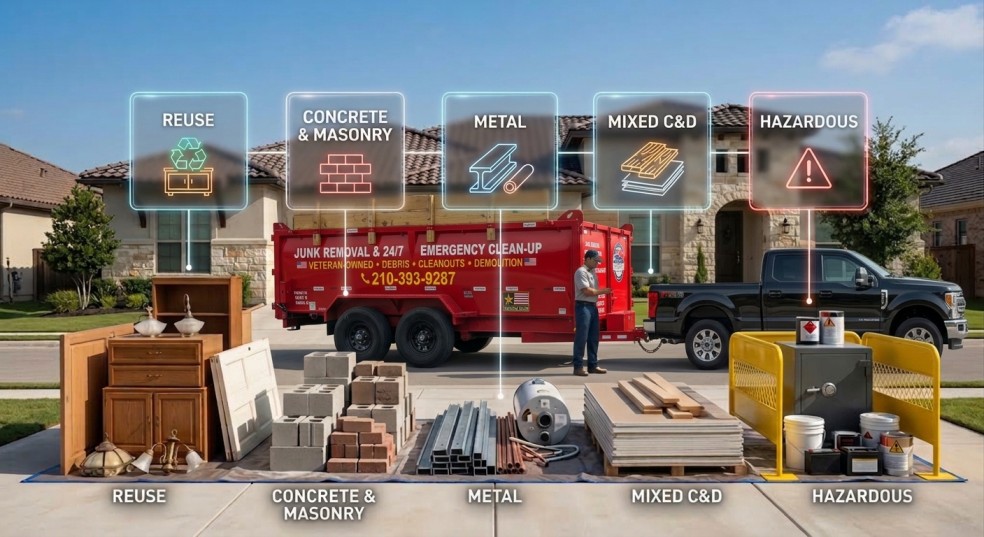
- Clean concrete, brick, asphalt, dirt, and rock usually belong at a material yard. Drywall, shingles, and mixed remodel debris belong at a C&D landfill. Paint and job site chemicals are hazardous waste and need a separate route.
- Every load must be covered and secured. Texas law also reaches people who allow or permit illegal dumping, not only the person who unloads it.
- If your project is bigger than the drop-off limits, or you don’t have a suitable vehicle, a dumpster or a hauling service can move the debris to an approved site.
Your Real Options for Construction Debris in Bexar County
Construction debris has six practical disposal routes in Bexar County. Private facilities set their own rates and change them, so the Cost column describes how each option charges, not what it charges. Call before you go.
| Where | What It Takes | Cost | Who Can Use It |
| City bulky waste collection centers | Up to one cubic yard of construction material and lumber | Free with a CPS Energy bill and photo ID | San Antonio residential customers only, no trailers |
| Beck Landfill | Full C&D loads plus clean inert materials | Charged by weight, with a minimum load charge | Anyone, including contractors |
| Private landfills such as Tessman Road and Covel Gardens | Mixed loads and commercial volumes | Per-ton gate rate | Anyone, including commercial haulers |
| Material yards | Clean concrete, dirt, rock, brick, and asphalt only | Often low cost, sometimes free for clean loads | Anyone, but loads must be uncontaminated |
| Roll-off dumpster | Debris accumulated over days or weeks | Flat rate plus tonnage overage | Anyone with driveway or approved street space |
| Full-service hauling | Debris you do not want to load or transport | Priced by volume and weight | Anyone |
Two things stand out. The only free option is also the smallest, and it is limited to residential customers. Access comes from the environmental fee on your CPS Energy bill, so the bill and a photo ID are part of the price of admission. Everything larger is priced by weight, so heavy materials like concrete and tile cost more to move than their volume suggests.
Roll-off dumpsters and full-service hauling solve a different problem. They change who loads and transports the material. With a dumpster, you fill it over days or weeks, and the provider delivers the contents to an approved site. With a hauling service, the crew does the loading and transport. American Valor Waste & Disaster Services serves San Antonio and surrounding communities throughout Bexar County, and its construction debris removal and dumpster rental services cover both approaches.
Neither is automatically cheaper. A dumpster can make sense when a project runs for weeks, and you have room to place it. Hauling can make sense for a one-time cleanup you’d rather not load yourself. Some dumpster providers set a tonnage limit and ask you to call before loading heavy material such as roofing, concrete, or soil. Tell any provider what is going in before it is loaded.
Why Construction Debris Has Fewer Options Than Household Junk
Household junk has a well-worn path. Furniture, mattresses, and large appliances can go out with the City’s scheduled bulky collection or to a drop-off center that accepts up to four cubic yards. Construction debris breaks most of those rules. It is dense, it is often mixed with materials that need different handling, and even a modest remodel can outrun a household system.
Because of that, disposal sorts itself by material and by weight. Some facilities accept only clean inert material. Some accept a broad range of construction waste. Hazardous waste needs its own route. That is why one remodel can involve two or three stops instead of one.
What the City Will and Will Not Take
The City’s programs are built for household waste. They are useful for small projects, but the limits are strict enough that many remodels outgrow them quickly.
Construction Debris Is Not Accepted at the Curb
San Antonio’s curbside brush and bulky collection runs twice a year for residential solid waste customers, with a door hanger showing your collection week. It is meant for household bulky items and brush. The City’s curbside program refuses concrete, construction and demolition material, roofing, and soil.
If construction debris ends up in a set-out pile, the City may refuse the pickup, charge extra collection fees, and issue fines under the solid waste code. The curb is not a place to stage remodel debris.
The One Cubic Yard Limit at Drop-Off Centers
The City runs four bulky waste collection centers at Bitters, Frio City Road, Culebra, and Rigsby Road, for residential customers only. They are open Tuesday through Saturday, with shorter Saturday hours, so confirm current hours on the City’s page before you drive. The main rules are:
- You need a recent CPS Energy bill showing payment of the environmental fee, plus a photo ID.
- Construction material and lumber are accepted up to one cubic yard. Bulky household items are allowed up to four.
- Material in a truck bed cannot be loaded above the fender wheel, and loads from commercial waste haulers are not accepted.
- Trailers are not accepted.
- Boards longer than ten feet, unbagged insulation, railroad ties, and hazardous material are refused.
A cubic yard is a cube three feet on each side. A gutted bathroom, or the flooring pulled from a couple of rooms, can pass that mark. The one-cubic-yard cap is the reason many remodel loads do not fit here, even though the visit itself is free.
Concrete, Soil, and Rocks Are Refused Outright
Soil, rocks, and concrete are on the bulky centers’ unaccepted list. Free Landfill Day excludes dirt and brick as well. These are among the heaviest materials on a job site, so the rule hits patio demolition, foundation work, driveway replacement, and landscaping projects hardest. Send them to a material yard or a C&D landfill instead. The material table below shows which fits which load.
Why Free Landfill Day Will Turn Your Load Away
Free Landfill Day is a City event held on selected dates at participating private landfills. It is for San Antonio residential solid waste customers who bring a recent CPS Energy statement. The name suggests a free dump for anything. The event is really meant for household bulky items.
Roofing materials, sheetrock, dirt, brick, brush, lumber, and construction materials are all excluded, along with industrial, commercial, and construction waste. Loads must be covered with a tarp, and customers without the required bill and matching photo ID are charged the disposal fees. If your load is remodel debris, plan on a different destination.
Beck Landfill and the Type IV Difference
Landfills are not interchangeable. Beck Landfill describes itself as a Type IV (C&D) landfill, which means it accepts only certain kinds of waste that generally come from construction, and it takes no household waste. That is a narrower list than a general landfill, and it is what makes Beck a common destination for renovation and demolition loads.
What a Type IV C&D Landfill Accepts
Beck’s published list covers construction and demolition waste such as lumber, metal, drywall, glass, plastic, cardboard, and roofing material. It also covers inert materials, including clean soil, dirt, concrete, gravel, brick, asphalt, and rock. Contractors and homeowners can both use it.
Some items are still turned away. Hazardous and household waste, liquids, paint, chemicals, batteries, and tires are on Beck’s not-accepted list. Asphalt shingles are accepted, but a load with a large share of shingles is priced under a separate shingle rate. A tear-off load and a mixed remodel load can therefore be billed differently. Acceptance lists change, so confirm with the scale house before you haul.
The Minimum Load Charge and Why It Matters for Small Loads
Facilities that charge by weight often set a minimum load charge. Minimum load fees are among the charges to ask about before you commit to a site. The minimum means a small load can cost about the same as a much fuller one, up to the point where the weight passes the minimum.
For a homeowner with a few bags of drywall scraps, that is a poor trade. For someone with a full load of tile and mortar, it barely matters, because dense material passes the minimum quickly. Ask for the current minimum and what weight it covers, then decide whether to combine loads.
Separating Scrap Metal Before You Go
Beck accepts separated loads of scrap metal and appliances without refrigerant for recycling. Ductwork, pipe, and metal framing can be pulled out of a mixed pile so they go to metal recycling instead of the general disposal area. Some scrap metal also has resale value at metal recyclers, though what it pays depends on the metal and the market.
Ask the scale house whether separated metal is priced differently, and sort only what you can handle safely. Sharp, heavy, or unstable material is better left to people with the equipment. Appliances that contain refrigerant need handling elsewhere.
Where Each Material Actually Needs to Go
This table is a starting point. Facility rules differ, and a call to the site or a hauler can settle edge cases.
| Material | Best Destination | Why |
| Clean concrete, brick, and asphalt | Material yard or C&D landfill | Inert material is often recycled into road base, so clean loads cost less |
| Clean dirt, soil, and rock | Material yard | City drop-off centers refuse it entirely |
| Drywall and sheetrock | C&D landfill | Excluded from curbside and Free Landfill Day, and bulky centers cap all construction material at one cubic yard, so confirm before bringing any |
| Lumber and framing | C&D landfill, or bulky center under one cubic yard | Boards longer than ten feet are refused at city centers |
| Treated lumber and old fence posts | C&D landfill | Some facilities charge a contamination fee if it is mixed into clean loads |
| Roofing shingles | C&D landfill | Refused at curbside and on Free Landfill Day, and shingle-heavy loads may carry separate pricing |
| Tile, mortar, and flooring | C&D landfill | Heavy enough to hit weight minimums fast |
| Mixed remodel debris | C&D landfill or a hauler | Sorting it yourself is usually the only way to lower the rate |
| Paint, solvents, and job site chemicals | Environmental Recycling Center | Hazardous waste is refused by C&D landfills and the City’s bulky centers |
One caution on the last row. The Environmental Recycling Center on Culebra Road is a City residential program, so businesses are not eligible. Contractors with job site chemicals need another arrangement, such as a licensed hazardous waste handler. Materials in older buildings that may contain asbestos are regulated separately and should be evaluated by the right professional before demolition, not treated as ordinary debris. Standard junk removal and dumpster services typically do not take hazardous materials, so confirm with any provider before you book.
Why Clean Loads Cost Less Than Mixed Ones
A clean load can be processed instead of buried. Concrete, brick, and asphalt can be crushed and reused, which is why material yards may take them at low cost or free. Beck describes separated, uncontaminated wood waste being ground for uses such as mulch, erosion control, and fuel.
A mixed load has none of those options. Facilities handle it as general construction waste and bill it at the weight rate. Recycling is an opportunity that depends on the material, the facility, and what is in the load. It is never a guarantee.
Contamination Fees and What Triggers Them
Each facility defines contamination in its own rules and usually decides by inspecting the load. Common triggers include:
- household trash or bagged garbage mixed into a load meant to be inert
- drywall or other non-inert material mixed into concrete, soil, or brick
- treated lumber mixed into clean wood
- shingles above a facility’s threshold in a mixed load
Ask what the site counts as contamination before you load, and keep loads separated in the truck bed or on the tarp.
The Legal Requirements Most People Miss
San Antonio’s Tarp Law and Securing Your Load
The City cites Ordinance No. 2015-09-10-0760 when it tells drivers to cover loads with a tarp. Separately, Texas Transportation Code Chapter 725 requires drivers hauling loose material to keep it from escaping onto the road.
Some disposal sites charge a fee for unsecured loads. A spilled load can also bring a citation and civil liability if debris causes a crash. Cover the load, tie the cover down so it cannot lift at highway speed, and check that nothing hangs over the tailgate or sides.
Residential Versus Commercial Load Rules
The City’s drop-off centers and Free Landfill Day are residential programs. Loads from commercial waste haulers are not accepted at the bulky centers. A contractor hauling a client’s remodel debris is generally running a commercial load, even when the material came from a home. If you are unsure how the City would classify yours, call 311 before driving.
Contractors and commercial haulers typically use private landfills, C&D landfills, material yards, or a dumpster or hauling service. Two other differences apply. Texas illegal dumping law sets lower penalty thresholds when the dumping is done for a commercial purpose. Commercial vehicles can also face cargo securement rules beyond what a homeowner’s pickup does. Homeowners who hire a contractor should ask how the debris will be disposed of and where the receipts will go. Landlords and property managers should ask the same of any crew working on their units.
When Your Project Needs a Dumpster Permit
A dumpster placed entirely on private property generally does not need a City permit. One that sits on a street, alley, or sidewalk requires a City of San Antonio Right-of-Way permit. Street placement is often restricted, and approval is not guaranteed, so a driveway or private lot is usually the simpler choice.
HOA rules may apply even on private property. Apply for any required permit before delivery, and ask your dumpster provider who handles the application. Rules in other Bexar County cities can differ, so check with the city where the project is located.
Why Illegal Dumping Costs Far More Than Disposal
Texas Health and Safety Code Section 365.012 makes it an offense to dispose of, or allow or permit the disposal of, waste at a place that is not an approved solid waste site. Penalties scale with the size of the load, from misdemeanors up to a state jail felony at 1,000 pounds or 200 cubic feet. The thresholds are lower when the dumping is done for a commercial purpose.
The words “allow or permit” matter if you hire someone. Ask any hauler where your debris will be taken, and keep the paperwork that shows it arrived at an approved site. A gate fee is a few hours and a receipt. A dumping charge is a criminal case. This is general information, not legal advice, and rules change, so confirm current requirements with the City of San Antonio or the facility.
Before You Load the Truck
Call the Facility First, Every Time
Acceptance lists, hours, ID requirements, payment methods, and load rules all change. A short call answers the questions that decide whether the trip works:
- whether they accept your specific materials, and in what mix
- the current minimum load charge and rate
- what they require at the gate, such as ID or a customer bill
- whether trailers are allowed and what covering rules apply
- how they define a contaminated load
If a site’s answer contradicts an article, including this one, the site’s answer wins.
Weigh Your Load Against the Minimum Charge
Before you drive, estimate whether the load justifies the trip. Light debris such as lumber and drywall may not reach a facility’s minimum weight, so combining loads can cost less than separate trips. Dense debris such as concrete, tile, and masonry can be heavy in a small pile, and your vehicle’s payload rating is a real limit. Check it in the owner’s manual. Overloading a truck is a safety problem, and it can also make the load harder to secure.
Keep Your Disposal Receipt
A scale ticket or receipt is your proof that debris reached an approved site. Keep it with your project records. It helps if a client, landlord, HOA, or city office ever asks where material went, and it is the paper trail that separates lawful disposal from a dumping question. If a hauler or contractor does the disposal for you, ask them for the receipts.
Frequently Asked Questions
Can I take construction debris to the dump in a trailer?
Not at the City’s bulky centers. Trailers are not accepted there. Landfills that weigh loads on a scale generally handle trailers, but each site has its own vehicle and ID rules, so confirm at the scale house. Cover and secure the load, and make sure your vehicle is rated to tow what you have loaded.
What happens if a facility rejects my load at the gate?
The load is still your responsibility. Common reasons for rejection include the wrong material for that facility, contamination, a missing ID or customer bill, and an uncovered or overloaded vehicle. You can re-sort and return, redirect to a facility that accepts the material, or hire a hauler. Never leave the load on a roadside or vacant lot, since that is the illegal dumping scenario the law describes.
Do I need to separate my debris before hauling it?
Often, yes. Separation lets clean inert material go to a material yard and lets scrap metal and clean wood go to recycling streams where a facility offers them. Hazardous items must be kept out of construction loads entirely. Sorting is also the most reliable way to avoid contamination fees. Only sort material that is safe for you to handle.
Can contractors use the free city drop-off centers?
No. The bulky centers exclude loads from commercial waste haulers, and free access is tied to residential customers who pay the City’s environmental fee. Contractors typically use Beck Landfill or another C&D facility, a private landfill, a material yard, or a dumpster or hauling service.
Is it cheaper to make several small trips or one big one?
It depends. At weight-based facilities, each trip may carry a minimum load charge, so several small trips can each pay it, while one consolidated load pays it once. Against that, you have to count fuel, time, and whether your vehicle can safely carry the larger load. At the City’s free centers, per-visit limits cap what you can bring, and the center’s rules decide whether repeat visits are allowed. Compare the total, not just the gate fee.
What do I do with debris if I do not own a truck?
You have two main options. A roll-off dumpster lets you load at your own pace, though you need space to place it. A hauling service sends a crew to load and transport the material. Renting a truck still leaves you with the loading, covering, and driving. Each option’s cost depends on the amount, weight, and type of material, so compare what each includes.
Can I dispose of construction debris outside San Antonio city limits?
Yes, but the options depend on where you live. Residents of unincorporated Bexar County generally do not pay the City’s environmental fee, so the free City centers are not an option for them. Conversely, Universal City, Schertz, Live Oak, Windcrest, Kirby, and other Bexar County municipalities have their own waste providers. Private landfills, C&D landfills, material yards, dumpsters, and hauling services generally accept loads regardless of address. Texas illegal dumping and load securement laws apply statewide.
When Hauling It Yourself Stops Making Sense
Disposing of construction debris yourself is realistic for a small project with light, sorted material and a suitable vehicle. It stops making sense when the project outgrows what one vehicle can safely and legally handle. Signs you have reached that point include:
- The debris is heavy, such as concrete, tile, or masonry, and your vehicle’s payload rating is a limit.
- The material needs more than one stop, such as a material yard, a C&D landfill, and a hazardous waste drop-off.
- The volume is well past one cubic yard, and you would need repeated trips.
- The load is commercial, which takes the free City options off the table.
- Access is difficult, with stairs, long carries, or debris that is awkward to lift.
- Your schedule does not fit facility hours, since the City’s bulky centers are closed Sunday and Monday.
The three main options compare like this. DIY disposal costs you labor, a vehicle, gate fees, and time. A dumpster costs you loading time and placement space, and possibly a permit. A hauling service takes over the loading and transport, and the price reflects the volume, weight, access, and material involved. None is always cheapest. The right one depends on project size, timing, material type, and how much of the work you want to do yourself.
If hauling is the better fit, a few details help you get a useful answer:
- the types of material, and roughly how much, such as the number of rooms or the size of the demolition
- where the debris sits, and how far it is from the driveway or truck
- any paint, chemicals, or unknown materials that need special handling
- whether the project is a one-time cleanup or will need pickups in stages
Pricing for this kind of work is project-specific, and what a crew can accept depends on the material, local facility rules, and regulations.
To talk through your project and the right removal option, contact American Valor Waste & Disaster Services and request an estimate. You can also read more about the company or see how the construction debris removal service works before you call.