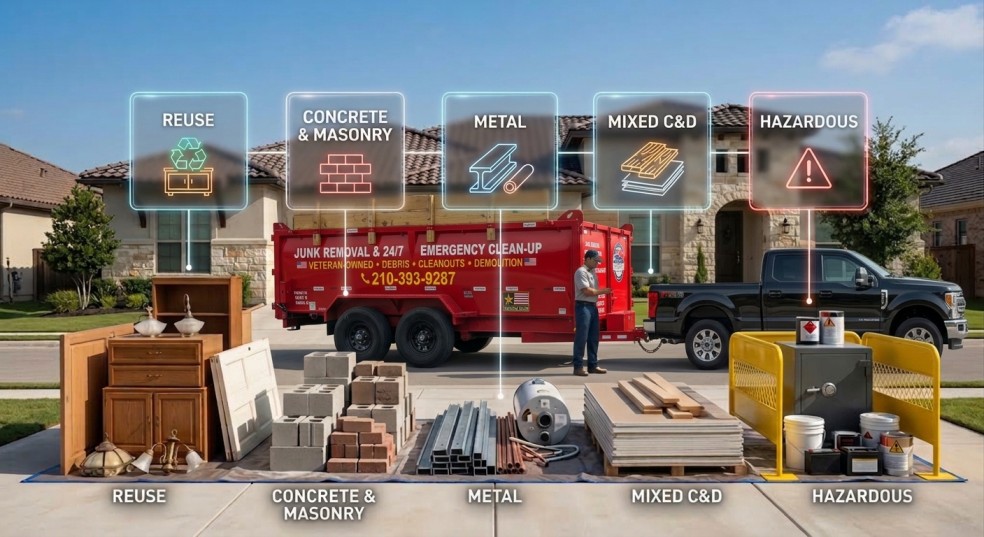
Construction debris is easier and usually cheaper to get rid of when it’s separated before the haul. If you split a remodel’s leftovers into five groups (salvageable items, clean concrete and masonry, scrap metal, mixed construction debris, and hazardous materials), each group can go where it belongs instead of all of it being charged as the most expensive kind of waste. This construction debris removal guide is for homeowners, landlords, property managers, and small contractors in San Antonio. It covers what to separate, where each pile typically goes, how to stage the material safely, and when sorting is no longer worth the effort.
Key takeaways
- Mixed loads are usually priced as mixed C&D debris, so one bucket of paint or a few cabinets tossed into a concrete pile can change how the whole load is handled.
- Salvage is worth separating only when it’s in genuinely reusable condition. Donation programs have strict acceptance rules and the final decision is theirs.
- Clean concrete and separated metal have more disposal options than mixed debris, but only if they stay clean.
- Suspected asbestos or lead materials aren’t a sorting problem. Stop work and get them tested before demolition continues.
- Sort at the start of a project. Once the pile forms, re-sorting often costs more time than it saves.
Why Sorting Debris Lowers Your Disposal Bill
Disposal cost for construction and demolition debris depends on what’s in the load, how much it weighs, and where it’s allowed to go. Sorting gives you more of those destinations to work with.
How Construction Debris Differs From Household Junk
Household junk is mostly bulky and fairly light: a couch, a mattress, boxes from a garage. Construction debris is dense, sharp, and mixed. A single bathroom demo can produce broken tile set in mortar, drywall with screws still in it, a cast-iron tub, copper supply lines, and half-empty tubes of adhesive, all in one afternoon.
That mix matters for a few reasons:
- Weight drives cost. Concrete, tile, and plaster fill a truck’s weight limit long before they fill its volume. Hauling and disposal charges for construction waste reflect this.
- Facilities specialize. Concrete recyclers, scrap yards, reuse stores, and C&D landfills each take different materials and turn away others.
- Some materials are restricted. Chemicals, old fuel, and materials that may contain asbestos or lead can’t simply go in with the rest of the debris.
Household drop-off options are also limited for this kind of waste. The City of San Antonio’s bulky waste centers are for residents only, with a limit of 1 cubic yard of construction materials per trip, and they won’t take material from commercial waste haulers. One cubic yard disappears quickly during a kitchen demo.
Why Mixed Loads Cost More Than Sorted Ones
When materials are mixed, the whole load is generally handled at the level of its least flexible component. A trailer of clean broken concrete has options: some recyclers and material yards take it, often for less than mixed debris. Throw drywall scraps, carpet, and a few paint cans into that same trailer, and it becomes a mixed C&D load. It is typically charged by weight at a landfill, and anything restricted has to be pulled out before it can be accepted.
Mixing also costs labor. If a crew has to pick copper out of a drywall pile or pull paint cans from under broken tile, that time shows up in the estimate. Sorting as you work avoids both problems.
Construction Debris Removal Guide: Sort Your Debris Into Five Piles
Most residential remodel debris fits one of five categories. Set up the piles, bins, or tarps before demolition starts, and label them if more than one person is working.
| Pile | What Goes In It | Where It Ends Up |
| Salvage and donate | Cabinets, doors, windows, light and plumbing fixtures, unused tile, surplus lumber, working appliances | Reuse stores such as Habitat Home Center, which offers free donation pickup for approved items |
| Clean inert | Concrete, brick, block, asphalt, clean dirt and rock, with no rebar or trash mixed in | Concrete recyclers or material yards, often at a lower rate than mixed debris |
| Scrap metal | Copper pipe, wiring, ductwork, steel framing, aluminum trim, rebar | Scrap yards, which may pay for separated metal. Some C&D facilities also accept it separately |
| Mixed C&D | Drywall, treated lumber, roofing, carpet, insulation, mortar-backed tile | A Type IV C&D landfill, typically charged by weight |
| Hazardous | Paint, solvents, adhesives, old fuel, and anything with asbestos or lead risk | Household chemicals: the City’s Environmental Recycling Center (eligible residents only). Suspected asbestos or lead: stop and test, and use licensed professionals. C&D landfills will not accept these materials |
A few notes on the table. “Where it ends up” describes common routes, not guaranteed outcomes. Acceptance depends on condition, the facility’s current rules, and in some cases your residency or whether you’re a business. And the hazardous pile is really a holding area for items that need separate handling. It isn’t a pile a hauler can simply load.
What Habitat Home Center Will and Will Not Take
Habitat for Humanity of San Antonio runs the Habitat Home Center, a reuse store that sells new and gently used furniture, decor, and building materials at discounted prices, with proceeds supporting its home building program. It can be a good destination for remodel salvage, but its standards are specific. Common remodel items and the conditions attached to them:
- Cabinets and vanities: Cabinets are accepted with their doors attached, and vanity tops are accepted with their cabinets. Remove them carefully rather than prying them off in pieces.
- Plumbing fixtures: Sinks, tubs, and shower bases must be free of cast iron, rust, chips, cracks, and large stains, with no caulk or glue attached, and plumbing must be lead-free. Scraping off old caulk before storage helps.
- Tile and flooring: Tile must be new, in its original boxes, and a matching color. Small lots and trim pieces aren’t accepted. Tile you pulled off a wall won’t qualify.
- Lumber and drywall: Lumber and plywood are accepted without nails or screws, along with new, unbroken drywall. Pallets and small scraps are not.
- Appliances: Appliances need to work and generally be under five years old. Dishwashers, garbage disposals, and built-in appliances aren’t accepted.
- Doors and windows: Doors must be under 6’8″ tall with no holes, rot, or protruding nails. Windows must be residential vinyl with the jamb and no broken or fogged glass.
- Lighting: Fixtures need their mounting hardware. Ceiling fans, track lighting, and commercial fluorescent fixtures aren’t accepted.
Habitat notes that its list isn’t exhaustive; store managers can refuse items at their discretion, and donors should call for guidance before dropping off or scheduling. Use the list to decide what’s worth setting aside, then confirm directly.
How Free Donation Pickup Works
For items too large for a car, Habitat offers a free pickup. The process on its website is: review the acceptable items list, reserve a pickup online, submit your details with a photo, choose an available date, and wait for a confirmation email once the donation is reviewed and approved. Smaller items that fit in a car can be dropped off at any of the three locations.
Photos are important because they’re how approval is decided. Take them in good light, show the whole item, and be honest about any damage. Pickup dates aren’t always immediate, so if salvage is part of your plan, request it early in the project, not the week the dumpster or haul-away is booked.
Why Clean Concrete Is Worth Separating
Concrete, brick, block, and asphalt are heavy, which makes them expensive when they’re mixed with lighter debris and charged by weight. Kept clean, they can often go to recyclers or material yards, where they may be crushed and reused.
“Clean” is the key word. Keep these out of the concrete pile:
- Wood forms, trash, and plastic
- Drywall, insulation, and roofing
- Loose dirt mixed with debris (clean fill dirt is sometimes accepted separately)
- Heavy rebar or wire mesh, where the facility requires it to be removed
Facilities set their own standards for what counts as clean and whether embedded steel is acceptable. Check before loading, because a contaminated load may be rejected or charged at a mixed rate.
Separating Scrap Metal Before Anyone Hauls It
Metal is often the easiest thing to pull out during demolition and among the most useful to keep separate. Copper pipe and wire, steel studs, ductwork, aluminum trim, and rebar can go to scrap yards, and some pay for clean, sorted metal. Prices and acceptance vary by yard and change with the market, so don’t count on a specific amount.
A few practical tips:
- Keep copper separate from steel and aluminum. Mixed metal is usually worth less.
- Cut out and set aside supply lines and wire as you remove them.
- Don’t try to salvage refrigerant-containing equipment yourself. Old AC units and refrigerators need the refrigerant handled properly before scrapping.
- Never cut into wiring you haven’t personally confirmed is disconnected at the panel.
Preparing Debris So It Is Ready to Load
Sorted debris still needs to be staged in a way that’s safe to lift and easy to reach. Good preparation shortens load time and reduces the chance of injury or property damage.
Bagging Drywall Dust, Offcuts, and Small Debris
Heavy-duty contractor bags work well for drywall offcuts, small tile fragments, sweepings, and insulation. Keep each bag light enough to lift comfortably. A bag full of plaster or tile can easily get too heavy and tear.
- Don’t overfill. Fill to a weight you’d carry across a yard, not to the top.
- Double-bag anything sharp or dusty.
- Keep bags off wet ground and covered if rain is expected. Wet drywall gets heavier and starts breaking down.
- Don’t hide restricted items in bags. Paint cans and chemical containers stay in the hazardous pile.
Bundling Lumber, Trim, and Long Materials
Loose boards slide, tangle, and hide nails. Pull or bend over protruding nails where you safely can, then stack lumber and trim in parallel bundles and tie them with twine or strapping. Keep treated lumber in the mixed C&D pile, separate from any clean, nail-free lumber you set aside for donation or reuse.
Stacking Heavy Material So It Can Be Lifted Safely
Concrete chunks, pavers, and stone should be broken into pieces one person can lift without straining and stacked low and stable. Tall piles of broken masonry shift and fall. If pieces are too large to lift safely, leave them for a crew with the right equipment rather than trying to break them further without proper tools and protection.
Where to Stage Debris on a Residential Property
A good staging spot:
- Sits on a hard surface such as the driveway or a paved side yard
- Is as close as practical to where a truck or trailer can park
- Doesn’t block garage doors, gates, meters, or neighbors’ access
- Stays off the sidewalk and street, unless you’ve confirmed that’s allowed
- Isn’t under low branches or power lines that would interfere with loading
If the property is managed or part of an HOA, check the rules before piling debris in visible areas.
Keeping the Load Accessible and Off the Grass
Debris left on grass kills the turf, leaves nails in the lawn, and can make the area harder to reach after rain. Lay down plywood or a heavy tarp under the staging area. Keep a clear, level path from the pile to the loading spot, and let whoever is hauling know about any steps, slopes, narrow gates, or soft ground. Access affects how long loading takes, which affects cost.
Staying Safe Around Demolition Debris
Sorting means handling the debris more, so it adds some exposure. These basics lower the risk.
The Protective Gear You Actually Need
For most residential demo and sorting:
- Work gloves rated for cuts, not thin garden gloves
- Safety glasses or goggles
- Boots with thick soles, ideally puncture-resistant
- Long sleeves and pants
- A properly fitted respirator (at least an N95, and more protective for dusty cutting) for any dust-producing work
- Hearing protection around saws and breakers
Silica Dust From Cutting Concrete, Tile, and Masonry
Cutting, grinding, or breaking concrete, brick, stone, and many types of tile releases fine silica dust. Breathing it in over time is linked to serious lung disease. To reduce exposure:
- Use wet-cutting methods or tools with dust collection where possible.
- Cut outdoors, with the wind at your back.
- Wear a respirator suited to the task. A basic dust mask isn’t enough for heavy cutting.
- Clean up with a HEPA vacuum or wet methods, not dry sweeping or a leaf blower.
Nails, Screws, and Puncture Injuries
Demo debris is full of fasteners pointing in every direction. Wear thick-soled boots, pull or bend nails as boards come out, and don’t reach blindly into piles. Keep a magnetic sweeper handy for driveways and walkways. Loose nails also puncture tires, including your hauler’s. If a puncture wound breaks the skin, clean it and check whether your tetanus protection is current.
Controlling Dust Inside an Occupied Home
If people are living in the house during the work:
- Seal off the work area with plastic sheeting and tape, and cover doorways with zippered barriers where you can.
- Turn off central HVAC or seal the returns in the work zone so dust isn’t spread through the house.
- Carry debris out along one path and cover the floor along it.
- Keep children and pets away from the work area and the debris piles.
What to Stop and Test Before Demolishing Older Materials
Some materials in older homes shouldn’t be torn out until they’ve been tested.
Asbestos may be found in older vinyl floor tile and its adhesive, popcorn ceilings, some drywall joint compounds, pipe and duct insulation, and some siding and roofing. It usually can’t be identified by looking at it.
Texas rules differ by building type. Under the DSHS demolition decision tree, single-family homes and apartment or condo buildings with four or fewer units generally fall outside the TAHPR and NESHAP survey requirements, though OSHA worker protection rules may still apply. Commercial and public buildings are a different matter: owners must have a thorough inspection done and any regulated asbestos-containing material that could be disturbed abated before renovation or demolition, and notification is required for any demolition of a facility or public building, whether or not asbestos has been found.
The home exemption covers paperwork, not safety. The health risk from disturbing asbestos is the same in a house as in an office.
Lead-based paint is a concern in homes built before 1978. Sanding, scraping, or demolishing painted surfaces can release lead dust, which is especially harmful to children and pregnant people.
If you suspect either material, stop. Leave it undisturbed, have it tested by a qualified professional, and use properly licensed contractors if abatement is needed. A regular debris hauler is not an asbestos or lead abatement service.
When to Sort and When to Stop Sorting
Sorting pays off when the value of the separated material or the savings in disposal outweighs the time it takes. It doesn’t always.
| Situation | Worth Sorting | Why |
| Kitchen or bath remodel with intact cabinets and fixtures | Yes, definitely | Salvage value is high, and donation pickup is free for approved items |
| Concrete patio or driveway removal | Yes | Clean inert loads usually cost far less than mixed debris |
| Roofing tear-off | No | Shingles have one destination, and sorting changes little |
| Small drywall repair or single-room demo | No | The load is too small for sorting to pay off |
| Whole-house gut renovation | Yes, at the start | Sorting is easy before the pile forms and impractical after |
| Storm or water-damaged material | No | Contaminated material generally can’t be salvaged or donated |
| A pile that has already been mixed | Usually not | Re-sorting a mixed pile often costs more time than it saves |
There is one exception to the “no” rows: hazardous items always come out, however small the job. A single can of solvent doesn’t belong in a roofing load.
Sorting During the Project Instead of After
The cheapest time to sort is when material first comes off the wall or floor. Practical ways to build it into the job:
- Set up labeled piles or containers before day one.
- Remove salvage first (cabinets, fixtures, doors) before any demolition starts.
- Assign one person to keep the piles clean on multi-person jobs.
- Move full bags and bundles to the staging area at the end of each day rather than letting them build up inside.
- Book salvage pickup and debris haul-away in the right order: salvage first, debris after.
Frequently Asked Questions
Do junk removal crews sort debris for me?
It depends on the company and the job. Many crews load and haul construction debris and decide where materials go, and some will pull out obvious items like metal. How much sorting is included, and whether it affects price, varies. Ask when you request an estimate. Pre-sorting on your end usually makes the job simpler whichever way it goes.
Will Habitat pick up materials from an active job site?
Pickup crews need approved items to be accessible and ready. Plan to move salvage to a garage, driveway, or other clear staging area rather than leaving it inside an active work zone. Habitat also advertises a deconstruction service called the Wrecking Crew that removes cabinets, doors, windows, and similar items before a remodel for resale in its stores. Contact Habitat directly to confirm current availability and requirements.
How do I know if my old tile or insulation contains asbestos?
You can’t tell by looking. The only reliable way is to have samples taken and analyzed by a qualified professional. Until you have results, treat suspect material as if it could contain asbestos: don’t break it, sand it, or bag it with other debris.
Can I put drywall scraps in construction bags at the curb?
Generally don’t count on it. Regular trash service isn’t designed for renovation debris, and City bulky programs limit construction materials. The city’s bulky centers cap construction materials at 1 cubic yard per trip for eligible residents, and the Dial-A-Trailer community collection program excludes construction and remodeling materials entirely. Check the City of San Antonio Solid Waste Management Department’s current rules before setting anything out. For larger amounts, plan on hauling or a debris removal service.
Is it worth separating scrap metal from a small remodel?
If the metal is easy to separate, like copper supply lines, a few lengths of duct, or steel studs, yes, it’s usually worth tossing in its own bin. It keeps the mixed load lighter, and a scrap yard may pay for it. If the metal is embedded in other debris and hard to get out, it’s often not worth the time on a small job.
What do I do with leftover paint and caulk at the end of a job?
Unopened, new cans of paint may be donatable: Habitat Home Center lists new cans of paint and stain among the building materials it accepts. For used chemicals, City of San Antonio residents can use the Environmental Recycling Center. It operates at 7030 Culebra Rd for City of San Antonio ratepayers, Tuesday through Friday 8 a.m. to 5 p.m. and Saturday 8 a.m. to noon, except holidays. You’ll need a recent CPS Energy bill showing payment of the Environmental Fee and a photo ID. Latex and oil-based paints may be handled differently, so check the city’s current guidance before you go. Keep products in their original, sealed containers, and never pour paint or solvents down drains or into storm drains. Businesses and contractors generally need a commercial disposal route instead.
How long can debris sit in my driveway?
There’s no single answer. It depends on local code enforcement, HOA or lease rules, and whether debris is blocking a sidewalk or right-of-way. In practice, shorter is better. Piles attract pests, scatter nails, soak up rain (which adds weight and cost), and can draw complaints. Plan the haul-away for soon after demolition ends rather than leaving debris out for weeks.
When You Are Ready for the Pile to Go
Once salvage has been picked up, metal pulled, hazardous items set aside, and the rest staged on a hard surface, you’re ready for removal. At that point, the main questions are how much material there is, how heavy it is, how accessible it is, and what it’s made of. Those factors, not a flat rate, determine the cost of hauling it away.
American Valor Waste & Disaster Services offers construction debris removal in San Antonio for residential and remodeling cleanups. If you’d like to talk through what you have, including whether your piles are sorted enough, what can go together, and what needs to be handled separately, you can contact the team to request an estimate. You can also read more about the company or see the full range of junk removal and cleanup services.