
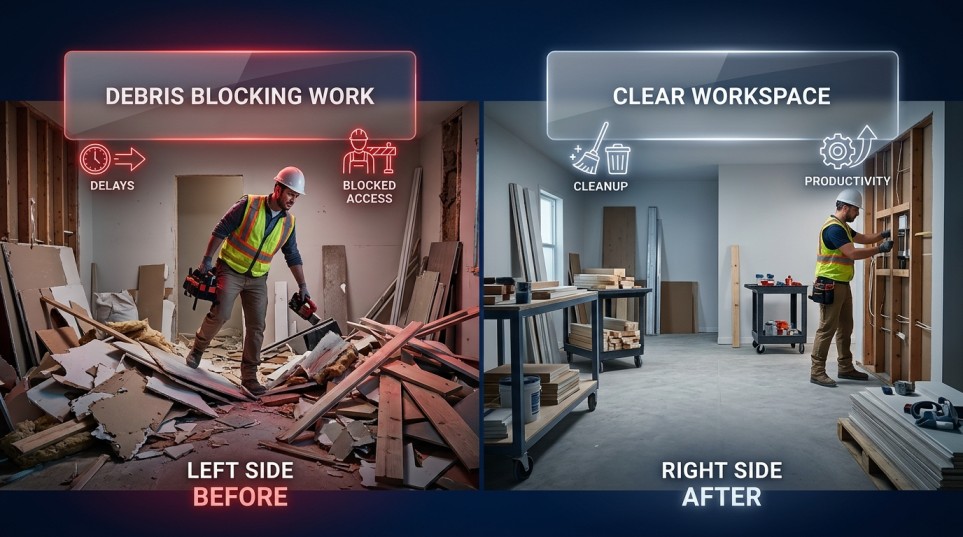
Remodel debris is blocking subcontractors when leftover demolition materials, drywall, tile, and other construction waste prevent the next trade from starting work. Responsibility for remodel debris removal is decided by the contract, not by custom. On a full-service job, the general contractor usually arranges and pays for hauling as part of the contract price. When trades are subcontracted, each trade is typically expected to clear its own material and the GC handles what is left. On an owner-builder or single-trade job, removal almost always falls to the homeowner.
Key Takeaways
- “Cleanup” and “debris removal” are different obligations. Broom-clean language commits a crew to sweeping and stacking, not to loading a truck and paying tipping fees.
- The dispute is usually about sequencing, not money. Debris blocks the next trade, the schedule slips, and the cost of the delay quickly passes the cost of the haul.
- Heavy materials change the math. Tile, plaster, concrete, roofing, and dirt are often priced by weight at disposal facilities, so a small tear-out can cost more to dispose of than a large volume of cabinets.
- Owner-builders are the most exposed. Trades price their labor assuming a container is already on site, and most residential curbside programs do not take construction and demolition debris.
- Name the responsibility in writing before demolition starts. Who supplies the container, who schedules removal, who pays overage, and what happens to prohibited materials.
Who Normally Pays for Remodel Debris Removal
These are the arrangements we see most often on remodel sites. They describe common practice, not a legal rule. Your contract controls the answer on your specific job.
| Arrangement | Who hauls the debris | Who pays | Where disputes start |
| Full-service general contractor | The GC, usually through their own hauler or container | Built into the contract price | When the contract says “cleanup” but not “haul-away” |
| GC with subcontracted trades | Each trade clears its own; GC handles the rest | Split, per the subcontractor agreements | When a sub leaves material behind, and nobody is named to remove it |
| Owner-builder managing trades directly | The homeowner | The homeowner | When trades assume the owner arranged a container and none exists |
| Handyman or single-trade job | Usually the homeowner | The homeowner | When the quote never mentioned debris at all |
| Demolition-only contract | Typically the demo contractor | Usually included, but confirm it | When demo debris is left for the next trade to work around |
| Insurance or restoration work | The restoration contractor | The claim, if scoped correctly | When debris removal was left out of the adjuster’s scope |
Why “Cleanup” and “Debris Removal” Are Not the Same Thing
Most remodel contracts include a cleanup clause. Read closely; that clause usually describes housekeeping: sweeping floors at the end of the day, bagging small waste, keeping walkways clear, and stacking material in one place. A crew can satisfy every word of it and still leave eleven cubic yards of lath, drywall, and old tile sitting in the driveway.
Debris removal is a separate chain of work. Material has to be sorted where sorting matters, carried out of the structure, loaded, transported to a facility that accepts construction and demolition material, and paid for at the scale or the gate. Each of those steps costs labor, truck time, or money, which is exactly why it needs to be assigned to someone by name.
When you read a quote, treat “site will be left broom clean” as a statement about the floor and nothing else. If the words haul, remove from the property, disposal, or dump fees do not appear anywhere, assume removal has not been priced.
The Gap That Creates Most Disputes
The gap almost never sits inside one trade’s scope. It sits in the handoff between two.
Demo finishes and pulls off the job. The pile they stacked is in the garage, because that was the only staging space. Framing arrives, works around it for two days, and adds their own offcuts to it. Plumbing needs the wall the pile is leaning against. Now three crews have touched the material, each one reasonably believes it belongs to someone else, and the only person with authority to settle it is the GC or the owner, who is being asked to pay for something they thought was already covered.
By the time anyone calls a hauler, the real cost is no longer the haul. It is the crew that showed up and could not start, the rescheduled inspection, and the trade that will not come back until the floor is clear. That is the expense worth preventing, and it is prevented on paper weeks before the first wall comes down.
What a Contract Should Actually Say
Debris language does not need to be long. It needs to answer four questions: who removes it, where it goes, who pays, and how often. The sections below describe what experienced parties tend to put in writing. This is general information about how remodel contracts commonly handle debris, not legal advice. Have an attorney review the terms of your own agreement.
Language Worth Looking For Before You Sign
Before signing, find the answer to each of these somewhere in the document; if you cannot, ask for it in writing as a change to the contract rather than a verbal assurance.
- Removal, not just cleanup. Language that says debris will be removed from the property, not merely consolidated or staged.
- Who supplies the container or truck. Named by party, not left to “as needed.”
- Who pays disposal fees. Whether tipping and landfill fees are included in the price or passed through at cost.
- Frequency. Removal at the end of each phase, at a set interval, or only at project completion. The last option is the one that blocks trades.
- Heavy and oversized material. Whether concrete, tile, masonry, roofing, and dirt are included or excluded from the debris allowance.
- Excluded materials. What the contractor will not handle, which usually includes suspected asbestos, lead-painted components in certain conditions, chemicals, fuels, and other regulated waste.
- Final condition at completion. What “complete” means in terms of the site being clear.
What to Add to a Subcontractor Agreement
If you are issuing subcontracts, the cheapest clause you will ever write is the one that assigns debris by trade. A workable version covers four points:
- Daily duty. Each trade removes its own generated debris to the designated container or staging area before leaving the site each day.
- A named location. Not “outside” or “the garage.” A specific container or spot, so material does not migrate into the next trade’s work area.
- A remedy. If debris is left beyond the agreed point, the GC may arrange removal and deduct the documented cost from the subcontractor’s payment. Make the remedy explicit, because a backcharge with no contractual basis is where arguments go from scheduling to legal.
- Notification. The trade stops and notifies the GC if they encounter material they suspect is regulated, rather than putting it in the container.
Confirming Who Supplies the Container
The container question is where two reasonable people most often assume opposite things. Settle these before demo day:
- Is there a roll-off container on site, or is removal being handled by on-call truck hauling as the material accumulates?
- Who orders it, who schedules the swap when it fills, and how much notice does that swap require?
- Where will it sit? Driveway placement can mark or crack a surface; street placement may require a permit from the local municipality, and requirements differ from city to city across Texas.
- Who is responsible if it is overfilled, if neighbors add household junk to it, or if it holds material the facility will not accept?
On tight residential lots, a smaller remodel is often handled better by scheduled truck hauling than by a container that occupies the only parking the trades have. That is a planning decision, not just a price decision.
Settling Disposal Costs for Heavy Materials Upfront
Volume is what people picture. Weight is what frequently drives the disposal cost. Many facilities price construction and demolition material by the ton, and the materials that pile up fastest in a remodel are some of the heaviest: ceramic and stone tile, mortar beds, plaster and lath, brick, concrete, roofing shingles, and excavated soil.
The practical consequence is that a bathroom gut can generate a smaller-looking pile than a kitchen and still cost more to dispose of. If your contract includes a debris allowance, ask what it assumes about heavy material and what happens if the actual weight exceeds it. Agreeing on how that difference is handled takes one conversation before demolition and turns into a dispute after.
What to Do When Remodel Debris Is Blocking Subcontractors
You hired one company, and you reasonably expected the house to be put back in order. Whether that includes hauling depends entirely on what was written down, and most homeowners find out which version they signed on the day the debris stops the job.
What Your Contractor’s Quote Probably Does and Does Not Cover
Read your quote for the specific verb. Several words that sound like removal are not:
- “Demolition” often describes tear-out labor only. The material still has to leave the property, and that may be a separate line.
- “Daily cleanup” or “broom clean” describes housekeeping during the work.
- “Haul-off,” “debris removal,” “disposal included” describe material leaving the property. These are the words you want.
- “Dump fees at cost” or “disposal billed separately” means removal is planned but not included in the number you are looking at.
If the quote is silent, it is not an oversight you should resolve by assumption. A short email asking the contractor to confirm in writing whether disposal is included, and whether there is a weight or volume limit, protects both of you.
Questions to Ask Before Demolition Starts
Ask these while the walls are still up and you still have leverage in the conversation:
- Is debris hauling included in this price, or billed separately?
- Who supplies the container or truck, and where will it sit?
- How often will material be removed during the project?
- What happens to tile, plaster, concrete, or other heavy material?
- Is there a volume or weight limit on what is included, and what is the cost beyond it?
- What materials will you not remove, and what should I do if we find them?
- Who is on site to receive a hauler if removal is scheduled on a day your crew is not here?
- At completion, what condition will the site and the driveway be in?
Get the answers in a text or email. You are not being difficult. You are preventing the one disagreement that reliably sours an otherwise good remodel.
What to Do When Debris Is Left Behind
If material is already sitting on your property and the contractor has moved on, work through it in order:
Document it. Photograph the material, the location, and anything it is blocking, with dates. If it is preventing another trade from working, note the date they were scheduled.
Put the request in writing. Reference the clause you are relying on and ask for a date by which removal will happen. A written record matters far more later than a phone call does.
Check what remains unpaid. Whether you can hold back funds depends on your contract and on state law, and it is a question for an attorney rather than for a hauler or a contractor forum. Getting this wrong can weaken your position.
Decide what the delay is costing you. If the project is stalled and recovery from the contractor is going to take time, many homeowners arrange construction debris removal themselves to get the trades back on site, keep the itemized invoice, and pursue reimbursement separately. Whether that is the right call depends on the size of the amount in question and on what your agreement says.
One caution before you clear anything yourself: if the structure is older and the debris includes material that may contain asbestos or lead paint, do not disturb it, bag it, or sweep it. Those materials require testing and licensed handling, and the section below on regulated material explains why that is outside the scope of standard debris hauling.
If You Are Managing Your Own Remodel
Owner-builders carry a responsibility that is rarely stated out loud, because every trade on the job assumes somebody else already handled it.
The Cleanup Responsibility Trades Assume You Have Handled
When a subcontractor bids a job for a general contractor, they price their labor against a site that already has a container, a staging area, and someone coordinating removal. When the same subcontractor bids directly to a homeowner, that assumption usually travels with them unexamined.
So the tile setter arrives expecting somewhere to put the old tile. The cabinet installer expects the cardboard and the old uppers to have a destination. Nobody mentions it, because on most of their jobs it is not their problem. The first time it becomes a conversation is when someone cannot get to the wall they came to work on.
If you are coordinating trades directly, assume debris removal is yours unless a specific trade’s written quote says otherwise. That single assumption prevents most owner-builder scheduling failures.
Arranging Removal Before It Blocks the Next Trade
The cheapest time to move debris is before the next crew arrives, and the most expensive is after they have left and rescheduled.
A few practical habits make the difference:
- Map the generation points. Demolition, flooring tear-out, roofing, cabinetry, and drywall each produce a surge. Those are your removal dates, not the end of the job.
- Stage in one place with truck access. A pile in the back bedroom costs far more to load out than the same pile near the driveway. Distance from the truck is a real labor factor in hauling.
- Keep the path clear. Door widths, stairs, tight gates, and parked vehicles all affect how long a removal takes.
- Book removal against the schedule, not the pile. If rough-in starts Tuesday, the debris needs to be gone Monday, regardless of whether the pile looks big enough to justify a trip.
- Set aside anything questionable. Unlabeled containers, old chemicals, and suspected regulated material should be identified and discussed with the removal company in advance rather than buried in a load.
For a remodel generating material in waves, scheduled pickups from a junk removal and hauling service often fit the rhythm of the job better than a single container sitting through the whole project.
Why Owner-Builders Cannot Use Residential City Disposal for Trade Debris
This surprises people every season. Residential waste collection and municipal bulk pickup programs are built for household waste and household-scale bulky items. Construction and demolition debris is generally handled under a different set of rules, and many programs exclude it outright, along with material generated by contractors at a residence.
The practical limits owner-builders run into include:
- Weight limits that a few bags of mortar, tile, or plaster will exceed quickly.
- Exclusions for lumber with fasteners, drywall, roofing material, concrete, and similar debris.
- Restrictions on material produced by a contractor rather than by the household.
- Transfer station rules that differ from curbside rules, including requirements about how loads are sorted, covered, and paid for.
Rules vary between municipalities and between waste providers across Texas, so confirm with your own provider rather than relying on what a neighbor did. The common outcome of guessing is a load left at the curb that does not get collected, which puts the debris right back in the path of your schedule and sometimes adds a code complaint on top of it.
If You Are the General Contractor
You are the one holding both ends of this problem. The owner believes debris is covered because you are running the job, and the trades believe it is covered because that is how it usually works for them. When neither assumption is written down, the cost lands on you.
Allocating Debris Responsibility Across Trades
Allocation works when it is specific about three things: what each trade owns, where it goes, and when.
Trade-generated material is the simplest to assign. Demo owns demo debris. Framing owns offcuts and banding. Drywall owns scrap and bucket waste. Roofing owns tear-off. Flooring owns tear-out and packaging. The arguments tend to come from the categories nobody generated on purpose:
- Packaging and pallets from owner-supplied materials delivered before anyone is scheduled.
- Pre-existing material already in the structure, such as items stored in a garage or attic before work began.
- Common waste, including food containers, water bottles, and site trash.
- Material from a trade that is no longer on the job and will not be coming back.
Name an owner for each of those in the contract documents, even if the answer is that you absorb them. A known cost in your bid beats an unplanned one in week six.
Recovering Costs When a Sub Leaves Material Behind
Recovery depends almost entirely on what you can show and what your agreement permits.
The documentation that makes a backcharge stick is routine: dated photographs of the material left behind, the scope language assigning it, written notice to the sub with a reasonable window to correct it, and an itemized invoice from the removal company tied to that specific job and date. A lump-sum deduction with no invoice behind it invites a dispute you will spend more time on than the debris was worth.
The prevention is cheaper than the recovery. Subs who know from the first page of the agreement that debris is deducted at documented cost tend to carry their own material out, which is the actual goal.
Building Disposal Into Your Bid Instead of Absorbing It
Disposal has a habit of disappearing between the estimate and the invoice. A few approaches contractors use:
- Carry it as a visible line item. It reads as transparency to the client, and it survives value-engineering conversations better than a buried cost.
- Use an allowance with a stated basis. State what the allowance assumes about heavy material and how overage is reconciled.
- Price removal by phase. Demo-phase removal and finish-phase removal are different volumes, different weights, and often different access conditions.
- Quote the access, not just the volume. Second-floor work, long carries, narrow gates, and limited parking all change the labor involved, and estimating them as if everything is curbside is how a line item becomes a loss.
If you are lining up a removal partner for repeat work rather than a one-off, it is worth knowing who you are handing the material to before you build their pricing into a bid.
Frequently Asked Questions
Does my contractor have to haul away debris, or just pile it up?
It depends on what the contract says. A cleanup clause generally obligates a contractor to keep the site tidy and consolidate material. Hauling it off the property is a separate obligation that usually has to be written as removal or disposal. If your agreement only mentions cleanup, the contractor may be within their rights to leave a staged pile, even though that is rarely what the homeowner pictured.
Can I withhold payment if a contractor leaves debris behind?
That depends on your contract and on the law in your state, including rules about notice, retainage, and lien rights. It is a legal question rather than a cleanup question, and the answer is worth getting from an attorney before you act. What helps in every version of that conversation is documentation: dated photos, written notice, and a record of what the debris prevented from getting done.
Who is liable if someone is injured by debris left on site?
Liability generally turns on who controlled the site, who created the condition, what the contract assigned, and what the relevant insurance policies cover. Those facts vary too much for a general answer, and an attorney or your insurer is the right source. From a practical standpoint, debris piles, protruding fasteners, and unstable stacks are among the more common hazards on an active remodel, which is a strong argument for clearing material promptly rather than letting it accumulate while responsibility is debated.
Should debris removal be a line item or built into the bid?
Both are used. A visible line item makes the cost easier to discuss, easier to compare between bidders, and easier to defend if the scope changes. Building it into the overall price can read as simpler to a client but makes it harder to explain later why extra disposal is being billed. Whichever you choose, the scope assumptions behind the number should be written down.
What if the debris turns out to contain asbestos or lead?
Stop and do not disturb it. Older homes may contain asbestos in materials such as floor tile, certain mastics, pipe insulation, and some textured surfaces, and lead paint is a consideration in many pre-1978 properties. Suspected regulated material requires assessment by a qualified professional, and removal is performed by licensed abatement contractors under specific regulatory requirements. This is outside the scope of standard debris hauling, and it is not something to handle, bag, sweep, or mix into a container of general construction debris.
Can a hauler bill the contractor directly instead of me?
In most cases, the account is set up with whoever books the work, so if the general contractor arranges removal, the invoice goes to them. If you are the homeowner and you want the cost to sit with the contractor, the arrangement needs to be made that way from the start rather than corrected after a load has been hauled. Confirm who the payer is when the work order is created, and make sure the job address and project reference are on the invoice so it can be matched to the right contract.
Get Remodel Debris Removed Without the Standoff
Most of the time, the question of who should have hauled the debris is still unsettled while the house sits unusable and the trades wait. Those are two separate problems, and only one of them has to be solved today.
American Valor Waste & Disaster Services handles construction and remodel debris removal for homeowners, contractors, and property managers in Texas. We load the material, haul it off the property, and route it to the appropriate disposal option for what it is, so the next trade can get to work.
What a project costs depends on the volume and weight of the material, how far it has to be carried, access conditions at the property, and the disposal requirements for the specific debris, which is why we would rather look at the job than quote a number blind. Some materials, including suspected asbestos, lead-containing components in certain conditions, chemicals, and other regulated waste, fall outside what we can accept and require specialized handling.
If remodel debris is holding up your schedule, tell us about the project, and we will walk through what removal would involve. For details on how we handle job-site material, including demolition and renovation waste, see our debris hauling for construction and remodel sites.