A Garage Cleanout guide can help you avoid the most common mistakes before you start moving boxes, furniture, and old belongings. A garage cleanout is mostly a planning job. The lifting is the part people picture, but the part that decides whether the project finishes in a weekend or drags into a month is what you settle before the first box moves: what you want the space for, how much you are taking on, when you are working around San Antonio heat, who is lifting with you, and where every item is going once it leaves the shelf.
Most first cleanouts do not stall because sorting is hard. They stall because the driveway fills up faster than the disposal plan can empty it.
This guide walks through the decisions in the order you will actually face them, with the local realities that make a Texas garage different from a garage anywhere else.
Key Takeaways
- Decide what the garage is for before you sort. The goal sets the finish line and settles most keep-or-toss arguments.
- Plan the disposal before you build the pile. Knowing where things go is more important than knowing what to remove.
- Timing matters more here than in most of the country. A closed San Antonio garage runs hotter than the forecast, and summer cleanouts need shorter sessions across more days.
- Pull hazardous items, documents, and valuables out first, before anything gets bagged or handed to anyone.
- Be honest about lifting and hauling capacity early. Deciding at 4 p.m. that a load will not fit in your truck is the most common way a cleanout ends up half-finished.
Garage Cleanout Guide: How to Plan Your First Cleanout
These four answers shape everything else. Write them down somewhere you will see them, because on cleanout day, tired people renegotiate decisions they already made.
What Do You Actually Want the Garage For?
“Cleaner” is not a goal you can measure. Parking a vehicle, building a workshop, creating storage you can actually find things in, or making room for a gym or laundry area each produces a different finish line and a different amount of removal.
Parking is the strictest goal. A mid-size SUV needs roughly sixteen feet of clear length and eight feet of clear width, plus door swing on both sides and a walkway to get past the front bumper. That usually means the floor is fully clear and everything lives on walls, shelves, or overhead racks. A workshop goal is looser on floor space but stricter on organization, because tools you cannot reach are tools you will buy again. A storage goal is the most forgiving, but it is also the one most likely to quietly turn back into what you started with.
Name the goal out loud before you start. When someone picks up an item and hesitates, the question stops being “do we still like this?” and becomes “does this fit what the garage is now for?”
Full Cleanout or Just the Worst Corner?
A full cleanout means everything comes out, the floor gets swept, and items go back in deliberately. It takes longer, and it is the only version that actually resets the space. A partial cleanout targets a defined zone, which is realistic when you have limited time, limited help, or a specific problem such as a corner you cannot reach or a pile that has become a hazard.
The tradeoff is straightforward. Partial cleanouts finish faster, but anything you did not touch stays undecided, and undecided items tend to expand back into the space you cleared. If you go partial, define the boundary physically. Tape a line on the floor or work one wall from corner to corner. A vague boundary produces a vague result.
One Weekend, or Spread Across Several?
A single-car garage with moderate storage is a realistic one-weekend project. A two-car garage packed to the walls, with shelving and overhead storage and years of accumulation, usually is not, at least for someone doing it the first time. Sorting is the slow part. Loading and hauling move quickly once the decisions are made.
Spreading the job across weekends works, but it introduces one problem worth planning around: you cannot leave a staged driveway sitting for six days. Rain ruins cardboard and soft goods, wind moves light items into the street, and a pile in a visible driveway can draw HOA or code complaints. If you are working in stages, end every session with the driveway empty and the garage door closed, even if that means moving a sorted pile back inside as a single block.
Who Is Helping You Lift?
Confirm your help before you pick the date, not after. Garages accumulate the heaviest and most awkward objects in a house: loaded tool chests, safes, chest freezers, treadmills, riding mowers, workbenches, tube televisions, engine parts, and boxes of tile or books that weigh far more than they look.
Two people who show up beat four people who might. If your help is uncertain, plan the day around what one or two people can safely handle and set aside the rest as a separate problem to solve, rather than improvising a heavy lift at the end of a long afternoon. That improvisation is where most garage cleanout injuries happen.
Timing Your Garage Cleanout Around San Antonio Heat
Season is not a comfort question here. It changes how many hours you can safely work, how many days the project takes, and how well you make decisions late in the day. Use this as a planning frame:
| Time of Year | Working Conditions | How to Plan It |
|---|---|---|
| November to March | The best window by far, comfortable most of the day | Take on a full garage in a single weekend |
| April and October | Warm but workable; afternoons get heavy | Start by mid-morning, finish before late afternoon |
| May and September | Hot enough to shorten your working day | Work early, break through midday, resume near evening |
| June to August | Genuinely difficult, garages hold heat long after sunrise | Start at first light, cap it at three or four hours, split the job across multiple days |
If you have any flexibility at all, a first cleanout belongs in the cooler half of the year. If the timing is forced, as it often is with a move, a sale, or a rental turnover, plan shorter sessions and more of them rather than one long push.
Why a Closed Garage Is Hotter Than the Forecast
A garage is a heat trap by design. The concrete slab and everything stored on it absorb heat through the day and release it slowly, so the space can still be warm at sunrise. Most residential garage doors are thin, uninsulated steel, and a west- or south-facing door takes direct sun through the hottest part of the afternoon. Attached garages usually have no ventilation and no conditioned air, which means humidity and heat build with nothing moving them out.
The practical result is that a garage interior can run meaningfully hotter than the outdoor temperature your phone shows, and it lags behind the outside air in cooling off. Open the main door and any side door first thing in the morning and put a box fan in the doorway pointed outward to pull hot air out rather than pushing it around. Do that before you start moving anything, not after you notice the heat.
Working Safely When It Is Hot
Heat is the most likely thing to hurt you on this project, and it builds quietly.
- Drink before you are thirsty, and keep water in the shade rather than in the garage where it will warm up.
- Take breaks on a schedule instead of by feel. Fatigue and heat both degrade judgment, and bad judgment is what produces a dropped freezer or a rushed lift.
- Set a hard stop time before you begin and honor it. “One more hour” in August is how people end up ill.
- Know the difference between heat exhaustion and heat stroke. Heavy sweating, cool clammy skin, dizziness, headache, or nausea means stop, get into air conditioning, and rehydrate. Confusion, slurred speech, hot skin, or someone who stops sweating is a medical emergency. Call 911 and start cooling the person immediately.
- Do not work alone in extreme heat if it can be avoided, and check on anyone helping who is older, on medication, or not used to working outdoors.
Move fuel containers, propane cylinders, aerosols, and pool chemicals into shade early, and never leave them sitting on hot asphalt or in direct sun while you work through the rest of the garage.
Checking the Weather Before You Stage in the Driveway
Once your piles are outside, the forecast becomes part of the project. Three things matter: rain, wind, and heat index.
Pop-up storms are common in the warm months and can arrive faster than you can move a driveway full of sorted items. Anything you intend to donate is finished the moment it gets soaked, and wet cardboard collapses under whatever is stacked on it. Wind moves foam, empty containers, tarps, and loose paper into the street and your neighbor’s yard. Check the radar before you commit to staging, keep tarps and a few heavy objects on hand to cover and weight piles quickly, and stage donation items closest to shelter so they are the first thing you can rescue.
Setting Up Your Space Before You Start Sorting
Sorting into a space that is not ready produces piles that have to be moved twice. Spend the first thirty minutes on setup.
Moving Vehicles and Claiming Enough Room to Work
You need the whole driveway, not half of it. Park vehicles on the street or down the block for the day, and move anything else that lives near the garage: trash and recycling carts, bikes, the grill, planters. If a vehicle has been sitting in the garage untouched for a long time, check that it will actually start and roll before cleanout morning rather than discovering it will not while five people wait.
Two local details worth checking in advance: whether your HOA restricts street parking or visible driveway storage, and whether the driveway itself gives you a flat area to stack on. Sloped driveways are common here, and stacking on a slope is how loads shift.
Building Your Staging Zones in the Driveway
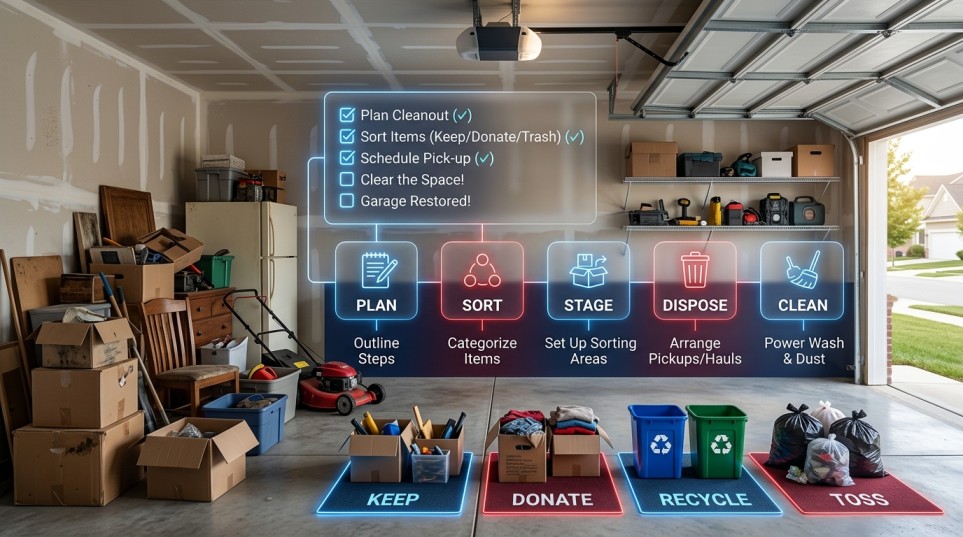
Give every decision a physical destination before you make the first one. Five zones, separated by real distance rather than an imaginary line, work well:
- Keep, which goes back into the garage rather than sitting in the driveway.
- Donate, staged closest to the shelter and kept dry and clean, because condition determines whether an organization can accept it.
- Sell, only if you have a real plan and a date to list it.
- Recycle: keep separate because metal, electronics, and cardboard often go to different places.
- Haul away, which is the pile that determines the size of your disposal plan.
Put down tarps under the piles, label each zone with tape and a marker on a cardboard sign, and set the hazardous and unknown-container zone off to one side in the shade, away from foot traffic and out of reach of children and pets. Once the zones exist, sorting becomes a physical act rather than a debate.
Working One Section at a Time Instead of All at Once
Emptying the entire garage at once feels productive for about twenty minutes and then becomes unmanageable. The better method is to clear a landing zone first, an open area of floor roughly the size of a parking space, then work one wall or one section at a time into that space.
Within a section, work top down. Overhead racks and high shelves come first, so nothing falls onto a work area you have already cleared, and so you are handling overhead items while you are fresh rather than exhausted. Finish each section completely, including sweeping the floor under it, before opening the next one. Sections that are genuinely finished stay finished. Sections that are half done get quietly reabsorbed.
What to Have on Hand Before You Begin
A supply run in the middle of the day costs an hour and breaks momentum. Gather these first.
Sorting, Labeling, and Bagging Supplies
- Heavy contractor bags, at least three mil, because standard kitchen bags tear on anything sharp or heavy.
- A few sturdy bins or boxes for items being kept, so the keep pile does not become a floor pile.
- Painter’s tape and a permanent marker for labeling zones and bins.
- Tarps for covering piles and protecting the driveway surface.
- A box cutter, scissors, and a broom and dustpan.
- A dedicated box for anything with personal information on it, which is a separate pile from recycling.
- Flattened cardboard kept apart from general trash, since it is one of the easier things to recycle when it is dry and clean.
Gloves, Masks, and Basic Safety Gear
Garages hold sharp metal, splintered wood, corroded containers, mouse droppings, wasp nests, and years of dust. In South Texas, they also hold spiders, scorpions, and the occasional snake in the cool space behind stacked boxes.
- Leather or coated work gloves, with disposable nitrile gloves for anything wet, corroded, or unidentified.
- An N95 respirator for dust, insulation fibers, and rodent debris. A cloth mask does not do this job.
- Safety glasses, closed-toe boots, and long sleeves and pants, uncomfortable as that is in summer.
- A headlamp or work light, because the back corners of a garage are dark even at midday.
- A basic first aid kit within reach, not in the house.
Do not reach blindly into gaps, boxes, or shelving you cannot see into. Move the box first with a tool or a gloved hand, give anything living a moment to leave, and tap or shake stored items before picking them up. If you find rodent droppings or nesting material, do not sweep them dry. Ventilate the area, wear the respirator and gloves, and dampen the material before cleaning it up. If you find a wasp or hornet nest, deal with that as its own task on a different day rather than working around it.
Dollies, Straps, and Anything That Saves Your Back
Most of this can be rented for a day for less than the cost of one injury.
- An appliance dolly with a strap for freezers, water heaters, and anything tall and top-heavy. A flat furniture dolly for tool chests, cabinets, and workbenches.
- Furniture sliders, which work well on a concrete slab and let one person move something that two people would otherwise carry.
- Ratchet straps and rope for securing loads, not bungee cords.
- Moving blankets to protect anything you plan to donate or sell.
- A sheet of plywood or a ramp if there is a step down from the garage to the driveway.
Set these up before you start. A dolly that is still in the shed when you need it does not get used.
A Sorting System That Actually Works
The system matters less than the discipline of applying it consistently. What follows is a version that holds up under fatigue.
Keep, Donate, Sell, Recycle, and Toss
Keep means it supports what the garage is now for, it works, and it has a place to live. If you cannot name where it will go when the garage is finished, it is not a keep.
Donate means it is clean, complete, functional, and something an organization can realistically put on a shelf. Garages produce good donation candidates: unused tools, sporting goods, camping gear, small appliances, unopened supplies, and building materials. Acceptance still depends on condition and on each organization’s current policies, and those policies change, so call ahead rather than driving across town with a full truck. Building materials, cabinets, doors, and fixtures are worth asking about at a home improvement resale charity, which often takes items a general thrift store will not.
Sell is the pile that ruins timelines. It is only a real category if you set a listing deadline, usually two weeks, and agree in advance that anything unsold by then moves to donate or haul. Otherwise, the sell pile becomes storage with extra steps.
Recycle covers scrap metal, clean cardboard, electronics, and certain specialty items. These usually go to different places, so keep them separate from the start.
Toss is everything broken, unsafe, incomplete, or genuinely used up. Being realistic here is what makes the rest of the system work.
Why the Maybe Pile Ruins Garage Cleanouts
A maybe pile is a decision you have agreed to make later, at a point when you will be more tired and less patient than you are now. In practice, it becomes the seed of the next garage problem, because it goes back inside intact and nothing about it has changed.
If you truly need one, contain it: a single labeled bin, no more, with the date written on the lid and an agreement about what happens if it has not been opened by then. One bin is a compromise. A maybe corner is a cleanout that did not happen.
Deciding on Each Item Once and Moving On
Touch each item once. Pick it up, decide, and put it in a zone. Setting it down to think about it means you will handle it again, and handling everything twice roughly doubles the length of the project.
A few questions that resolve most hesitation quickly:
- Have I used this in the last two years, and can I name the next time I will?
- Do I own more than one, and is this the better one?
- If it were gone tomorrow, would I replace it, and what would that cost?
- Does it work right now, or does it need a repair I have been meaning to do for years?
Give yourself about ten seconds per ordinary item. Genuinely difficult items, which are usually sentimental or expensive, are worth more time, but they are also worth recognizing as a separate task rather than letting one of them stop the whole line.
Pulling Out Documents and Valuables Before You Sort
Do this pass first, before anything is bagged, donated, or handed to anyone. Garages hold old filing boxes, tax records, bank statements, canceled checks, insurance paperwork, vehicle titles, deeds, and hard drives, and any of those in a donation box or a curbside pile is an identity theft problem.
Set aside a dedicated box for anything with a name, account number, or signature on it, and plan to shred it rather than recycle it loose. Check the pockets, drawers, and undersides of furniture before it leaves, because cash, jewelry, and small valuables turn up in old dressers and toolboxes more often than people expect.
Firearms and ammunition need to be secured separately and handled by someone who knows how, never sorted casually and never included in a donation or removal pile. The same goes for prescription medications, which have their own disposal channels.
Planning the Disposal Before You Create the Pile
This is the step people skip, and it is the one that decides whether the project ends on schedule. You are not just deciding what leaves the garage. You are deciding where it goes, who takes it, and when.
Separating Hazardous Items First
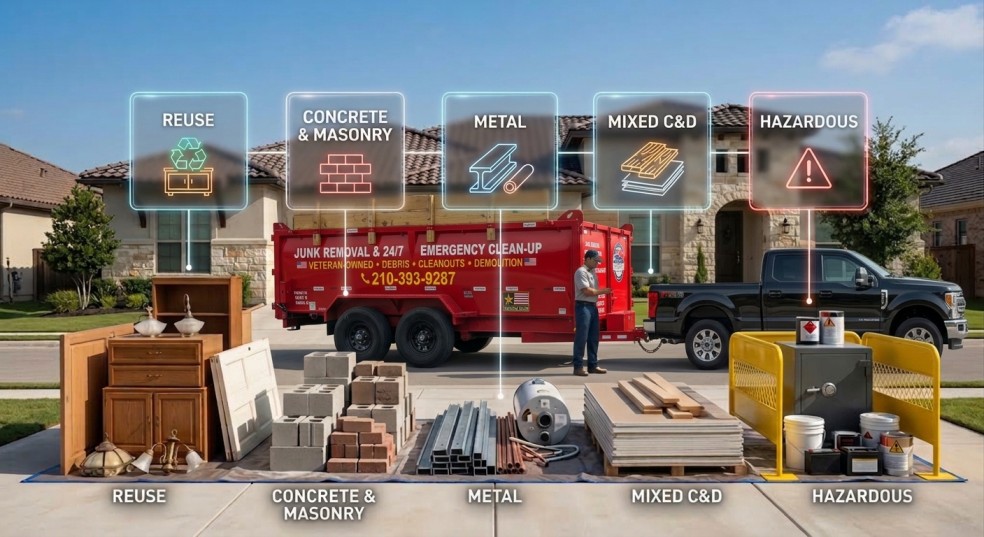
Garages are where household chemicals go to be forgotten. Before any general sorting begins, walk the space and pull these into a separate shaded staging area:
- Paint, stain, thinner, solvents, and adhesives.
- Gasoline, diesel, kerosene, and old fuel in cans or in equipment.
- Motor oil, transmission fluid, antifreeze, and brake fluid.
- Pesticides, herbicides, and pool chemicals.
- Propane cylinders and pressurized aerosol cans.
- Car batteries, lithium batteries, and fluorescent tubes or CFL bulbs.
- Any container that is unlabeled, leaking, swollen, corroded, or that you cannot identify.
Handle these by not handling them. Do not open unknown containers, do not pour anything into another container to consolidate it, do not mix products, and do not put any of it in your household trash or down a drain. If a container is leaking or unstable, leave it where it is and get guidance rather than moving it. In older homes, be aware that stored construction leftovers such as old floor tile, sheet flooring, or insulation may contain asbestos. If you suspect it, do not break it, sand it, or sweep it. That is a job for a qualified abatement contractor.
Most household hazardous waste has to go through a dedicated program rather than through general junk removal or curbside collection. San Antonio residents typically have access to a city household hazardous waste drop-off, and rules about eligibility, appointments, quantity limits, and accepted materials do change, so confirm the current requirements before you load anything. Junk removal companies generally cannot accept these materials, and that limitation is set by disposal regulations rather than by preference. Ask what a company can and cannot take when you book, so nothing is a surprise on the day.
Estimating How Much You Will Actually Need to Haul
Guessing volume by looking at a garage is unreliable, because vertical storage hides how much is actually there. Estimate after sorting, when the haul-away pile physically exists.
A simple method: measure the footprint of the pile in feet, multiply length by width by average height, and divide by twenty-seven. That gives you cubic yards, which is the unit almost every disposal option is priced and sized around. For reference, a standard six-foot pickup bed loaded to the top of the rails holds roughly two cubic yards of loose material, and a small utility trailer with two-foot sides holds a bit more than that.
Weight is the second variable, and it catches people out. Volume decides whether a load fits. Weight decides whether it is legal and safe to move. Tile, concrete, brick, paving stones, bags of hardened mortar, books, paint cans, engine parts, and exercise equipment reach a vehicle’s payload limit long before they fill the bed. A half-ton pickup’s payload is often somewhere between a thousand and seventeen hundred pounds, and dense debris passes that quickly. If your haul pile is heavy rather than bulky, plan around weight, not size.
Booking Your Disposal Before Cleanout Day, Not After
Arrange the exit before you create the pile. Donation centers have hours, acceptance windows, and items they cannot take. Dumpster deliveries need lead time and a place to sit. Recycling and specialty drop-offs may be open only on certain days. And a driveway full of sorted material with no scheduled pickup is the single most common way a cleanout stops feeling finished. If you are planning to bring in junk removal and property cleanup services, talk to them while you are still planning rather than after the pile exists, so the crew arrives with the right capacity for what you actually have.
When you make that call, describe the load honestly: roughly how much, what the heaviest items are, whether there are stairs or a narrow side gate, whether anything needs disassembly, and whether the pile includes items that need special handling. Mixed loads containing restricted materials often result in a partial pickup, where most of the pile leaves and the problem items stay behind. Naming those materials in advance avoids that.
Schedule the pickup for the day you expect to finish or the morning after, not several days later. The gap between finishing and hauling is where driveway piles get rained on, picked through, and complained about.
Items to Flag as Someone Else’s Job
Part of planning well is deciding in advance what you are not going to do yourself. Making that call early is far better than making it at the end of a hot afternoon.
Things You Should Not Lift Alone
Weight is only half the problem. Shape, balance, and where you have to carry it matter just as much.
- Gun safes, tool chests loaded with tools, and anything on casters that no longer rolls.
- Chest and upright freezers, refrigerators, and water heaters, which are heavy, tall, and prone to tipping.
- Treadmills, weight benches, home gyms, and loose weight plates.
- Riding mowers, motorcycles, generators, air compressors, and engine components.
- Workbenches, solid wood cabinets, and old televisions with picture tubes, which are far heavier than they look.
- Anything stored overhead or on an upper shelf that requires a ladder and both hands at the same time.
A reasonable rule is that anything you cannot lift with a straight back and controlled movement, or anything you cannot see over while carrying, is a two-person item at minimum. Overhead storage deserves particular caution, because bringing a heavy box down a ladder alone puts you in a position where you cannot recover if it shifts.
Fuel-powered equipment adds one more consideration. Many disposal facilities and haulers require that mowers, generators, trimmers, and similar equipment have fuel and oil removed before they will accept them. Do not improvise that with a garden hose and a bucket. Ask your hauler or the facility how they want the item prepared, or have it handled by a small engine shop.
When Your Vehicle Is Not the Right Tool
Plenty of garage cleanouts can be handled with a pickup and a few trips. Plenty cannot, and it is worth being realistic about which one you have.
- Payload limits are real, and dense debris exceeds them quickly. Overloading a vehicle affects braking and handling and can damage suspension and tires.
- Loads must be secured and covered. Items blowing out of a truck bed create a genuine hazard and a liability problem for the driver.
- Disposal sites have hours, acceptance rules, minimum charges, and separate fees for tires, appliances, mattresses, and electronics. Several trips means paying and queueing several times.
- Multiple round trips consume the whole day. Four trips at forty-five minutes each is three hours you did not budget, plus fuel and disposal fees.
- Some things simply will not fit or cannot be loaded safely by two people without a ramp and a lift gate.
Do this arithmetic before cleanout day. The point at which hauling it yourself stops making sense is usually earlier than people assume.
What to Do With Things Nobody Will Take
Every garage cleanout produces a category of items that are not donatable, not sellable, and not simple to throw away. Broken particleboard furniture. A stained mattress. A television with a picture tube. Cracked storage totes. Old tires. A treadmill that no longer runs. Half-used containers of products nobody wants. Appliances containing refrigerant.
These are the items that quietly go back into the garage, because dealing with them requires knowing which facility accepts what, and often paying a specialty fee. Tires, mattresses, electronics, and refrigerant-containing appliances commonly carry handling requirements or fees, and refrigerant in particular has to be recovered by someone certified to do it before the unit can be scrapped.
This is the specific point where bringing in a garage cleanout service earns its cost for many households. A crew brings the labor, the vehicle capacity, and the working knowledge of where different material types are supposed to go. Items are evaluated, loaded, and transported, and disposal is routed based on what the material is and what local facilities accept. Some usable items may be suitable for donation, and some materials may be recyclable, depending on condition and on current local acceptance policies, but no honest company will promise a specific outcome for a specific item before seeing it.
Frequently Asked Questions
How long should I set aside for a first garage cleanout?
Plan in sessions rather than hours. A single-car garage with moderate storage is commonly a full day of sorting plus a half day of loading and cleaning. A packed two-car garage is more often two or three sessions. Sorting takes the majority of the time, and it slows down further when several people are involved in decisions. Add time for the trips you did not plan: a donation drop-off, a recycling run, a hardware store stop for more bags. If you are working in summer, cut your daily estimate roughly in half, because you will be starting early and stopping by late morning.
What is the best month to clean out a garage in San Antonio?
November through March, with December through February being the most comfortable stretch. In that window, you can work a full day without heat setting your schedule, which means a garage that would take three summer sessions can often be done in one weekend. Late winter has a second advantage: it lines up with spring cleaning, when donation centers are actively taking items, and it gets the project done before the heat arrives. If you have a choice, avoid scheduling a first cleanout between June and August.
Should I rent a dumpster or wait until I know how much there is?
For a first cleanout, sort first and decide after, unless you already know the volume is large and the material is mostly heavy debris. Ordering a container before you know what you have usually means paying for space you do not fill, or filling it with items that could have been donated or recycled.
A dumpster makes sense when the volume is genuinely large, you have days to load at your own pace, and you have driveway room for a container, which typically needs something on the order of eight feet wide by twenty-two feet long plus overhead clearance for the delivery truck. Junk removal makes sense when you want the loading labor included, the volume is uncertain, or the pile includes items you cannot lift or transport. Neither option is automatically cheaper. It depends on volume, weight, how much loading you are willing to do yourself, and how many days you want the project to last.
What do I do with things that are sentimental but useless?
Separate them from the rest of the sort and handle them as their own task, ideally when you are not tired. Mixed in with general sorting, they stop the line and drain the decision-making energy you need for everything else.
Two approaches work well. Give sentimental items a container and a limit: one bin rather than an open-ended category, which forces a ranking. And photograph things you want to remember but do not need to store, which preserves the memory without the shelf space. For inherited items nobody in the family wants, ask everyone once with a clear deadline, then decide. Waiting indefinitely for a decision is itself a decision to keep storing it.
Can I do a garage cleanout by myself?
The sorting, yes, and many people prefer to. The lifting and hauling, usually not entirely. A solo cleanout is workable when items are light, you have somewhere to take them, and you can spread the work across multiple sessions.
The hard limits are consistent: anything you cannot lift with good form, anything awkward or overhead, anything that needs a vehicle you do not have, and anything that requires special disposal handling. Working alone in summer heat is its own risk, since nobody is there to notice the early signs of heat illness. A common and sensible pattern is to do the sorting yourself and bring in help only for the removal, which is the part where equipment and extra hands matter most.
What if I run out of time and the driveway is still full?
It happens on most first cleanouts, and it is manageable if you do not leave the pile out overnight. Rain ruins anything you meant to donate, wind scatters light material, and a full driveway can attract both attention and complaints.
You have three practical options. Move the pile back into the garage as a single sorted block, keeping the zones intact so you do not resort it. Cover and weight it securely if it must stay out, and the forecast is clear. Or schedule a pickup so the pile leaves the same day you finish. Calling a removal company partway through a project is completely normal, and it is a much better outcome than a staged pile that slowly migrates back onto the shelves it came from.
When You Are Ready for the Pile to Disappear
The planning is the part you control. What you want the space for, when you work, how you sort, and where things go will determine how the weekend feels. The removal is the part that goes faster with the right equipment and a crew that already knows how different materials have to be handled.
American Valor Waste & Disaster Services provides junk removal and property cleanup in the San Antonio area, including garage cleanouts. If you would rather have the sorting be your job and the hauling be someone else’s, or you are looking at a pile that is heavier or larger than you planned for, get in touch to talk through the project and what is involved in your specific cleanout.
Every garage is different, so pricing and scheduling depend on the volume, the weight, the access, and what the load contains. Describe what you have and ask what can and cannot be accepted before the day arrives. You can also read more about the company and the work it handles before deciding who to call.