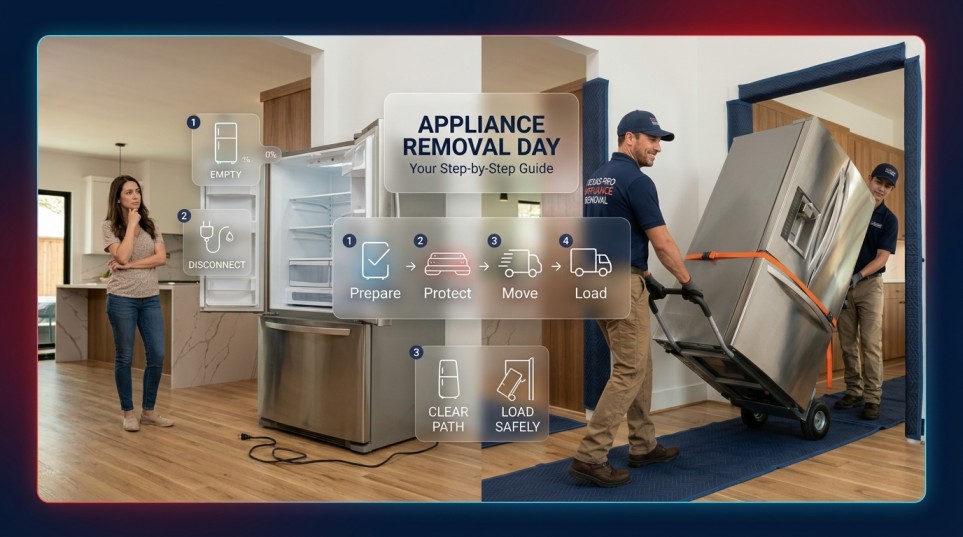
Appliance removal day goes smoothly when two things are true before the truck pulls up. The appliance is empty, dry, and disconnected from power, water, and gas. And the route from the appliance to the door is clear enough for two people to walk a heavy unit through it without turning sideways. Everything after that is the crew’s job: uninstalling built-in units, padding the door frames, protecting the floors, and getting a three-hundred-pound refrigerator out of a kitchen without leaving a mark on the way.
This guide covers what we ask homeowners to handle before an appliance removal service arrives, what the crew brings and handles on site, and what actually happens when a unit turns out to be wider than the doorway.
Key Takeaways
- Defrost and empty the unit the day before. Melting ice is the single most common avoidable problem on removal day, and it adds weight to a unit that is already heavy.
- Electric and water connections can usually be handled by you or by the crew. Gas is different. A gas line has to be capped by a licensed plumber before removal day, not on the same visit.
- Built-in and under-counter units take longer than free-standing ones. Say so when you book so the job is scheduled with enough time and the right tools.
- Clearing the path matters more than moving the appliance. Most property damage on an appliance job happens in hallways and doorways, not at the appliance itself.
- Disposal depends on the unit. Refrigerators, freezers, and window air conditioners contain refrigerant and follow a different handling path than a dryer or a dishwasher.
Who Does What on Appliance Removal Day
Most of the confusion about appliance pickup and removal comes down to one question: how much of this is on me? Here is the split we use, and the reason behind each line.
| Task | Who Handles It | Why |
|---|---|---|
| Emptying and defrosting the unit | You, the day before | Melting ice and standing water make a mess of the truck and add weight |
| Unplugging a standard cord | You or the crew | Simple and safe either way |
| Shutting off and draining a water line | You or the crew | Straightforward, but someone has to catch the water |
| Capping a gas line | A licensed plumber | Safety requirement, and it has to be done before removal day |
| Uninstalling a built-in unit | The crew | Cabinet trim, mounting screws, and hardwiring are part of the job |
| Protecting floors, walls, and door frames | The crew | We bring the pads and the protection |
| Lifting, carrying, and loading | The crew | This is what you are paying for |
| Clearing the path to the door | You, before we arrive | Faster job, lower risk of damage |
The pattern is simple. Anything that involves water, food, or personal belongings is easier for the person who lives there. Anything that involves weight, tools, or property protection belongs to the crew.
What Has to Be True Before We Can Move Anything
Run through this list the evening before your appointment. It takes about fifteen minutes, and it is the difference between a thirty-minute visit and a rescheduled one.
- The unit is empty. No food, no dishes, no laundry, no loose glass shelves sliding around inside.
- The unit is dry. Ice melted, drip pan emptied, drum and hoses drained.
- Power is disconnected, or you have told us the unit is hardwired so we can plan for it.
- The water supply valve is closed if the appliance uses one, and the line has been drained into a pan.
- Gas has been capped, not simply switched off at the valve.
- Someone eighteen or older is on site to confirm which appliance is going and to walk the crew in.
- There is a clear route from the appliance to a spot where the truck can park.
- Pets are secured. Exterior doors get propped open for the length of the job.
Confirming the Appliance Is Actually Ready
Ready does not mean unplugged. It means every utility feeding that appliance has been safely separated from it, and that separation has been left in a condition somebody can live with once the appliance is gone. That last part is what people miss.
The Disconnect Check: Power, Water, and Gas
Power. A standard plug is the easy case. Unplug it, coil the cord, and tuck it behind the unit so nobody steps on it. Electric dryers and electric ranges use a heavier 240 volt plug that sits tight in the outlet, and pulling it usually means easing the appliance out a few inches first. If that feels awkward, leave it, and we will handle it. Dishwashers and many wall ovens are hardwired to a junction box rather than plugged in. Those need the circuit switched off at the breaker before anyone opens the connection. If you know which breaker it is, label it. If the wiring situation is not straightforward once we look at it, we will tell you it needs a licensed electrician rather than guess at it.
Water. Refrigerators with ice makers, washing machines, and dishwashers all have a supply line. Close the shutoff valve first, then disconnect the line with a shallow pan and a towel underneath, because there is always more water in the line than people expect. Two things to watch for. Older copper ice maker lines and saddle valves get brittle and sometimes keep weeping after the valve is closed, which is a plumbing repair rather than a removal-day fix. And front-load washers hold water in the pump even after the hoses are drained, so empty the filter door at the bottom front of the machine.
Gas. Gas gets its own section, because turning the valve is not the same as making the line safe.
Why Gas Appliances Need a Separate Appointment First
A gas range or gas dryer connects to a shutoff valve through a flexible connector. When the appliance leaves the house, that valve becomes the only thing standing between the gas supply and your kitchen. It needs to be capped and leak-checked by a licensed plumber, and that work should happen a day or two before removal day rather than while a crew stands in the kitchen waiting.
So the sequence is: plumber caps the line, then we remove the appliance. We do not cap gas lines, and we will not move a gas appliance that is still connected. CPS Energy handles questions on the meter and service side if the situation is bigger than one appliance. And if you smell gas at any point, leave the house first and make the call from outside.
What Happens If the Crew Arrives and It Is Not Ready
It depends on what is missing. Small gaps are not a problem. A plug we can reach, a water valve that needs closing, a drain hose that needs a bucket, a couple of shelves to pull out. We handle those and keep moving.
The stopping points are the ones with real risk attached. A live gas line. A hardwired unit with no access to the breaker panel. A refrigerator still full of food. A freezer with an inch of standing water in the bottom. In those cases, we usually remove whatever is ready, explain exactly what needs to happen with the rest, and come back on a second visit. A return trip is a separate visit and is quoted as one, which is the main practical reason the preparation checklist is worth fifteen minutes of your evening.
How a Crew Actually Moves a Two Hundred Pound Appliance
A full-size side-by-side refrigerator generally runs somewhere between 250 and 350 pounds. A front-load washer with its concrete counterweight lands around 200 to 250. A wall oven is more awkward than heavy. The weight is rarely the hard part. The hard part is that the weight is tall, top-heavy, has no useful handholds, and is usually sitting in the narrowest room in the house.
Positioning and Walking the Unit Out From the Wall
The first move is straight out from the wall, not diagonally, so the leveling feet or the rear rollers do not catch and tip the unit. Before that happens, someone checks what is behind it: the water line, the dryer vent duct, the outlet, and whatever has fallen back there over the years.
On tile or a hard subfloor, a heavy unit can be walked out by rocking it corner to corner a few inches at a time. On hardwood, luxury vinyl, or a refinished floor, walking it is exactly how the leveling feet leave gouges. There, the unit gets lifted onto a runner or a pad instead of being slid. This is a small decision that decides whether your floor looks the same afterward.
Strapping to an Appliance Dolly
An appliance dolly is not a furniture dolly. It has a taller frame, a ratcheting belly strap that pins the load to the frame, and on stair work, a stair-climber belt. The strap wraps the body of the appliance, never the doors and never across a glass front or a control panel.
Once strapped, the unit tips back to roughly a forty-five-degree angle so the weight sits over the axle rather than in the mover’s arms. One person works the handles. The second spots the top of the unit through turns, because a tall appliance leads with its top corner, and that corner is what finds the drywall.
Taking a Refrigerator Down a Staircase
Upstairs laundry rooms are common in newer construction around Cibolo and New Braunfels, and garage apartments and older two-story homes turn up their share of second-floor kitchens. Stairs change the job.
The person below controls the weight and the pace of the descent. The person above steers and keeps the unit pinned to the dolly. It moves one step at a time with no momentum, and the landing and the turn at the bottom get measured before anything comes down. If the bottom of the stairwell has a tight turn, we would rather pull the appliance doors off at the top than discover the problem halfway down. And if a staircase is genuinely too tight for the unit to come down safely, we will say so before we start instead of forcing it and repairing your drywall afterward.
When Doors Come Off the Hinges
Two different doors come off on a typical job. The interior door of the room comes off its hinges by tapping the hinge pins up and lifting the door away. That buys about an inch and a half to two inches of clearance, which is often all that is missing. The door goes back on before we leave.
The appliance doors come off when the unit is too wide for the opening. A standard interior doorway is roughly 30 to 32 inches. A full-size refrigerator with its doors and handles still attached is frequently 35 to 36 inches. Pulling the doors and the handles can bring the body down to something that fits, and on French-door models it is often the whole difference between fitting and not fitting.
Protecting Your Property During an Interior Removal
Damage on an appliance job almost never comes from dropping the appliance. It comes from the pinch points along the way, where a wide object meets a narrow opening and someone is looking at their feet instead of the top corner.
| Risk Point | What Usually Goes Wrong | How a Crew Prevents It |
|---|---|---|
| Door frames and casing | Wide appliances scrape or crack the trim | Frame padding and pulling the door off its hinges when clearance is tight |
| Hardwood and tile floors | Dolly wheels and dragged feet leave gouges | Floor runners, and lifting rather than sliding |
| Stair treads and railings | Weight shifts on the descent and hits the rail | Two-person control, straps, and one step at a time |
| Corners and hallway walls | Turning a long appliance scuffs the drywall | Corner guards, and rotating the unit before the turn |
| Driveway and garage floor | Scraped concrete from setting a unit down hard | Controlled lowering onto a pad |
What to Point Out Before We Start
The two-minute walkthrough at the start of the job is worth more than anything else you can do. Tell the crew about:
- Floors you care about, especially newly refinished hardwood or a floor with a board that already lifts.
- A door frame or stair tread that has been repaired before, since repaired trim splits more easily than original trim.
- A storm door or screen door with a weak closer that will not hold itself open.
- Where the truck can safely park and whether the ramp will land on soft ground, a sprinkler head, or a septic lid.
- Any existing damage near the route, so nobody has to guess afterward whether it was there before.
- Whether you want shoes off inside, and where the pets are.
Loading and Securing for Transport
What happens in the truck matters to you for one reason: an unsecured load shifts, and a shifted load is how a unit gets damaged on the way out of your driveway. It also affects what can go on the truck alongside your appliance.
How Appliances Are Stacked and Strapped in the Truck
Heavy appliances load first and ride against the bulkhead, upright, with glass doors and control panels facing inward. They get strapped to the rails as they go in rather than all at the end, so nothing is standing loose while the next item is loaded. Appliances are not stacked on top of soft loads like mattresses or bagged household junk, because the soft load compresses and the stack leans. Weight also gets balanced front to back rather than piled at the tailgate.
This is also why crews ask what else is going. An appliance plus a garage cleanout is a different loading plan than an appliance on its own, and it changes how the truck gets packed.
Why Refrigerators Should Stay Upright
Refrigerators, freezers, window air conditioners, and dehumidifiers all have a sealed refrigerant system with compressor oil in it. When one of those units is laid on its side, oil can migrate into the refrigerant lines, and it can weep out of the compressor and onto whatever is underneath. Keeping the unit upright avoids both problems.
The sealed system is also why these appliances follow a different handling path than a dryer or a dishwasher. The refrigerant has to be recovered by someone certified to do it before the metal can be processed. Where any specific unit ends up depends on its condition and on what the receiving facility accepts, so we will not promise a particular outcome for a particular appliance. If you want to know how a specific unit is likely to be handled, ask when you book, and we will tell you what we know.
Frequently Asked Questions
Do I need to move the appliance out of the way before you arrive?
No, and we would rather you did not. Leave the unit where it sits, disconnected and empty. Dragging a refrigerator across a kitchen floor by yourself is the most common way homeowners damage a floor or hurt their back on a project like this. What genuinely helps is clearing the path the appliance will travel, not the appliance itself.
What if my doorway is too narrow for the refrigerator?
It is usually solvable, and it is a common situation in older San Antonio homes, where original door openings are narrower than what modern appliances are built to. Taking the refrigerator doors and handles off and pulling the interior door off its hinges recovers several inches. Measure the narrowest point on the route, not the doorway you are thinking of, and tell us the number when you book. If the measurement says a unit genuinely cannot come out through the house, we will tell you before the appointment rather than after we have arrived.
Can you take an appliance out through a back gate or side yard?
Often yes, and sometimes it is the better route, particularly when the alternative is crossing carpet or a refinished floor. A few things need to be true. The gate has to be wide enough and unlocked, the side yard has to be clear of hose reels, planters, and AC condenser lines, and the ground has to be firm enough for a loaded dolly, which is not always the case for a day or two after heavy rain. Mention the back gate route at booking so the truck gets positioned on the right side of the property.
Will you move furniture that is blocking the path?
We will move what is reasonable to open a path. A dining chair, a small side table, a laundry basket. That is normal, and nobody charges you for it. What is a different scope is clearing an entire room, disassembling furniture, or shifting something heavy that then has to be put back. If the route to your appliance runs through a room that needs real clearing, tell us at booking so the visit is scheduled with time for it.
What if the appliance is bolted or built into the cabinets?
That is standard work for a removal crew. Under-counter dishwashers are held by brackets into the countertop or the cabinet sides, wall ovens sit on a frame with trim screws hidden behind the door, and built-in refrigerators often have a cabinet panel and a top trim kit. All of that comes out as part of the job.
One thing worth knowing before the day: pulling a built-in unit leaves a visible opening. Cut ends of countertop, unfinished cabinet sides, unpainted wall behind the appliance. That is normal, but it surprises people who were planning to leave the space as is. If the unit is also hardwired, the circuit needs to be off at the breaker, and some hardwired connections should be handled by a licensed electrician before removal day.
Do you take the old hoses, cords, and vent ducts too?
Yes. Bag up the supply hoses, the drain hose, the old power cord, the dryer vent duct, the drip pan, and the anti-tip bracket if you have already unscrewed it, and leave them with the appliance. What stays with the house is the hardware attached to the building itself: the wall shutoff valve, the outlet, the capped gas line, and the vent hood on the exterior wall.
Book Appliance Removal With a San Antonio Crew That Comes Prepared
American Valor Waste & Disaster Services handles appliance removal in San Antonio and the surrounding communities, including New Braunfels, Cibolo, Stone Oak, Alamo Heights, Terrell Hills, Olmos Park, Shavano Park, Fair Oaks Ranch, and Hill Country Village.
When you reach out, the details that help us plan the visit are straightforward: what the appliance is, where it sits in the property, whether it is free-standing or built-in, what it is still connected to, and whether stairs are involved. That is enough to schedule the right amount of time, bring the right equipment, and give you a realistic picture of the visit before it happens. You can read more about the crew behind the work, or get in touch to discuss your appliance and request an estimate.