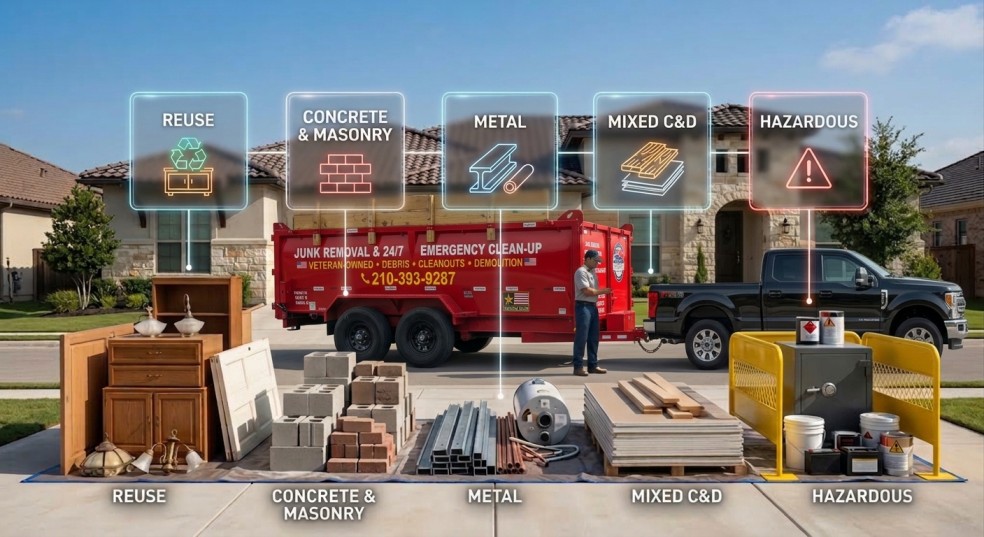
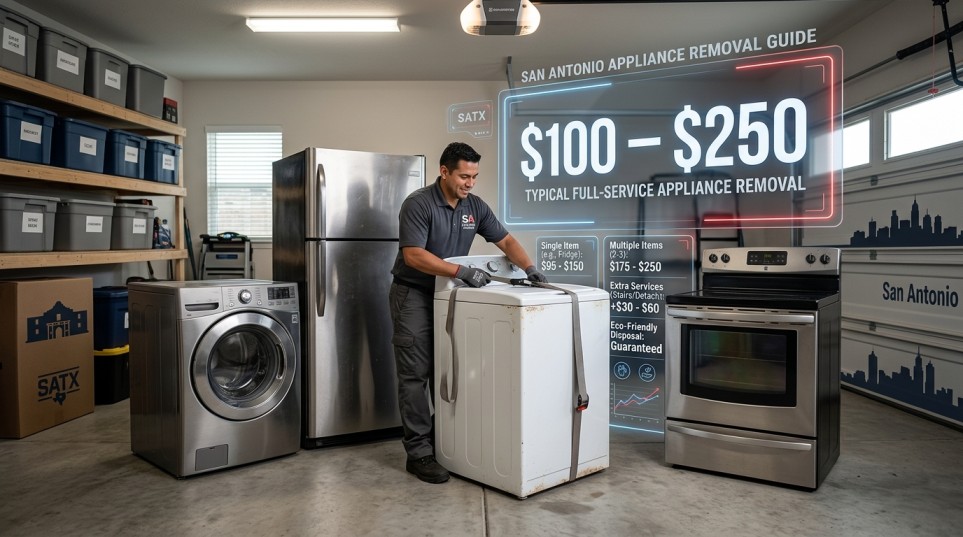
Appliance removal cost can vary depending on the type and size of the appliance, where it is located, the amount of labor required, and disposal fees. In San Antonio, homeowners often pay more when an appliance requires in-home removal, stair navigation, disconnection, or special handling. Understanding these factors can help you estimate your total appliance removal cost and choose the right removal option for your needs.
Here is the short answer. Most San Antonio homeowners pay between $100 and $250 to have a single appliance removed by a full-service crew that comes inside, disconnects it, and carries it out. Curbside-only pickup, where you put the appliance out front yourself, usually runs cheaper. Adding a second or third appliance to the same visit costs far less than the first one, because you are already paying for the truck and the trip.
But that range hides a lot. A refrigerator in a second-floor apartment is a completely different job from a microwave sitting in your driveway. And San Antonio gives you two free curbside bulky pickups per year plus four free drop-off centers, so sometimes the right answer is that you should not pay anyone at all.
I run a junk removal crew here in San Antonio, so I have loaded a lot of old refrigerators. Below I break down what actually drives the price, what the city will and will not take, and how to tell which option fits your situation. No sales pitch, just the real numbers.
What You Will Pay to Have an Appliance Hauled Away
Key Takeaways
- Single appliance, full service: roughly $100 to $250 in San Antonio.
- Curbside-only pickup is cheaper because nobody enters your home.
- The second appliance costs much less than the first on the same visit.
- Refrigerators, freezers, and AC units sit at the top of the range.
Appliance removal in San Antonio is priced per item for small jobs and by truck space for bigger ones. For one appliance, most local companies quote a flat rate. That rate covers the labor, the truck, the fuel, and the disposal fee at the other end.
Prices in this market spread out more than people expect. Curbside services that never enter your home advertise the lowest numbers, often near the $100 mark. Full-service crews that carry the appliance out of a kitchen, a garage, or an upstairs unit usually land higher, because that is a two-person job with real labor behind it.
| What You Need | Typical San Antonio Range | What Is Included |
|---|---|---|
| One appliance, already at the curb | $80 to $150 | Pickup and disposal only. You move it out yourself. |
| One appliance, removed from inside | $100 to $250 | Two-person crew, carry out, hauling, disposal fee. |
| Two or three appliances, same visit | $180 to $400 total | One trip, one truck, shared labor across the items. |
| Kitchen full of appliances during a remodel | $300 to $600 | Partial truckload pricing rather than per item. |
| Appliances plus general junk | Priced by truck space | Usually cheaper per item than booking separately. |
Why the Second Appliance Costs So Much Less
The first appliance carries the whole cost of the trip. We have to dispatch a truck, pay two people, drive to your address, and then drive to the disposal facility afterward. That happens whether we pick up one washer or four.
So the second and third items only add loading time and a little disposal weight. Nine times out of ten, removing three appliances at once costs far less than three separate visits. If you know a second appliance is coming out next month, it is almost always worth waiting and doing both together.
Why You See Prices as Low as $58 Online
Some cost estimate sites list San Antonio appliance removal in the $58 to $103 range. Those numbers usually come from lead generation databases that mix in curbside jobs, scrap pickups, and partial quotes. They are not wrong, exactly, but they rarely reflect a crew coming into your home.
Here is the honest version. If the appliance is outside and easy to grab, you can find low prices. If somebody has to come in, disconnect it, and get it down a staircase, expect to pay for that labor. Any quote that ignores the difference is going to change once the crew shows up.
Appliance Removal Cost by Type
Key Takeaways
- Refrigerators, freezers, and AC units cost most because refrigerant must be professionally recovered.
- Built-in appliances cost more than freestanding ones, even when they weigh less.
- Gas connections on dryers and stoves add a safety step to the job.
- Weight matters, but awkward shape and location matter more.
Not every appliance is priced the same, and it is not just about weight. What really moves the number is whether the unit contains refrigerant, whether it is built into cabinetry, and whether it is still connected to gas, water, or a 240 volt outlet.
| Appliance | What Drives the Price | What Adds Cost |
|---|---|---|
| Refrigerator or freezer | Heaviest common appliance, and the refrigerant has to be recovered before disposal | Built-in or counter depth units, upstairs placement, doors that will not clear the frame |
| Washer | Moderate weight, plus water lines that have to be shut off and drained | Stacked units, second floor laundry rooms, residual water in the drum |
| Dryer | Similar weight to a washer, but gas models need the line safely closed | Gas connections, vent removal, tight closet installations |
| Stove or oven | Heavy, and usually wired to 240 volts or plumbed to a gas line | Built-in wall ovens and cooktops that need cabinet work to free them |
| Dishwasher | Lighter than most, but almost always plumbed and wired into cabinetry | The job is labor rather than lifting, since it must be uninstalled |
| Water heater | Heavy, and often installed in a closet, attic, or garage ceiling | Attic placement, tight access, water still sitting in the tank |
| Microwave | Light and simple when it sits on a counter | Over-the-range units are mounted, wired, and vented |
| Window or portable AC unit | Small and light, but it still contains refrigerant | Recovery is required no matter how small the unit is |
Why Refrigerant Appliances Cost More to Remove
This is the single biggest reason a refrigerator costs more than a washer of similar weight. Federal law requires the refrigerant to be recovered by a certified technician before the appliance is scrapped or landfilled. It cannot simply be crushed with the coolant still inside, because those chemicals damage the ozone layer.
That means an extra step and an extra fee at the disposal end. Refrigerators, freezers, wine coolers, window AC units, and dehumidifiers all fall into this category. So does a mini fridge from a dorm room, even though it weighs almost nothing.
This also explains something else. It is the reason free scrap pickup services turn down so many appliances, and the reason some transfer stations charge a surcharge on refrigerant units. Somebody has to pay for that recovery, and it is not free.
Built-In Appliances Versus Freestanding Units
A freestanding refrigerator is heavy but simple. You unplug it, walk it out on a dolly, and you are done. A built-in wall oven is lighter, but it is screwed into cabinetry, wired into the panel, and often surrounded by trim that has to come off first.
So built-in appliances are usually priced higher despite weighing less. You are paying for uninstallation, not muscle. If you are mid-remodel and the cabinets are already coming out, tell us. That often makes the job easier and cheaper.
What Actually Changes Your Final Price
Key Takeaways
- Where the appliance sits matters more than what it weighs.
- Stairs and long carries add labor time, so they add cost.
- Still connected to gas, water, or power usually means an extra charge.
- A broken appliance does not cost more than a working one to haul away.
When we quote a job, we are really pricing four things: how far the appliance has to travel to reach the truck, how many people it takes to move it, whether anything has to be disconnected first, and what the disposal facility will charge us for it.
Where the Appliance Sits in Your Home
A washer in an attached garage is the cheapest scenario. It is on the ground floor, close to the driveway, and there is nothing to navigate. A refrigerator in a third-floor walk-up is the most expensive, because two people are carrying two hundred pounds down two flights of stairs.
Between those extremes, the things that add time are narrow hallways, tight door frames, sharp turns at the bottom of a staircase, and long walks from the back of the property to the street. Every extra minute of carrying is labor we have to price in.
Whether It Still Needs to Be Disconnected
If the appliance is already unplugged, drained, and pulled away from the wall, the job is faster, and the price reflects that. If it is still hooked up, somebody has to handle that safely before anything moves.
Water lines and standard electrical plugs are usually straightforward. Gas lines are the exception, and I will come back to that below, because it is a safety issue rather than a pricing one.
Curbside Placement Versus In-Home Removal
This is the easiest way to lower your bill. If you can safely get the appliance to your driveway or curb, curbside pickup is meaningfully cheaper than in-home service across every company in San Antonio.
But be honest with yourself about the word safely. A full-size refrigerator on a staircase has hurt a lot of people. If you do not have a proper appliance dolly, straps, and a second able-bodied person, the savings are not worth the risk. Back injuries cost more than junk removal.
Working, Broken, or Already Scrapped
Here is something that surprises people. A broken appliance does not cost more to remove than a working one. The weight is the same, and the disposal fee is the same. Condition does not change the hauling price.
What does change is your alternatives. A working appliance might qualify for donation or free scrap pickup. A rusted-out unit with a cracked door will be turned down by both, which is often why people end up calling us in the first place.
Free and Low-Cost Appliance Disposal in San Antonio
Key Takeaways
- San Antonio gives residential customers two free curbside brush and bulky collections per year.
- Large appliances and water heaters are accepted at curbside bulky collection.
- Four free bulky waste drop-off centers are open Tuesday through Saturday.
- Mixing brush into a bulky pile can bring a fine of up to $2,000 per day.
I would rather tell you the truth than sell you something you do not need. San Antonio has real free options for appliance disposal, and for a lot of people they are the right choice. Here is how each one works and where each one falls short.
| Option | What It Costs | What It Will Not Do |
|---|---|---|
| City curbside bulky collection | Free, twice per year per household | Crews will not enter your home or disconnect anything. You must get the appliance to the curb yourself. |
| Bulky waste drop-off centers | Free with a recent CPS Energy bill and photo ID | You load it, drive it, and unload it. Limited to four cubic yards per visit. |
| Out-of-cycle city collection | Fee based on pile size, quoted by staff | Items must already be at the curb before the city will estimate the cost. |
| Free scrap metal pickup services | Free | They only want working or rebuildable major appliances. Built-ins, damaged units, and non-metal appliances get refused. |
| Retailer haul away on delivery | Free or a small fee | Only removes the appliance you are replacing, and usually only if you paid for delivery. |
| Self haul to a transfer station | Entry fee plus charge by weight | You need a truck, and refrigerant units may be refused or surcharged. |
How City Curbside Bulky Collection Actually Works
The city provides curbside brush and bulky item collection twice per year for each residential household. You do not schedule it. It runs on a neighborhood cycle, and you get a door hanger seven to ten days before your collection week.
Large appliances and water heaters are on the accepted list, along with furniture, mattresses, barbecue grills, carpeting, fencing, and up to three televisions. So yes, the city will take your old refrigerator.
But the rules are strict, and this is where people get burned:
- Your pile must be out by 7 a.m. on the Monday of your collection week.
- The pile must be within eight feet of the curb and no more than eight cubic yards.
- It has to be at the curb in front of your house, even if your garbage is collected in the alley.
- It cannot be blocked by parked cars or sit under low-hanging branches or power lines.
- Do not mix brush into a bulky pile. Mixing materials can bring a fine of up to $2,000 per day plus collection and disposal charges.
- Collection can take up to a week after your set-out date, so the appliance sits in your yard for a while.
If you miss both of your yearly collections, you can request an out-of-cycle pickup. A staff member gives you a free estimate based on the size of the pile, and once you pay, collection happens within two working days.
The Four Free Bulky Waste Drop Off Centers
If you have a truck and you do not want to wait for your collection week, the city runs four bulky waste collection centers open to residential customers. Bring a recent CPS Energy bill showing you pay the environmental fee, plus a photo ID, and the visit is free.
| Center | Address | Hours |
|---|---|---|
| Bitters Bulky Waste Collection Center | 1800 Wurzbach Parkway, San Antonio, TX 78216 | Tue to Fri, 8 a.m. to 5 p.m.; Sat, 8 a.m. to noon |
| Frio City Road Center | 1531 Frio City Road, San Antonio, TX 78226 | Tue to Fri, 8 a.m. to 5 p.m.; Sat, 8 a.m. to noon |
| Culebra Bulky Waste Collection Center | 7030 Culebra Road, San Antonio, TX 78238 | Tue to Fri, 8 a.m. to 5 p.m.; Sat, 8 a.m. to noon |
| Rigsby Road Bulky Waste Collection Center | 2755 Rigsby Road, San Antonio, TX 78222 | Tue to Fri, 8 a.m. to 5 p.m.; Sat, 8 a.m. to noon |
Large appliances, water heaters, and AC units are all accepted at these centers. So are sinks, tubs, countertops, furniture, and up to one cubic yard of construction material. Bulky items are capped at four cubic yards per visit, and materials in a truck bed cannot stack above the fender.
One detail worth knowing: the accepted list at the drop-off centers is different from the curbside list. Glass, mirrors, and auto parts are fine at a drop-off center but not at the curb.
Why Free Scrap Services Turn Down So Many Appliances
You will find companies advertising free appliance pickup all over San Antonio and Bexar County. They are legitimate, and the business model is simple: they make money on the scrap metal and on units they can rebuild and resell.
That model creates real limits. They want working or repairable major appliances made mostly of metal. A twelve-year-old washer with a bad motor is attractive to them. A cracked plastic dishwasher, a built-in wall oven, or a rusted freezer that has been sitting outside is not.
The other issue is scheduling. Because the pickup only pays if the item has resale value, these services can be slow to respond and sometimes do not show. If you are on a deadline, closing on a house, or turning over a rental, that uncertainty is the real cost.
When Free Options Genuinely Make Sense
Use the free routes when all of these are true. The appliance is already outside, or you can safely get it there. You are not in a hurry. Your collection week is coming up, or you have a truck and a free Saturday morning. And the unit is in decent enough shape that a scrap service will actually take it.
Pay for removal when any of these apply. The appliance is upstairs, in a basement, in an attic, or built into cabinetry. It is still connected. You need it gone this week. You have several items at once. Or you simply should not be lifting two hundred pounds, which is a completely reasonable position to take.
How to Prepare an Appliance for Pickup
Key Takeaways
- Empty and defrost refrigerators and freezers at least a day ahead.
- Drain washers and water heaters so you are not moving extra weight.
- Clear the path from the appliance to the door before the crew arrives.
- Never disconnect a gas line yourself. Call the utility or a licensed plumber.
A little prep genuinely lowers your price and speeds up the visit. Most of it takes fifteen minutes, and none of it requires tools you do not already own.
Emptying, Defrosting, and Drying Out the Unit
Start a day early with anything that holds water. Unplug a refrigerator or freezer at least twenty-four hours before pickup, prop the door open, and put towels down to catch the melt. A freezer full of ice is heavier than the appliance itself, and melting ice in the back of a truck makes a mess of everything else.
For a washer, run a spin cycle to empty the drum, then disconnect the hoses over a bucket. There is always more water in there than you expect. For a water heater, shut off the supply and drain the tank through the valve at the bottom. A full fifty-gallon tank weighs several hundred pounds on its own.
Water, Gas, and Electrical Disconnection
Water and standard electrical are usually safe to handle yourself. Shut off the supply valve, unscrew the hoses, unplug the cord. That is it.
A 240 volt outlet, the kind an electric dryer or range uses, is also fine to unplug, but do not cut or splice the wiring. If the appliance is hardwired rather than plugged in, that is an electrician’s job.
What You Should Not Try to Disconnect Yourself
Do not disconnect a gas line yourself. This is the one thing I ask everyone to take seriously. Gas dryers, gas ranges, and gas water heaters all need the line properly shut off and capped by someone qualified. A loose fitting is a genuine hazard, not an inconvenience.
Call CPS Energy or a licensed plumber for gas work. It is usually a quick, inexpensive visit, and it needs to happen before removal day either way.
The same goes for sealed refrigerant lines. Do not puncture or cut into the coils on a refrigerator or AC unit to make it lighter. That releases refrigerant illegally and can injure you.
Clearing the Removal Path
Walk the route from the appliance to your front door and move whatever is in the way. Rugs, shoes, potted plants, kids’ toys, the console table in the hallway. A clear path is faster, safer, and protects your walls and floors.
If you have a storm door or a screen door that does not open fully, mention it when you book. Sometimes we need to pull a door off its hinges to get a refrigerator through, and it helps to know that in advance.
Where Your Old Appliance Ends Up
Key Takeaways
- Major appliances are mostly steel, so the metal gets recycled.
- Refrigerant is recovered by certified technicians before scrapping.
- Working appliances can sometimes be donated to local charities.
- Ask any company where your items go. A good answer is a good sign.
Almost nothing about an appliance needs to go in a landfill, and that matters more than most people realize.
What Gets Recycled and What Gets Scrapped
A washer, dryer, or stove is largely steel with some copper, aluminum, and plastic. Scrap processors separate those metals and feed them back into the supply chain. The plastic and insulation that cannot be recovered is the only part that ends up as waste, and it is a small fraction of the total weight.
Refrigerators and freezers go through an extra step first. A certified technician recovers the refrigerant, and only then does the shell get processed for metal. That is a legal requirement, not an optional courtesy.
When an Appliance Can Still Be Donated
If it works, somebody probably wants it. Local charities and reuse organizations regularly accept working refrigerators, washers, dryers, and stoves, especially newer units in clean condition.
Most will not take anything that needs repair, and many have age limits on refrigerators for efficiency reasons. So the test is simple: would you be comfortable selling it to a neighbor? If yes, donation is worth a phone call before you pay anyone to haul it.
What to Ask Before You Book Anyone
Ask where your appliance is going. It is a small question that tells you a lot. A company that recycles and donates will answer immediately and specifically. A company that dodges the question is probably taking everything straight to a landfill, which costs them less and costs the city more.
At American Valor Waste, we sort every load before disposal, and we handle refrigerant units through the proper channels. We are a veteran-owned local crew, not a call center, and we will tell you honestly if the city can take your appliance for free instead. Sometimes that is the right answer, and I would rather you trust us next time than pay us this time.
Frequently Asked Questions
Will you take an appliance that is still connected?
Yes, for water and standard electrical connections. We can shut off a water line, disconnect hoses, and unplug the unit as part of the job. Gas lines are the exception. A gas dryer, range, or water heater needs to be disconnected and capped by CPS Energy or a licensed plumber before we move it, for safety reasons.
Do I pay more if the appliance does not work?
No. A broken appliance costs the same to remove as a working one, because the weight and the disposal fee are identical. Condition only affects your free alternatives, since donation programs and free scrap services usually turn down units that need repair.
Can you remove an appliance from a second floor apartment?
Yes, and this is exactly the situation where a crew is worth the money. Stairs add labor time, so the price is higher than a ground-floor pickup. Tell us the floor number and whether there is an elevator when you book, so the quote is accurate before we arrive.
Is same-day appliance removal available in San Antonio?
Often, yes, depending on how the day is already booked. We give you a two-hour arrival window and call about fifteen minutes before we get there. Same-day works best when you call early, and the appliance is easy to access.
Do you take appliances from rental properties if I am not the tenant?
Yes. Property managers and landlords are a regular part of our work, especially during tenant turnovers. We just need someone to grant access to the unit, and we can coordinate with you remotely if you do not live nearby.
Can I get paid for my old appliance instead of paying for removal?
Sometimes. Free scrap metal services will take working or rebuildable major appliances at no charge, and a few resale-focused companies offer credit for items with real value. It is worth a call if your unit still runs. If it is damaged, built-in, or has been sitting outside, expect to be turned down.
How many free bulky pickups does San Antonio give me per year?
Two. The city provides curbside brush and bulky item collection twice per year for each residential household, on a neighborhood cycle. You will get a door hanger seven to ten days before your collection week. If you miss both, you can request an out-of-cycle collection for a fee based on pile size.
What happens if I put my appliance out on the wrong day?
It sits there. Crews run on a set neighborhood cycle, and a pile set out after they have passed will not be collected. Worse, if your pile is obstructed or mixed with brush, the city can issue a fine of up to $2,000 per day plus collection and disposal charges.