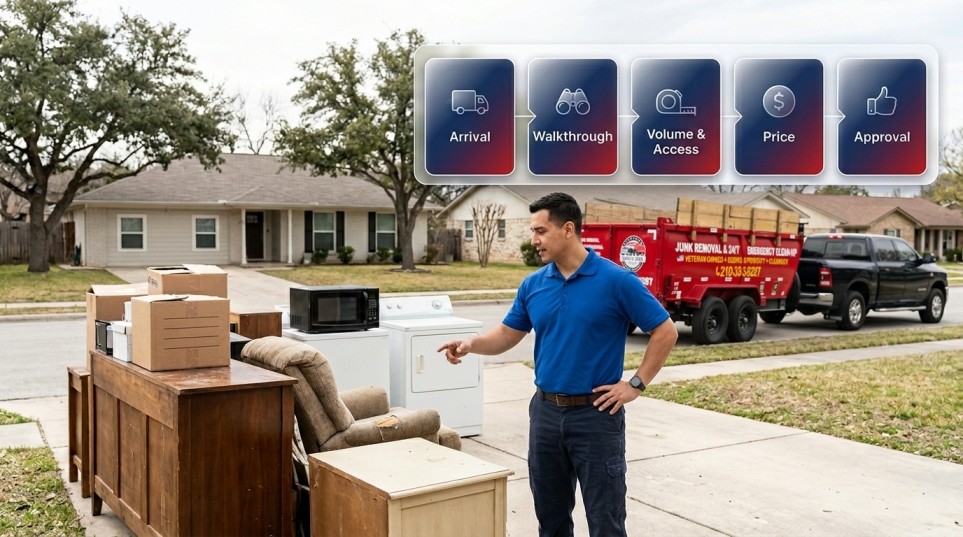
An on-site junk removal estimate is a short visit where a crew comes to your property, looks at everything you want hauled off, checks how difficult the items will be to reach and carry, and gives you a price before any work begins. Most visits run 15 to 30 minutes from the knock at the door to the number in your hand. Nothing is owed, and nothing is committed until you say yes, and if you approve the price, many crews can load the same day they are standing there.
This guide walks through the full workflow: how to book the visit, what the crew studies during the walkthrough, how truck space and access turn into a price, what to ask before you agree, and how to prepare so the number you get is the number you pay.
What an On-Site Junk Removal Estimate Actually Involves
Key Takeaways
- The visit follows a set sequence: arrival, walkthrough, volume and access assessment, price, your decision.
- Typical visits take 15 to 30 minutes, though large or scattered jobs take longer.
- A quote is not a commitment. You can approve it, decline it, or ask for time.
The visit is more structured than most people expect. A crew is not glancing at a pile and guessing a number. They are working through a short sequence of checks, and each one feeds the price.
| Stage | Typical Time | What’s Happening |
|---|---|---|
| Arrival and introduction | 2-3 minutes | Crew confirms your name, the job, and what you called about |
| Property walkthrough | 5-15 minutes | Crew views every item, checks access, notes anything unusual |
| Volume and access assessment | 3-5 minutes | Crew works out truck space and any handling difficulties |
| Price presented to you | 2-5 minutes | You’re given a firm number and what it covers |
| Your decision | However long you need | Approve, decline, or ask them to come back |
| Removal begins, if approved | Immediately | Many jobs are completed in the same visit |
Those times are typical ranges, not promises. A bedroom set in a driveway moves through the sequence quickly. A two-story house with a packed attic, a full garage, and a shed out back takes considerably longer, because the crew has to see all of it before anyone can price it honestly.
Why Companies Send Someone Out Instead of Quoting Over the Phone
Phone descriptions almost always undercount the job. A full garage means one thing to a person who parks one car in it and something very different to a family that has been stacking boxes in it for eleven years. Both callers describe it the same way.
Two things stay invisible over the phone, and both drive the price:
- Volume. How much truck space the load actually takes once furniture, boxes, and odd-shaped items are stacked together.
- Access and labor. Whether the crew carries items ten feet to the truck or hauls them down two flights of stairs, through a narrow hallway, and across a long driveway.
A number given blind has to protect the company against the worst case, or it gets revised on removal day when the crew sees what is really there. Neither outcome is good for you. Seeing the job in person is what allows a company to hand you a firm price instead of a range that moves later.
Before the Visit: Booking and What to Expect
Key Takeaways
- Have the property address, item list, access details, and your availability ready when you call.
- Most companies give an arrival window rather than an exact time, usually with a call ahead.
- Someone who can grant access and approve the price needs to be at the property.
How to Schedule an On-Site Estimate
Booking usually takes one phone call or one form submission. You can request an estimate with the basics, and the office will match a crew to your area and your timing. The more you can describe up front, the better the scheduling fits the job.
Useful details to have ready:
- The property address and property type: house, apartment, condo, rental unit, office, retail space, warehouse, or storage unit.
- A rough item list by area: garage, one bedroom, back patio, attic, and so on.
- Access notes: stairs, elevator, gate codes, locked units, or limited truck parking.
- Anything heavy or awkward, such as a safe, a piano, a treadmill, a hot tub, or a shed.
- Anything you suspect is restricted, including paint, fuel, chemicals, or unlabeled containers.
- Your availability, including any window when the property can be accessed.
Commercial jobs need a little more coordination. Offices, retail spaces, and facilities often have building hours, loading dock rules, freight elevator reservations, and insurance paperwork requirements. Mention those when you book a commercial cleanout so the visit is scheduled around your operating hours instead of through them.
Arrival Windows, Confirmation Calls, and Delays
Expect a window, not a precise minute. Junk removal is physical work with unpredictable variables, and the job before yours can run long for reasons nobody could see in advance. A window absorbs that. Most companies also call or text when the crew is on the way, which gives you time to move a car or unlock a gate.
Delays happen for ordinary reasons: heavy traffic, a previous job with more items than expected, weather that makes an outdoor load unsafe, or a landfill or transfer station line that runs longer than usual. If your window is passing and you have not heard anything, call the office. A crew that is running behind should be able to tell you where they are and when to expect them.
Do You Need to Be Home for the Estimate?
Somebody with access and approval authority needs to be there, but it does not have to be you. That can be a spouse, an adult family member, a tenant, a property manager, a real estate agent, or an employee at a business. What matters is that the person can let the crew in and can say yes or no to the price.
If you are sending someone in your place, tell the company in advance who will meet the crew and what they are authorized to approve. Some companies can also present the price to you by phone while the crew is standing in the property. That works well for landlords, out-of-state family members, and anyone managing a cleanout remotely.
The Walkthrough: What the Crew Is Actually Looking At
Key Takeaways
- Crews price volume plus labor, so what an item weighs and how far it travels matters as much as its size.
- Stairs, narrow doorways, long carries, and parking distance all change the number.
- Certain materials get flagged for special handling and may need a separate disposal route.
The First Pass Through Your Property
The crew starts where you called about, then asks the question that decides half the estimate: is there anything else? There almost always is. The garage cleanout turns into the garage plus the shed plus two bikes on the side yard plus a mattress in the spare room.
Walk them everywhere, even the areas you feel unsure about. Open the attic hatch, point at the crawlspace, mention the storage unit across town. Forgotten items are the single most common reason a price changes after the fact, and every one of them is easy to avoid by showing the crew now.
How Crews Judge Truck Space on the Spot
Experienced crews think in fractions of a truck, not in cubic feet. They look at your items and mentally stack them: what nests, what collapses, what has to ride whole because it cannot be broken down. A sofa that cannot be disassembled holds its full footprint the entire trip. Twenty bags of clothing compress into a fraction of the space they occupy on your floor.
Two limits apply to every truck, and either one can be the one that matters:
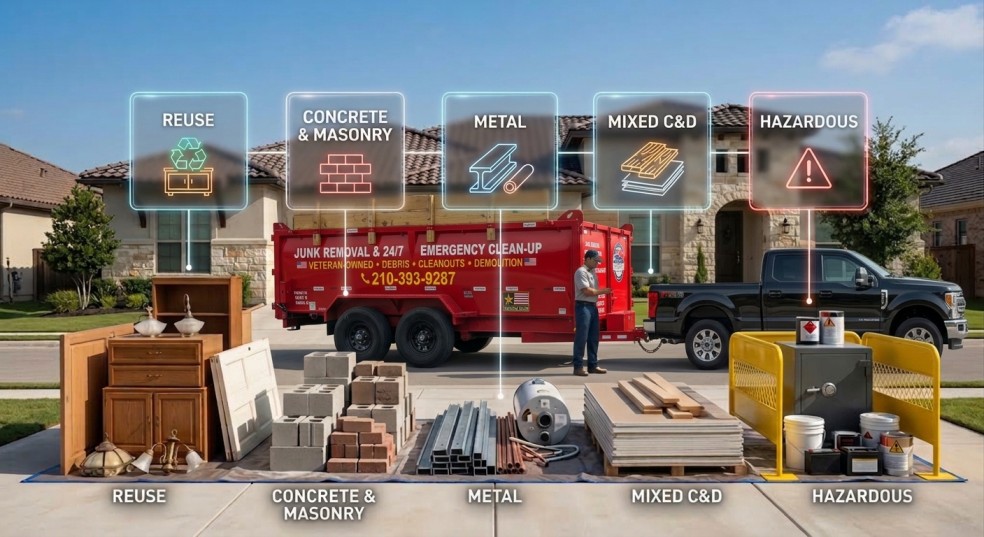
- Space limits show up with bulky, light material: furniture, mattresses, boxes, plastic storage bins, and yard debris.
- Weight limits show up with dense material: concrete, tile, dirt, brick, roofing shingles, plaster, and wet lumber.
This is why a modest-looking pile of renovation debris can price like a much larger load of household clutter. The pile is small, but it is heavy, and weight decides both what the truck can legally carry and what the disposal facility charges. When a crew asks what is underneath a tarp or inside those buckets, this is why.
Access Checks: Stairs, Doorways, Gates, and Parking
Access is labor, and labor is price. The same load costs differently depending on the trip each item has to make. During the walkthrough, crews are quietly measuring the route:
- Stairs. How many flights, how tight the turns, and whether a landing forces items to be tipped or pivoted.
- Doorways and hallways. Whether a sectional or an armoire clears the frame, or whether it has to come apart first.
- Elevators. Whether one is available, whether the building requires it to be reserved, and whether padding is required.
- Parking and carry distance. Whether the truck can back up close, or whether every item travels the length of a driveway or a parking lot.
- Gates, locks, and codes. Whether a fence, alley, or gated entrance limits the approach.
- Ground conditions and clearances. Low branches, soft ground, tight alleys, and turns a loaded truck cannot make.
Carry distance surprises people more than stairs do. Fifty extra feet on every trip adds up fast across an entire truckload, which is why a second-floor apartment above a close parking spot can be easier than a ground-floor unit at the far end of a complex.
Items That Get Flagged for Special Handling
Some materials cannot simply be loaded with everything else. Acceptance depends on company policy, local regulations, and what nearby facilities will take, so the answer is genuinely different from company to company and city to city. Items that commonly get flagged include:
- Appliances containing refrigerant, such as refrigerators, freezers, and air conditioners.
- Mattresses and box springs, which some facilities process separately.
- Tires, electronics, and televisions, which often follow their own disposal routes.
- Paint, solvents, fuel, pesticides, and pool chemicals.
- Propane tanks, batteries, and pressurized containers.
- Materials that may contain asbestos, such as old pipe wrap, certain floor tiles, and some textured ceilings.
- Medical or biohazard waste, and anything in an unlabeled container.
If you have something in this category, the safest move is the simplest one: leave it where it is and point it out. Do not open unknown containers, pour anything out, or try to consolidate chemicals so they take less room. Tell the crew what you know and what you do not know about it. If an item cannot be taken, a good crew will tell you that on the spot and explain the disposal route that does apply, rather than loading it and hoping.
What Can Make a Walkthrough Take Longer Than Expected
A few situations reliably stretch the visit. None of them are problems, but knowing about them helps you plan your afternoon:
- Nothing is sorted yet, so keep-and-toss decisions are being made while the crew waits.
- Contents are stacked deep, and items have to be shifted before anyone can see what is behind them.
- More than one decision-maker is involved, which is common with estates and family properties.
- Multiple areas or units, such as a house plus a shed plus a storage unit, or several suites in one building.
- Unknown contents, like a sealed attic, an inherited property, or a unit nobody has opened in years.
- Conditions that need a safety look first, including heavy accumulation, water damage, pests, or unstable piles.
Getting Your Price: What You Should Hear and See
Key Takeaways
- A clear estimate names a specific number tied to a specific list of items.
- Ask what is included, excluded, and what would change the price before you approve.
- You are allowed to think about it. A quote is information, not an obligation.
What a Clear On-Site Estimate Sounds Like
A good estimate is specific enough that you could repeat it back. It should cover four things:
- The exact scope. Which items, from which areas, are included in this number.
- What the price covers. Labor, loading, hauling, and disposal handling, stated plainly rather than assumed.
- Anything extra. Fees tied to specific item types, or anything the crew cannot take and why.
- What would change it. Usually added items, or something the crew could not see during the walkthrough.
You should be given the number before work starts, and you should be able to get it in writing by text or email. For a defined pile in front of everyone, be cautious about an answer along the lines of let us start, and we will see where we land. Open-ended pricing has its place on jobs where the scope genuinely cannot be known yet, but that should be explained to you, not glossed over.
Questions Worth Asking Before You Agree
These questions take two minutes and prevent nearly every misunderstanding that happens on removal day:
- Does this price include labor, loading, and disposal, or are those separate?
- What would change this number once you start?
- Are there extra charges for specific items, such as appliances, mattresses, tires, or electronics?
- What happens if it does not all fit on the truck today?
- Do you sweep or tidy the area after loading?
- When and how do I pay, and is a deposit required?
- Can I get this in writing before you begin?
- Where do the items go, and is anything here likely to be donated or recycled?
On that last question, expect an honest answer rather than a sweeping one. Usable furniture and household goods may be suitable for donation depending on condition and what local organizations are accepting, and some materials such as metal, cardboard, and certain electronics have recycling routes. Condition, material type, and local facility availability decide the outcome, so treat any promise that everything gets donated or nothing ever reaches a landfill as a claim worth asking more about.
Approving on the Spot vs Taking Time to Decide
Both are normal. Approving on the spot makes sense when the price fits your budget, you want the space cleared today, and it saves you from scheduling a second visit. If the crew has time remaining in their day, work often begins within minutes.
Taking time makes sense when the job is large, when someone else has to sign off, or when you are comparing companies. Ask how long the quote is good for, since pricing can shift with disposal costs and schedule availability. If you are comparing bids, compare the scope rather than only the number: what each company includes, what each one refuses to take, whether disposal is bundled, and how each one handles the possibility of a second load. The lowest quote is not automatically the best value, and the highest is not automatically better work.
What Happens Immediately After You Approve
The crew confirms the final list with you one more time, so everyone agrees on exactly what is leaving. Then the practical work starts: protecting doorways and floors where it makes sense, planning the loading order so heavy and awkward items go first, and clearing the largest pieces before the small stuff.
Before the truck leaves, walk the areas yourself. Check that nothing you meant to keep went out and that nothing you meant to remove got missed. Payment is usually collected once the work is done and you have looked it over, and you should receive a receipt. Keep in mind that the price is tied to the list you approved, so items added mid-job are a fair reason for the number to be adjusted, and it should be discussed with you before it is.
How to Prepare So the Estimate Is Accurate the First Time
Key Takeaways
- Visible items get priced accurately. Hidden items are the reason numbers change later.
- Separate and clearly mark everything you are keeping before the crew arrives.
- Never move anything heavy, sharp, or chemical just to prepare. Point it out instead.
Gather Everything Into One Visible Place
If you can safely move smaller items into one area, such as the garage, the driveway, or a single room, do it. A consolidated pile is far faster to assess and easier to price precisely, because the crew can see the true volume instead of estimating around corners and closet doors.
Do not push this past what is comfortable. Leave anything heavy, bulky, or awkward exactly where it is. Moving heavy furniture and appliances is the part you are hiring out, and a strained back before the crew even arrives helps nobody. Point at those items and let the crew plan the route.
Physically Separate What You’re Keeping
Distance is clearer than instructions. Move keepers to a different room, a closed closet, or a corner marked with painter’s tape and a sign. Verbal directions like everything except the blue chair get lost once four people are carrying items in different directions.
This matters most in garages, storage units, and estate properties, where useful items and discards have been sitting side by side for years. Once something is loaded and other items are stacked on top of it, retrieving it is genuinely difficult.
Clear the Path the Crew Will Carry Items Through
Five minutes here speeds up the whole visit and keeps everyone safer:
- Move cars off the driveway or reserve a parking spot near the entrance.
- Unlock gates, share codes, and reserve the freight elevator if the building requires it.
- Clear hallways and doorways, and roll up loose rugs or tape down cords.
- Secure pets in a closed room, since doors stay open during loading.
- Confirm entry instructions if the crew arrives before you do.
Point Out Anything Hidden, Heavy, or Awkward
Say it out loud during the walkthrough rather than after the price is set. Items worth mentioning specifically include safes, pianos, gun safes, treadmills, hot tubs, pool tables, sheds, playsets, and anything bolted down or built in. The same goes for debris under a tarp, contents in an attic or crawlspace, and any container of chemicals or fuel.
None of these are deal breakers. They simply need to be part of the plan, because they change the equipment, the number of people, and the time the job takes. A crew that knows about the safe in the back bedroom prices for it once. A crew that discovers it halfway through has to stop and renegotiate, which is the situation everybody wants to avoid.
When You Need an On-Site Visit and When a Photo Quote Is Enough
Key Takeaways
- Single, visible items usually price fine from photos or a phone call.
- Full rooms, garages, estates, and construction debris need an on-site look.
- Photo quotes are typically confirmed on arrival, so accuracy still depends on what the photos showed.
Not every job needs someone at your door. The dividing line is simple: if the volume and the access can be judged accurately from a description or a few photos, a remote quote works. If either one has to be seen, an on-site estimate protects you from a price that changes later.
| Your Situation | Better Option | Why |
|---|---|---|
| One or two clearly visible items | Photo or phone quote | Nothing to assess in person |
| Full garage, attic, or storage unit | On-site estimate | Volume is nearly impossible to judge from photos |
| Items spread across multiple rooms or floors | On-site estimate | Carry distance and stairs affect the price |
| Estate or inherited property you haven’t sorted | On-site estimate | Contents are usually more than expected |
| Construction or renovation debris | On-site estimate | Weight and material type need to be seen |
| Single appliance or mattress | Photo or phone quote | Standard item with predictable handling |
| You’re not local to the property | Photo quote, with an on-site confirmation | Someone still needs to grant access on removal day |
When you are genuinely unsure, choose the on-site visit. It costs you a short window of your day and removes the guesswork from the number. And if you do send photos, shoot them from a doorway rather than up close, include the path to the exit, and take one shot of the parking or driveway. That is the context a crew cannot get from a tight photo of a couch.
Frequently Asked Questions
Can someone else be home for the estimate instead of me?
Yes, as long as that person can let the crew in and has the authority to approve the price. A spouse, adult family member, tenant, property manager, real estate agent, or an employee at a business all work. Tell the company in advance who will be meeting the crew and what they are authorized to approve. Many companies can also present the price to you by phone while the crew is still at the property, which is useful if you are managing a cleanout from out of town.
What if the crew can’t fit everything on the truck that day?
It happens on large cleanouts, and it should be discussed with you before loading begins rather than after. Ask about it during the estimate: whether a second load or a second visit would be needed, how that affects the price, and how soon the truck could return. Weight limits can end a load before space does, especially with dense material like concrete, tile, or wet lumber, so a truck that looks half empty may already be full in the way that matters.
Will the crew move items to look behind or underneath them?
Usually only enough to see what is there and judge the volume, since a full excavation of a packed garage is the job itself, not the estimate. If a large portion of your items are buried or stacked deep, say so during the walkthrough. The crew can then price with that uncertainty in mind or explain what would change the number once they reach the bottom of the pile.
Can I get an estimate for a property I’m not currently living in?
Yes. Vacant homes, rental turnovers, inherited properties, foreclosures, and storage units are common jobs. What matters is access: someone has to open the property for the walkthrough and again on removal day. If you are out of the area, arrange for a neighbor, agent, tenant, or property manager to meet the crew, and ask whether the price can be presented to you by phone or email for approval.
What happens if I’m not home during my arrival window?
Call the office as soon as you know. Crews run on a schedule built around several jobs a day, so a missed window usually means rescheduling rather than waiting. If you are running late by a few minutes, a quick call often solves it, because the crew may be able to adjust the order of their stops. If someone else can let them in, that also works, provided they can approve the price or reach you by phone.
Does an on-site estimate mean I’m committed to hiring them?
No. The estimate is information, and you are free to decline, think it over, or get other quotes. A crew should present the price, answer your questions, and accept your answer either way without pressure. If you feel pushed to decide on the spot, that is a reasonable signal to slow down and compare your options before agreeing to anything.
Book a Free On-Site Junk Removal Estimate in San Antonio
If you are looking at a garage, an office, a rental turnover, or a property full of belongings you need gone, the fastest way to a real number is to have someone look at it. American Valor Waste & Disaster Services provides on-site junk removal estimates for residential and commercial properties in the San Antonio, Texas area, with the price presented to you before any work begins.
To get started, request an estimate with your address, the property type, and a rough description of what needs to go. We will confirm coverage for your location and set up a visit. You can also review our junk removal services for residential cleanouts and hauling, our commercial cleanout services for offices, retail spaces, and facilities, or learn more about our team before you call.
Bring your questions to the walkthrough. Ask what is included, ask what would change the price, and ask what happens to your items after they leave. A straight answer to those three questions tells you most of what you need to know about who you are hiring.