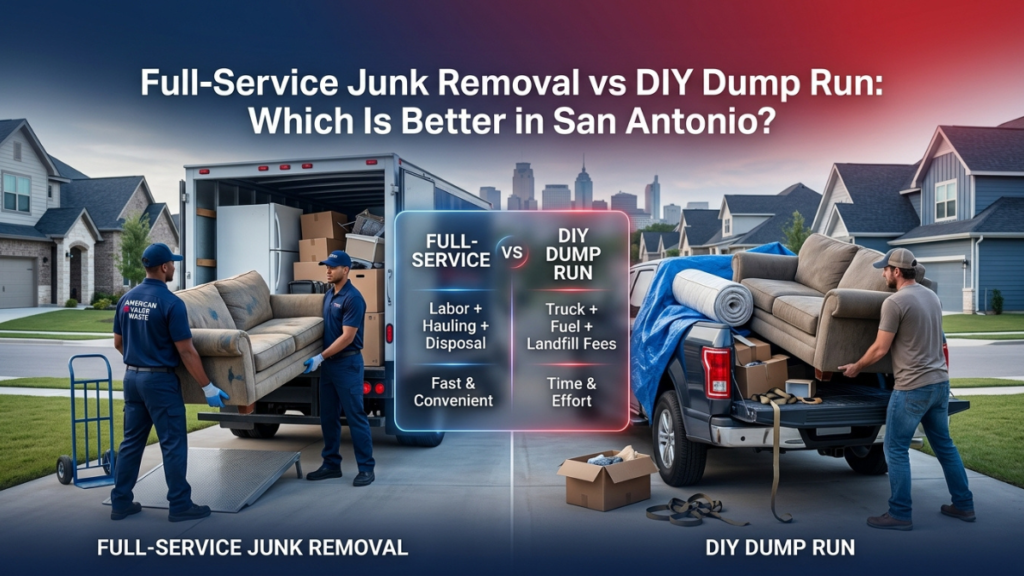
Full-Service Junk Removal vs DIY Dump Run comes down to load size and effort. Full-service costs more upfront but covers labor, hauling, and landfill fees. A DIY dump run works best for small, light loads. For heavy, large, or mixed loads, a San Antonio crew is usually smarter.
Key Takeaways
- A DIY dump run in San Antonio often costs $50 to $150 per trip. That is before counting landfill fees, fuel, rental gear, and your own time.
- Full-service junk removal charges one flat price for labor, hauling, and disposal. There is no separate landfill fee to calculate.
- Heavy items like refrigerators, sofas, and hot tubs create real injury risk. Most homeowners are not equipped to handle them alone.
- San Antonio’s free bulky waste drop-off centers only accept certain items. They also require proof of residency, so not every load qualifies.
- The break-even point usually arrives faster than expected, especially for full garages or multi-trip cleanouts.
Full-Service Junk Removal vs DIY Dump Run comes down to one wrong assumption. Most San Antonio homeowners assume renting a truck is cheaper. That assumption often breaks down fast. Add up landfill fees, rental costs, and your own hours, and the picture changes. This choice comes up constantly, whether it’s a garage, a storage unit, or an estate cleanout.
American Valor Waste hauls junk across San Antonio and Texas every week. We see both sides of this decision play out often. Some loads genuinely save money with a DIY dump run. Others turn into a costly, exhausting ordeal. A professional crew clears it in a fraction of the time.
This guide breaks down the real cost of a DIY dump run. That includes landfill fees and the risk of a pulled muscle. You will also see exactly when full-service junk removal makes more sense. We show you how to calculate your own break-even point before you load the truck.
Full-Service Junk Removal vs DIY Dump Run: The Short Answer
The short answer is simple. A DIY dump run saves money on small, light loads you can move in one trip. Full-service junk removal wins on anything heavy, bulky, or spread across multiple loads. The table below breaks down where each option comes out ahead.
| Factor | Full-Service Junk Removal | DIY Dump Run |
|---|---|---|
| Who loads and hauls | Crew handles everything | You load, drive, unload |
| What you need to own | Nothing | Truck or trailer, straps, tarp |
| Typical time cost | 1 to 3 hours, and you don’t have to be involved | Half a day or more per trip |
| What you pay for | Labor, transport, and disposal in one price | Fuel, rental, landfill fees, your own hours |
| Heavy items | Crew handles appliances, furniture, hot tubs | You need helpers and equipment |
| Disposal knowledge needed | None | You must know which facility takes what |
| Best for | Large, heavy, or mixed loads | Small, light, single-trip loads |
When a DIY Dump Run Genuinely Makes Sense
A DIY dump run makes sense when your load fits in one vehicle trip. Think a few boxes, a broken lamp, or yard trimmings after a weekend cleanup. If you already own a truck or trailer, the trip costs little. You mainly pay for fuel and a landfill fee. You also skip the wait for a scheduled pickup. For light, single-item loads, this option usually beats hiring a crew on price alone.
When Full-Service Is the Practical Choice
Full-service junk removal makes sense once a load turns heavy, bulky, or fills a garage. A refrigerator, a sectional sofa, or a stack of old tires is hard to lift alone. A single trip also rarely clears an entire cleanout. A professional crew handles the loading, hauling, and disposal in one visit. That convenience often outweighs the higher price. Property managers and landlords clearing several units at once often skip the DIY route entirely. They turn to a commercial junk removal service instead of running multiple dump trips themselves.
What a DIY Dump Run Actually Involves in San Antonio
Before you load the truck, it helps to know where San Antonio lets you take junk. The city offers several disposal options, and each one has its own rules, hours, and limits.
Where You Can Take Junk Yourself
San Antonio residents have more drop-off options than most people realize. Some are free. Others charge by weight or by the load. Here is where each type of junk actually goes.
| Disposal Option | What It’s For | What to Know Before You Go |
|---|---|---|
| Curbside bulky item collection | Large household items on your scheduled pickup | Set-out window and item limits apply; scheduled by service area |
| Bulky waste drop-off centers | Household bulk you haul in yourself | Proof of residency and a valid ID are typically required |
| Brush and yard waste drop-off | Tree limbs, branches, seasonal yard debris | Loads must usually be separated from household junk |
| Recycling and household hazardous waste facility | Paint, chemicals, electronics, batteries | Appointment or designated collection event may be needed |
| Private landfills and transfer stations | Construction debris and loads the city won’t take | Charged by weight; open to non-residents at higher rates |
San Antonio’s Solid Waste Management Department publishes the city’s official bulky and brush waste guidelines. These guidelines show which centers take bulky items and which take brush only. Checking this list before you load the truck saves a wasted trip.
Load Requirements, Tarping, and Residency Rules
Most San Antonio disposal sites require proof that you live in the city or county. A recent utility bill or a driver’s license with a matching address usually works. Loads also have size limits. Going over the limit at a bulky waste center can mean a second trip. On the drive over, state law applies. Texas Transportation Code Chapter 725 requires drivers hauling loose material to cover and secure the load. You can review Texas law on securing loose loads for the exact requirements. Skipping the tarp risks a fine between $25 and $500. It also creates liability if debris falls onto the road.
What San Antonio Facilities Will Turn Away
Not everything makes it past the gate. Household hazardous waste like paint, oil, and batteries usually needs its own drop-off event. Tires, mattresses, and appliances with refrigerant often require a separate line or a small fee. Mixed loads that combine hazardous material with regular junk get rejected outright at most centers. Knowing these limits before you drive saves you from hauling a rejected load back home.
The Real Cost of a DIY Dump Run
A DIY dump run looks free until the receipts start adding up. Here is where the real cost hides.
Truck or Trailer Rental and Fuel
Renting a pickup truck for a few hours typically runs $20 to $40. Add mileage and fuel on top of that. A trailer rental adds another cost on top of that. Multiple trips multiply every one of these expenses. Gas alone adds up fast across a large city.
Landfill and Transfer Station Fees
Landfill fees are charged by weight, and they have climbed steadily. The national average tipping fee reached $62.28 per ton in 2024. That figure comes from the Environmental Research and Education Foundation, or EREF. The South Central region (Texas included) averages closer to $44.87 per ton (Source: EREF, 2024). Many facilities also charge a minimum gate fee. Even a light load can cost $20 or more to unload.
The Hours You Spend Sorting, Loading, and Driving
Sorting takes longer than most people expect. Items often need to be separated by disposal type. Loading a truck bed safely also takes real time. Driving to a landfill across San Antonio traffic can eat up another hour each way. A single dump run easily consumes half a day. That includes waiting in line at the gate.
Injury, Vehicle Damage, and Property Damage Risk
Lifting a washing machine or a couch alone is how backs get hurt. Musculoskeletal injuries from overexertion in lifting are common. OSHA ranks them among the top causes of lost work time. Read OSHA’s guidance on manual material handling injuries for prevention tips. Dragging heavy furniture across a driveway can scratch vehicles or crack tile. A load that shifts in transit can also dent a truck bed or damage a tailgate.
How to Calculate What Your Dump Run Really Costs
Add up rental cost, fuel, and landfill fees first. Then multiply your hourly value of time by the hours the trip will take. Add that number to your out-of-pocket costs. For most single-item loads, this total lands between $50 and $150. For a full garage or multiple trips, it climbs fast.
How Full-Service Junk Removal Compares on Cost
Full-service junk removal charges more per job. But the price usually includes everything a DIY dump run bills separately.
What You’re Paying For Beyond the Hauling
A single flat price from a junk removal crew covers labor, transport, disposal fees, and cleanup. There is no separate landfill bill and no rental fee. You also don’t need to know which facility takes what. American Valor Waste has cleared homes, garages, and job sites across Texas for years. We know exactly where each material needs to go, so nothing gets rejected at the gate.
Where the Break-Even Point Usually Lands
For a single small item, a DIY dump run usually wins on price. Once a load needs two or more trips, or includes a heavy appliance, the math flips. Add up the rental, fuel, landfill fees, and your own hours from the section above. Compare that total against a same-day quote. Most homeowners find the break-even point arrives sooner than they expected.
Load Size, Weight, and Vehicle: The Real Deciding Factors
Your load size and vehicle decide which option actually works. Here is how different loads typically shake out.
| Your Load | Better Option | Why |
|---|---|---|
| A few boxes and light household items | DIY | Fits in most vehicles in one trip |
| One large item like a sofa or mattress | Depends on your vehicle | Needs a truck bed and a second person to lift |
| Refrigerator, washer, or other major appliance | Full-service | Weight and awkward shape make solo hauling unsafe |
| Full garage or storage unit | Full-service | Multiple trips erase any DIY savings |
| Construction and renovation debris | Full-service | City facilities restrict it; weight fees add up fast |
| Yard waste and brush only | DIY, if you have a trailer | Separated loads are cheap or free to drop off |
| Mixed household and hazardous items | Full-service | Requires sorting across multiple facilities |
Why a Pickup Truck Holds Less Than You Think
A standard pickup bed holds roughly 2 to 3 cubic yards when loaded flat. That shrinks fast once you account for odd shapes and safe stacking height. A cleaned-out garage or a full bedroom set can easily fill two or three truckloads. That math changes the entire cost comparison once you factor in extra trips.
Weight Limits That Catch DIY Haulers Off Guard
Every truck has a payload rating. Heavy debris like concrete, tile, or wet furniture can hit that limit fast. Overloading a truck strains the suspension and can be unsafe on the highway. Landfills also weigh every vehicle at the gate. An overloaded truck triggers a higher fee than expected.
Frequently Asked Questions
Can I haul junk in a rented moving truck?
Yes, most rental trucks work for a dump run. You will need to secure the load with straps or a tarp. Keep in mind that rental trucks charge by the hour or day. Fuel costs also add up fast on a large box truck compared to a pickup.
Do I have to cover my load when driving to the dump?
Yes. Texas Transportation Code Chapter 725 requires drivers to secure loose material. The load must be covered at the front and back. Skipping the tarp risks a fine between $25 and $500. It also puts other drivers at risk from falling debris.
What happens if the landfill rejects my load?
You will need to haul the rejected material somewhere else. That usually means a hazardous waste facility or a specialty recycler. This means a second trip, extra fuel, and more of your time. Calling ahead about what a facility accepts helps you avoid this problem entirely.
How many free bulky waste pickups do I get per year in San Antonio?
San Antonio provides curbside brush and bulky item collection twice per year. Your exact schedule depends on your route. Bulky waste drop-off centers stay open year-round. Residents can haul items themselves between scheduled pickups.
Can I drop off junk if I live outside San Antonio city limits?
Most city-run bulky waste centers require proof of San Antonio residency. Non-residents typically cannot use them for free. Private landfills and transfer stations usually accept loads from anyone. They do charge non-resident rates that run higher than resident pricing.
Is it legal to leave junk at the curb outside my collection window?
No. Setting items out before or after your scheduled collection week can result in a fine. The pile may also sit uncollected for weeks. Check your address-specific pickup week before setting anything at the curb to avoid a violation.
Skip the Dump Run: Let a San Antonio Crew Handle It
A DIY dump run works for a few light boxes or a trailer of yard waste. Beyond that, the math rarely favors doing it yourself. Rental costs, landfill fees, and hours of your own labor add up faster than expected. Heavy items also carry real injury risk.
American Valor Waste & Disaster Services has hauled junk across San Antonio and Texas for years. We know exactly which facility takes what. We also know how to load a truck safely and efficiently. Learn more about our team and how we work. We handle every job, from a single sofa to a full property cleanout.
If your load is heavy, mixed, or spread across a full garage, skip the dump run. Let a crew handle it in a fraction of the time. We would rather haul the heavy stuff so you do not have to. Contact us today for a straightforward quote on your San Antonio junk removal.